
If you’re reading this, I probably don’t have to tell you that the stock market beats most (all?) other ways of building wealth.
It’s not even close!
Over time, the S&P 500 has generated around a 10% annualized return. But of course, that line does not go straight up and to the right. There have been long periods when stocks have moved sideways, and occasional years (I’m looking at you, 2022), when they’ve taken a header.
At those times, in particular, we’re all keenly aware of the S&P 500’s lame dividend yield (around 1% as I write this). It means that those who hold, say, an index fund and need cash face the soul-crushing prospect of selling at a low (or maybe even a loss).
This is why a lot of investors (including us!) like to hold alternatives to stocks. I’m talking about assets with dividends high enough to complement our stock holdings. That way, we can lean on those payouts in a rough market without having to sell a single share.
This, in fact, is our mantra here at Contrarian Outlook. And in recent years, more investors have been looking at private investments to provide that income.
BDCs Offer Another Way to Build Your Dividend Income
One popular way to tap into private investments (private credit, to be exact) is through business development companies, or BDCs. These firms mostly lend to small- and mid-sized US firms.
The sheer diversification of America’s small- and mid-sized businesses means BDCs are naturally diversified, too. That’s a clear strength. And on the income side, we get support from the law, which says BDCs must pass 90% of their income on to investors as dividends (a structure similar to that of a real estate investment trust, or REIT). If they do, they get a pass on paying corporate income tax.
But we do have to be selective with BDCs. After all, these companies focus on smaller firms, which are naturally riskier than bigger companies. Some BDCs also come with high fees to manage their loan portfolios. And, as more BDCs enter the picture, competition for quality borrowers heats up. That can lead some BDCs to take greater risks in the loans they write (and who they lend to).
Beyond that, many BDCs have hundreds of loans, each requiring a lot of due diligence and monitoring (and more so, again, because these borrowers tend to be riskier, smaller companies).
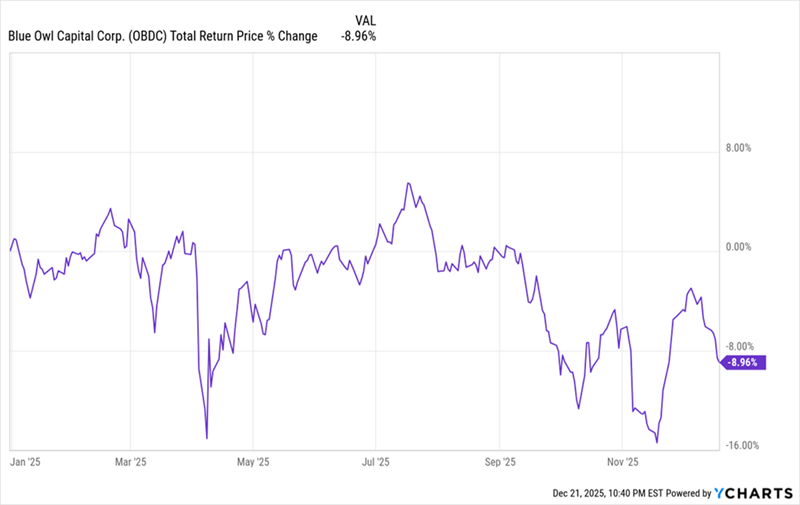
All of these factors can drag on performance. Consider, for example, Blue Owl Capital Corporation (OBDC), which has $6 billion in assets and attracts a lot of attention with its 11.7% yield. That’s been cold comfort for investors, since OBDC has dropped 9% this year, even with dividends included.
High Yield Didn’t Save OBDC Investors in ’25
Now don’t get me wrong. I’m not saying BDCs are to be avoided. But quality is critical here. One of the best BDCs out there is Main Street Capital Corporation (MAIN), which yields around 5% today (though it has paid closer to 7% on a trailing-12-month basis, thanks to its frequent special dividends).
MAIN (in orange below) has returned more than both OBDC (in blue) and the benchmark BDC ETF (in purple) this year.
MAIN Outruns the Competition
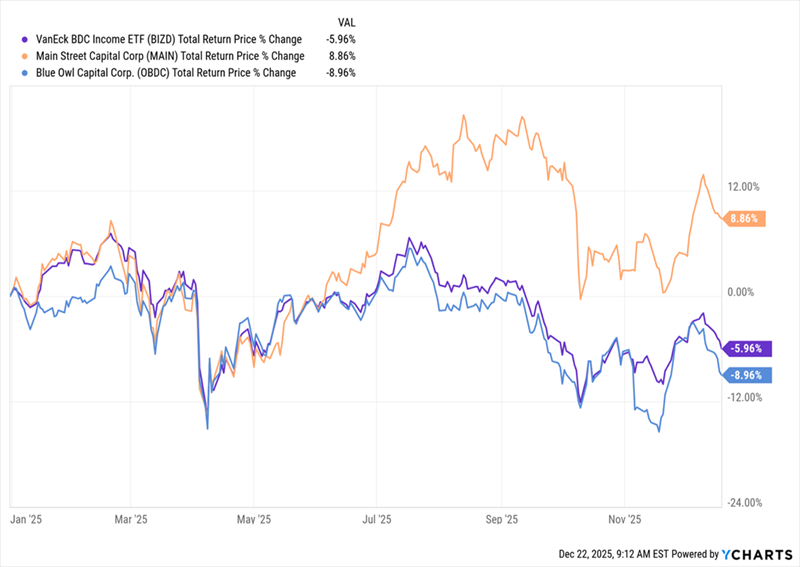
That’s not bad! MAIN is “returning its yield,” which is exactly what we want to see in a BDC. But when we combine, say, BDCs with closed-end funds (CEFs)—particularly equity focused CEFs—we can add more growth.
And better still, thanks to CEFs’ roughly 8% average dividends, we get a big slice of that growth “translated” into dividend income for us. So in essence, we’re getting the best of stocks and the best of BDCs here.
The best equity CEFs track, and better yet beat, the S&P 500 on a total-return basis. In fact, the equity CEFs tracked by my CEF Insider service’s Index Tracker have returned a bit more than 14% this year, just a shade off the S&P 500’s 17.5%, as of this writing:
Equity CEFs Post Another Strong Year
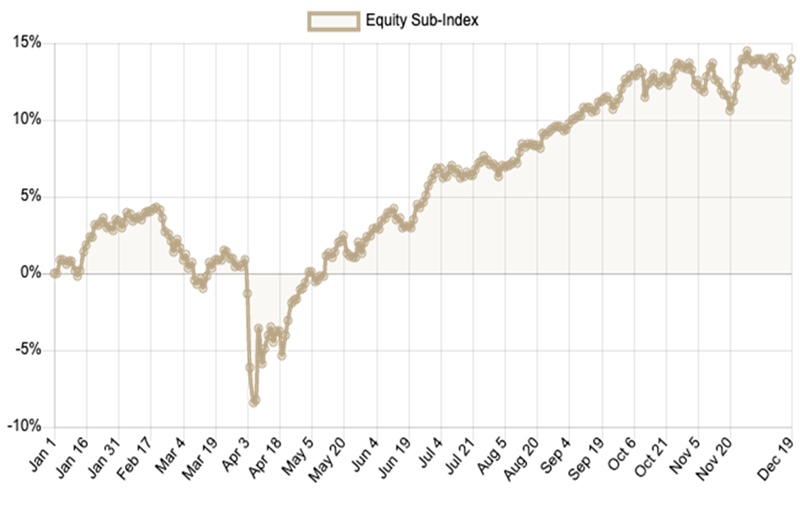
Source: CEF Insider
That slight underperformance is a small price to pay if you’re getting an 8% dividend (which is right around the average for all CEFs as I write this)!
And as I hinted at a second ago, some CEFs have done even better, like the Adams Diversified Equity Fund (ADX), a long-time CEF Insider holding that’s delivered a market-beating 23% total return this year, as of this writing.
This 8%-yielding fund can deliver that high payout because it translates growth (and some dividends) from its portfolio of US blue chips into cash for us. NVIDIA (NVDA), Amazon.com (AMZN), Microsoft (MSFT) and JPMorgan Chase & Co. (JPM) are among its top holdings.
Plenty of other CEFs deliver this mix of growth and income, too. Consider these numbers, which I think you’ll find pretty surprising:
- 97.7% of the CEFs tracked by CEF Insider have turned a profit over the last decade (or since their IPO for funds less than 10 years old).
- 20% of those funds have a 10% or higher return.
- CEFs trade at an average 5.3% discount to net asset value (NAV, or the value of their underlying portfolios), letting us buy in at less than market price.
- Most CEFs trade in publicly listed securities (stocks, bonds, public real estate).
These are clear strengths I see attracting more investors to CEFs in 2026, especially if we see more stock-market volatility (as I expect). In fact, it’s already happening: CEFs started the year with over 8% discounts to net asset value (NAV) on average and are now closing it with discounts at that 5.3% level I just mentioned.
A further push toward par—and the upward pressure on CEFs’ market prices it would bring—seems only a matter of time.
Exclusive (for Contrarians Only): My Top 9%+ Dividends for 2026
At CEF Insider, I’ve spent the last eight years recommending CEFs that deliver big yields and price upside—just like ADX.
With the new year about to dawn, I’m making a rare move: I’m taking 4 top picks from our service’s portfolio and dropping them into a “mini-portfolio for 2026” all their own. These 4 funds are rock-solid dividend generators, kicking out an outsized 9.2% yield, on average.
And thanks to their way overdone discounts, I have them pegged for 20%+ upside next year.
I want to give you access to them now.
I’ve broken down these 4 top picks (and my full CEF investing strategy) in an Investor Bulletin that gives you a free Special Report revealing these funds’ names and tickers. Don’t miss this chance to bulk up your income stream at a bargain. Click here to read more about these top 2026 dividend picks and grab your free Special Report now.