
Here’s one thing I can say for sure about 2026: This year, we’ll be grateful we’re NOT sitting on “America’s ticker”—my name for the SPDR S&P 500 ETF Trust (SPY).
I call SPY that because pretty well everyone owns it. But its 1% yield makes it more likely that holders will be forced to sell low in the next pullback, if they’re leaning on it to pay the bills.
Not us! We’ll be pocketing the 8%+ cash payouts from the portfolio of my Contrarian Income Report service. So while SPY holders face the next pullback with dread, we’ll be chugging along with our usual “dividends and chill” approach.
When a storm hits, we simply wait for our next big dividend payment to roll in. (And we don’t have to wait long—many of our divvies are paid monthly.)
Today I want to zero in on one attractive 13.4% (!) payer from our portfolio. Then I’ll show you a smart, simple way to forecast that massive dividend (and indeed any payout) with ease.
This 13.4% Payer Loves This “Bearish” Bull Market
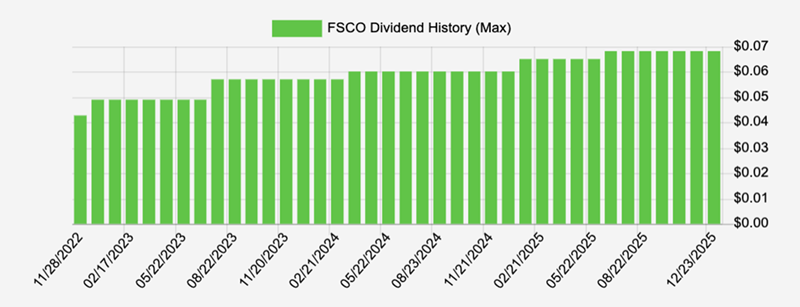
We love FS Credit Opportunities (FSCO) for a lot of reasons, but its sky-high—and growing—dividend is right up there. FSCO yields a mammoth 13.4% today (more on that in a second).
Small businesses—the main drivers of US economic growth—love BDCs, too, because they loan money to these firms. BDCs are a godsend for these mom-and-pop shops, who often struggle to get the capital they need from stingy banks.
Most BDC managers sit in their cozy offices, wait for a private-equity sponsor to call, then write a check for a safe but low-paying loan.
Not FSCO. Portfolio manager Andrew Beckman buys distressed loans for dimes—even pennies—on the dollar. His chops in this arena drive the stock’s growing 13.4% payout.
FSCO: A True Dividend “Unicorn”
Source: Income Calendar
Beckman is the industry’s “credit surgeon.” Forget the safe loan! He wants the patient who’s bleeding out on the table because he can stitch them up—and charge a fortune for doing so.
Before FSCO, he spent the core of his career at Goldman Sachs (GS), in their legendary Special Situations Group. These “credit commandos” thrived buying depressed assets in the 2008/2009 crisis.
FSCO is a BDC in a closed-end fund (CEF) wrapper. As a CEF, it can (and does!) trade at different levels in relation to its value. Today, it trades at a 14.7% discount to NAV because slower jobs numbers are sparking recession worries. That means we’re getting FSCO’s expertly run loan portfolio for just 85 cents on the dollar.
Yes, hiring is slow, but that’s because companies are implementing AI to boost efficiency. And small businesses are the No. 1 users of this tech.
Meantime, the Atlanta Fed’s GDPNow estimate shows that the US economy is still solidly in growth mode: a strong 3.5% rate, to be exact.
The disconnect between investors’ mood and strong growth is our opening to grab FSCO, and its 13.4% payout, at a bargain.
Buy FSCO, Then Do This to Forecast Your Dividends for Years
High, and rising, dividends like this one really are unicorns, and I see a diversified portfolio of them as a far better option than ETFs like SPY.
But the key to getting peace of mind (and dodging the urge to sell when markets fall out of bed) is knowing exactly when your next payout is coming. Truth is, there aren’t many tools out there that do this. And even fewer that do it well.
I know because I’ve tried a lot of dividend-projection tools and haven’t found any I loved (or even liked much). So our IT team created our own. It’s called Income Calendar, and it quickly and easily ensures your dividends are in your account before your bills come out.
The best way to show you how it works is to demo it for you. So let’s go to Income Calendar and plug in monthly paying FSCO, plus a couple other Contrarian Income Report holdings that pay quarterly, so we can see how IC navigates different payout frequencies.
Those would be gas-pipeline operator Antero Midstream (AM), which benefits from the Trump administration’s emphasis on fossil fuels over renewables—and Ares Capital (ARCC), another BDC set to write more loans as small biz boosts its productivity.
Let’s invest an imaginary $100,000 in each. Income Calendar tells us, immediately, what we can expect in terms of dividends every month from our 3-buy “mini-portfolio”:
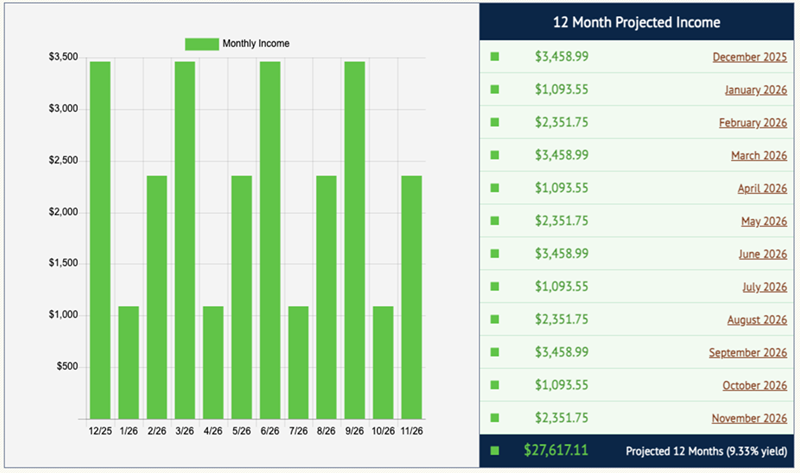
As you can see, just these three buys deliver dividends ranging from $1,093.55 in a month up to $3,458.99, and a total of $27,617.11 on the year, on just $300K invested.
That’s a rich 9.3% yield. Sweet! (Bear in mind, too, that to be overly conservative, we don’t project dividend growth, so our “real” payouts could end up higher.)
You can get breakdowns by stock, plus a month-by-month calendar showing key dates for every one of your holdings. Check it out. Here’s what our three-buy portfolio shows us for September 2026, one of our highest-paying months:
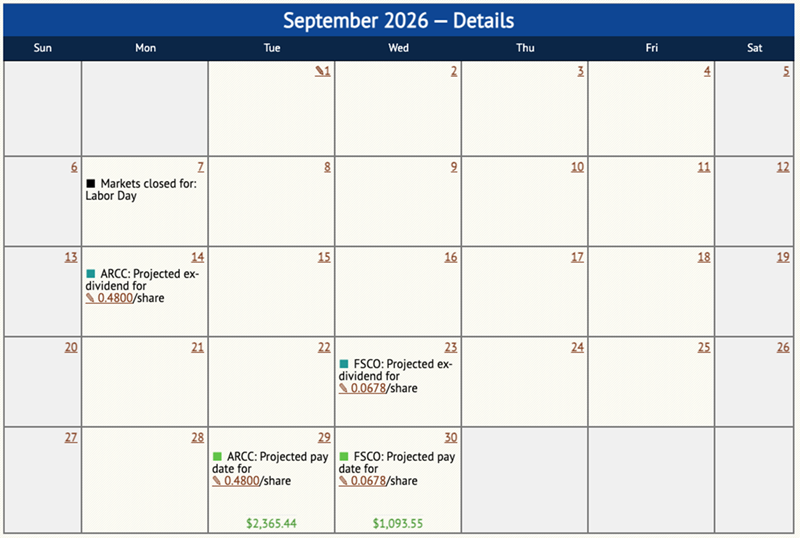
We can see our projected pay dates, as well as ex-dividend dates (the dates before which we need to be “in” the stock to get the next payout). We also get a heads-up on things like market holidays. We even know when our stocks report earnings—though there are none of these for our trio in September.
There’s more, too, like:
- Real-time email alerts when a dividend drops into your account.
- A “week-ahead” payout summary.
- A handy tool that tells you your “yield on cost” (so you can see the “true” yield on each of our stocks, based on your original investment)
- And much more.
Now—with a new calendar year at hand—is the perfect time to try Income Calendar and get a crystal-clear read of a full year of the dividend payouts you can look forward to. Click here and I’ll walk you through this powerful dividend tool and give you the opportunity to “road test” it yourself.