
You’ve no doubt heard the old Wall Street saw: “Sell in May and go away.”
There’s one problem with it: It doesn’t tell us when to buy again.
I mean, many investors take it to mean that the best time to buy again is in the fall, after Halloween. So maybe we could say, “In the season of orange and black, it’s finally time to go back”?
I don’t know. I’m not a poet (as you can probably tell).
But I am an investment strategist, and in my 15 years working in the field, I’ve seen this “sell in May” advice work sometimes and be disastrous at others. (And, by the way, for long-term dividend investors like us, it’s always a bad move, because it cuts off our income stream!)
With that “sell in May” idea in mind, 2026 has been, well, interesting.
Stocks Climbed a Wall of Worry in the First Half of ’26
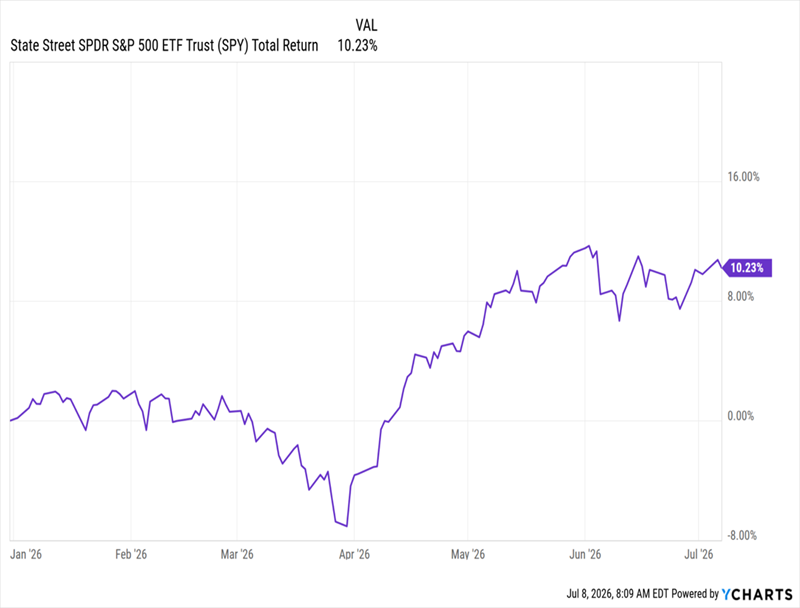
The year started with a laundry list of worries, mostly around AI. Chatter about an AI bubble combined with chatter that AI would hurt software firms as more people turn to “vibecoding” (or using AI to make software without any programming skills). Then, of course, the Iran conflict erupted.
But then a few strange things happened: First, it became clear that vibecoding is not as easy as it was first thought to be. Then the Iran conflict cooled (though it still remains very much active), and oil prices fell. Stocks, in response, rallied in April. They’ve more or less flatlined since mid-May.
A Pause, Not a Drop
Understanding how that happened tells us something about the months ahead. It also leaves us with a discounted dividend opportunity that I think will clearly show that selling in May would’ve been a particularly bad idea this year.
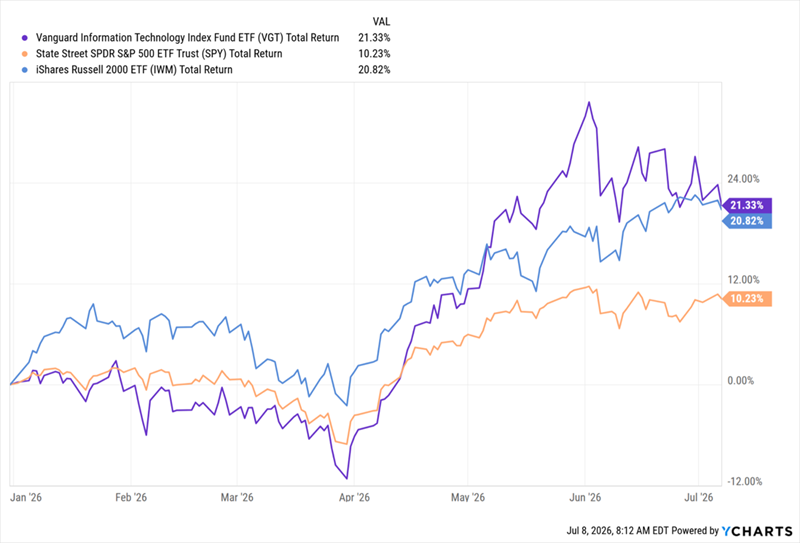
More on that in a moment. First up, to get a sense of the stall in the markets now, look at the performance of the Vanguard Information Technology ETF (VGT), in purple above. That fund includes all the Big Tech names, such as NVIDIA (NVDA), Apple (AAPL) and Microsoft (MSFT).
As you can see, it soared before summer officially began and has since cooled off. Nonetheless, VGT is still slightly ahead of the iShares Russell 2000 ETF (IWM), in blue, which mainly consists of small-cap stocks as of this writing.
Now, the least risky of the three is the S&P 500, tracked by the State Street SPDR S&P 500 ETF Trust (SPY), in orange above, which has posted the 10.2% year-to-date return noted a second ago.
That’s because SPY is a broad collection of US mid- and large-cap stocks that is, relative to the other indices, less tech-weighted and more diversified, while having none of the more volatile small-cap stocks held by IWM.
The takeaway here is that if investors were worried about the current environment, we’d expect to see the small-cap and tech indices slide dramatically. Despite a bit of recent volatility, they haven’t.
This has set up a nice buying opportunity on a very smartly run closed-end fund (CEF) called the Columbia Seligman Premium Technology Growth (STK), a holding in the portfolio of my CEF Insider service.
I’m highlighting STK now because of that stall in the tech sector, which I see as mainly driven by profit-taking. As a result, I don’t expect it to last long.
That’s just the first source of profit potential with STK. The second is that the fund’s discount to net asset value (NAV, or the value of the fund’s underlying portfolio) has suddenly widened to 7.9% due to recent volatility around tech. As a result, it’s now the cheapest it’s been in more than a decade, after jumping to a premium a few weeks ago.
STK’s Sudden Discount
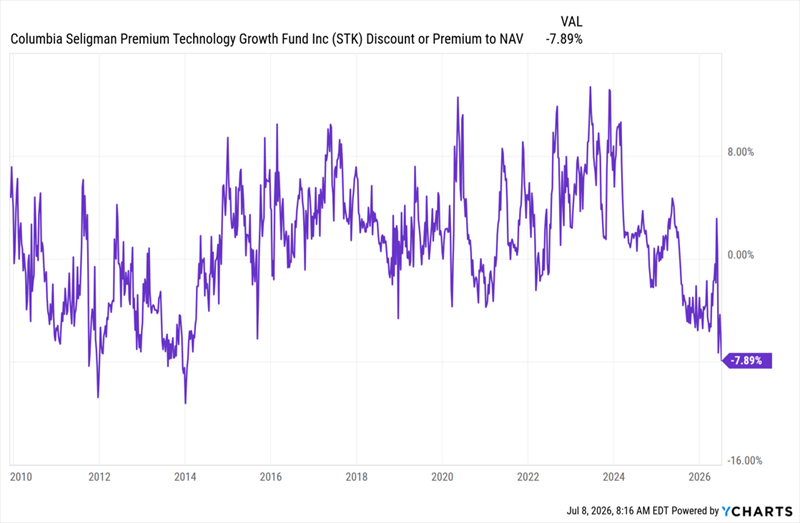
That makes the fund a buy because, as we’ve seen over the years (and is clearly visible in the chart above), STK tends to suddenly swing to a premium when the market turns bullish. Buying now, before that happens, is a good way to position ourselves for gains as that overdone discount heads back toward par.
We’ll also get decent dividends, with a 3.7% payout, which is low for a CEF, but STK has paid out special dividends throughout its history, which is almost inevitable given its strong gains over the last three years. On top of that, STK’s gains mean management is likely to hike the regular dividend sooner rather than later. And as we wait for that, we’re getting paid a steady income, with a chance for capital gains as the discount closes and the fund’s NAV gains ground, giving us two potential sources of upside here.
The story gets better when you consider this fund’s strong long-term performance.
STK Vs. Everyone
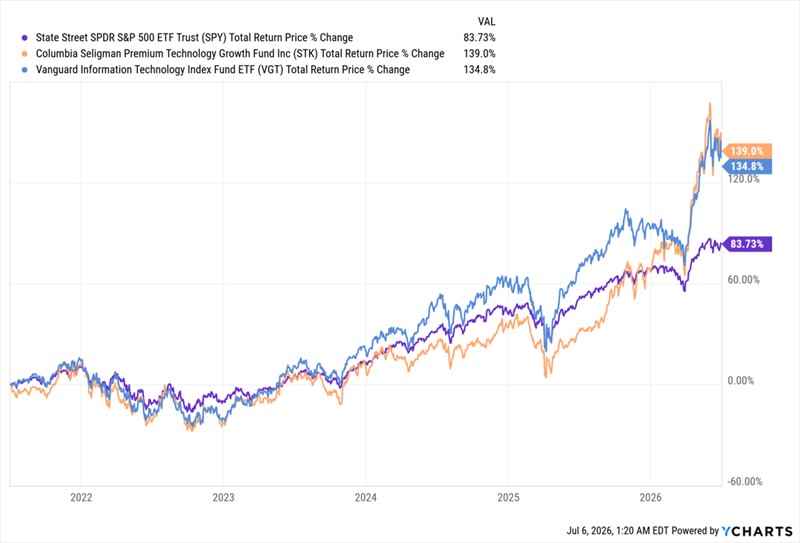
As you can see above, in the last five years, STK (in orange) has beaten both the S&P 500 ETF (in purple) and VGT (in blue), with dividends reinvested. That performance, plus the stalled tech sector and STK’s overdone discount, give us plenty of reasons to be bullish on the fund’s future returns.
The yield on this one—more than 10-times VGT’s 0.32% payout—seals the deal here, whether we’re buying in May, October or any other month.
STK Is a Good Start—But for the Next Phase of AI Gains (and 10% Dividends), Do This
STK is a smart bargain play on AI’s growth. And we’re building on it through 4 funds offering higher income and deeper discounts.
I’m talking about a 10% average dividend here. Most important, these 4 funds profit as AI spreads beyond tech into other areas of the economy, like manufacturing, insurance, finance and more.
This is the next phase of AI’s growth, and the pause we’re seeing in the stock market makes now a great time to buy in.