
Most investors love to talk about their winners. That’s understandable, but it’s still a shame, because losing investments can often teach us a lot more.
That’s true no matter what you invest in: stocks, real estate—and, yes, 8%+ paying closed-end funds (CEFs), our favorite income plays.
With that in mind, let’s look at three of the worst-performing CEFs of 2026 to see what they got wrong and how we can avoid holding such funds in the future.
I haven’t chosen this trio at random; these three CEFs are the worst performers on the market so far and have market caps above $250 million. (Why $250 million? Because it’s in the range of market caps we focus on at my CEF Insider service. Any fund smaller than, say, $200 million, can be volatile just on account of being thinly traded.)
Our first laggard: the Sprott Physical Platinum and Palladium Trust (SPPP), whose market price-based return and total NAV return (or the gains on its underlying portfolio, including dividends collected), have gone in the same direction—down—and fast.
A Straight-to-the-Bottom Drop
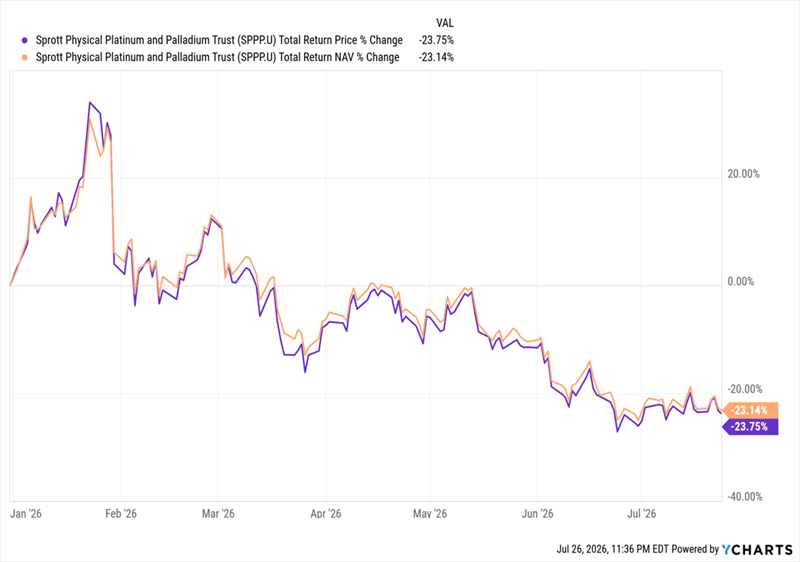
SPPP, as the name says, holds physical platinum and palladium. As such, it’s a way for investors to own these metals without having to store and trade them. SPPP’s drop is no surprise to us at CEF Insider: We discussed the risks of investing in metals a little over a year ago.
While we didn’t talk about SPPP specifically, the physical-metal CEFs we did discuss—the ASA Gold and Precious Metals Fund (ASA), Sprott Physical Gold and Silver Trust (CEF) and Sprott Physical Gold Trust (PHYS)—are all down in 2026, as well, though none have fallen as far as SPPP (shown in purple below).
Investors Abandon Precious Metals in 2026
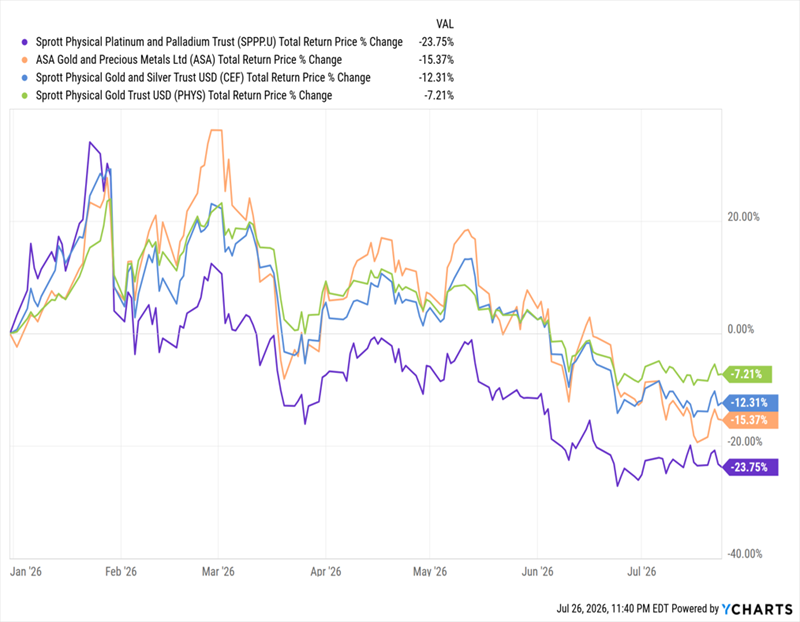
The reason comes down to an established pattern in gold and other precious metals. As we all know, gold soared in 2025, but that was a short-term phenomenon, which is typical when gold rises. It tends to go up sharply in a year, then retreat a bit the next year, and stay roughly flat for several years until its next move higher.
Investors aware of this fled these precious-metals funds before the new year in a (successful) bid to avoid the losses in the chart above.
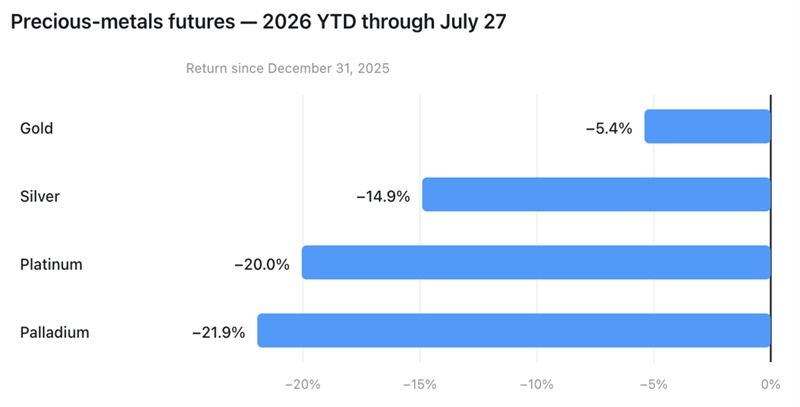
The fact that SPPP performed worse than the rest is also unsurprising: The metals it focuses on are in a far worse slump than silver and gold.
Source: Yahoo Finance, CEF Insider
With that in mind, we shouldn’t be surprised that SPPP has fallen so hard this year.
The second-worst CEF above $250 million in market cap is also unsurprising, because it focuses on silver, which has done worse than gold. The Sprott Physical Silver Trust (PSLV) does not have the most interesting portfolio: It consists of $12.6 billion in silver bars. As with SPPP, this makes buying into PSLV like buying into a stock of metal held in a vault somewhere. In SPPP’s case, this comes with a 0.51% management fee.
With a 19.3% year-to-date NAV decline, PSLV has done worse than silver on the spot market, showing that investing in silver via a CEF has not been a winning ploy.
The losses are an injury, but there’s an insult on top of this: Unlike the vast (vast!) majority of CEFs, neither SPPP nor PSLV pays a dividend. So it isn’t like investors have gotten an income stream to tide them over while they wait for these funds to recover.
This is why diversification is important, and investing only in metals just doesn’t make sense. But what you diversify into matters a lot, too, because some assets that might sound enticing are, in fact, mirages of wealth creation.
Oxford Lane Capital Corp. (OXLC) is another CEF we’ve warned about in the past, and with good reason: The stock price has collapsed 42.3% in 2026. This makes sense given the portfolio of collateralized loan obligations, or CLOs. These are a kind of debt derivative that can fall sharply if the Fed moves against them, and that’s what’s happened with OXLC.
OXLC’s Seven-Month (and Counting) Disaster
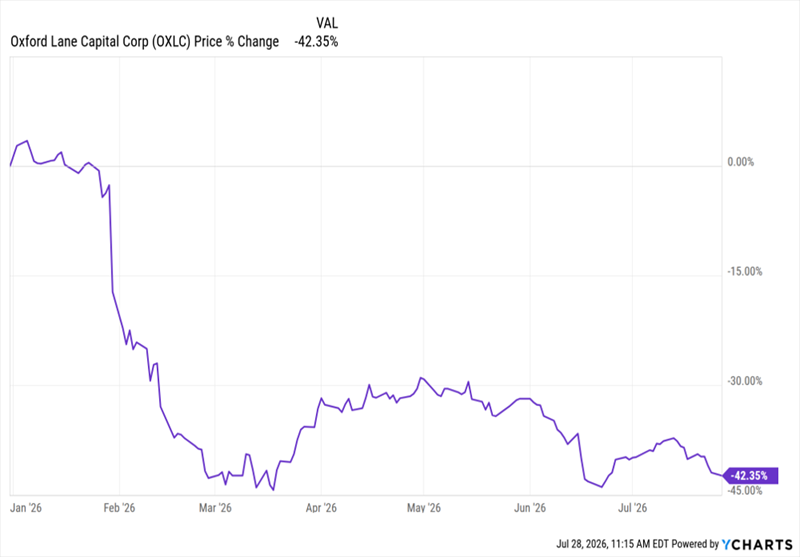
The massive dividend the fund offers—a 27.8% yield on its current stock price—looks impressive, but that still means that an investor’s year-to-date total return is negative 28.6%!
It gets worse, as the OXLC halved its dividend in April 2026. More cuts are likely.
Way back in 2020, we talked about a likely dividend cut at OXLC: “When that comes, many of OXLC’s yield-thirsty investors will sell—and fast.”
That’s happening now.
OXLC has given investors a negative 15.7% return since I wrote that, and more losses are likely around the corner. It’s true that you can recoup some of those declines with the huge payouts, but since those payouts are being cut, this fund is a true falling knife.
From Sells to Urgent Buys: 4 Funds Dropping Huge 9.9% Dividends
The 4 funds I’m urging all investors to buy today have none of the problems of the 3 funds above.
- They don’t hold precious metals.
- They DO have high, sustainable dividends (a 9.9% average payout!).
- And they are overlooked bargains, with unusual discounts poised to “slam shut” and propel their prices higher.
The time to buy them is now, while we can do so during this irrational market selloff. Click here and I’ll tell you more about them and give you a Special Report revealing their names and tickers.