
The media has been abuzz with fresh fears that the AI “bubble” is finally popping.
These worries, of course, have been around for almost as long as AI itself!
At the heart of the latest panic: semiconductor stocks, which have fallen hard, with the benchmark ETF for the sector, the VanEck Semiconductor ETF (SMH), plunging from an all-time high in late June to a level 11% lower today.
Yikes.
But here’s what we need to keep in mind: At CEF Insider, we’re mainly interested in collecting dividends in the long run. When these short-term panics arrive, we take advantage of them, and set ourselves up for extra upside as we do.
With that in mind, just where does this latest AI hand-wringing leave our AI-focused closed-end funds (CEFs), and the high yields they generate?
It’s a good time to break this down and talk about one of our holdings in particular, the BlackRock Technology and Private Equity Term Trust (BTX), a 6.9% payer that holds both large-cap AI poster children, like NVIDIA (NVDA) and Micron Technology (MU), and gets us into privately held AI firms, like Anthropic, too.
As such, BTX is about as close to the heart of AI business as we can get. It’s also giving us an interesting setup, with a discount to net asset value (NAV, or the value of its underlying portfolio) that’s attractive, at around 9.3%. Interestingly, that discount is shrinking. When we last discussed BTX, about a week ago, it was around 10.7%.
BTX Is Still Cheap—But It Gets Less So Every Day
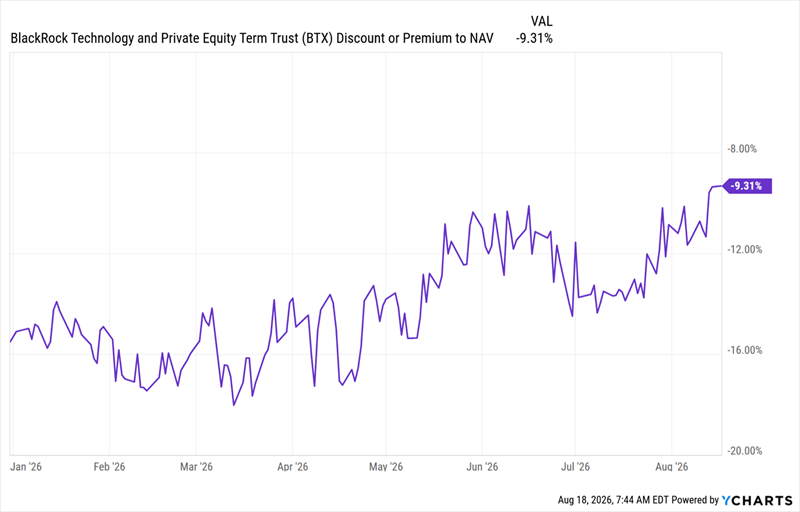
What’s happening here? I think investors are starting to pick up on the same data I’m seeing on the future of AI demand. That’s giving us a nice “discount-with-momentum” setup with BTX that’s worth buying now. Let me break down why I see things that way.
1 Simple Question to Cut Through the Noise: Is AI Growth Still Strong?
To answer that, we need to focus on the fundamentals, starting with this chart:
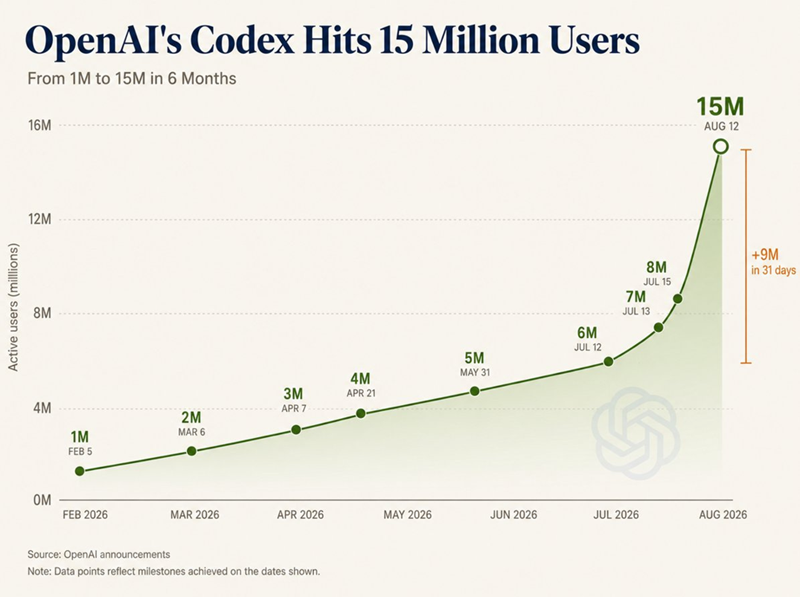
Source: Memeburn
Here we see the growth of the OpenAI application Codex, which people use to make software with ChatGPT. It’s a decent indicator of AI use, and it’s taking off: The jump from 5 million users to 8 million in just a month and a half was startling, and the rise from 8 to 15 million in less than a month is even more so.
Elsewhere, Anthropic recently told investors that its second-quarter revenue grew 1,400% from a year ago, from $787 million to $11.5 billion.
These are staggering numbers, and they show that AI demand has not been exhausted in the business world.
The Business Connection
Note I said business there, and that’s important.
When ChatGPT came out in 2022, a lot of people were amazed at how human-like the bot was. Businesses showed interest, but it wasn’t until 2025 that they began to see how they could use AI to improve their operations and become more profitable.
And business use is, of course, crucial. AI providers like Anthropic and OpenAI can earn, say, a $20 a month subscription fee from casual users, but they can earn millions from enterprise clients.
The Codex growth we just discussed largely stems from enterprise users, and Anthropic’s growth is overwhelmingly on the enterprise side, too. The public knows these AI firms for their chatbots, but in business, they’re considered software vendors. And the uptake of this software is growing like a weed, as the Codex figures show.
“Sure, But Can This Pace of Growth Last?”
This, of course, is the right question to ask, and it comes down to a look at how much companies now spend on AI, and how much they can still put into the tech. One way to look at this is to consider how much the top-spending companies are putting into AI, then compare that to what the median company is doing.
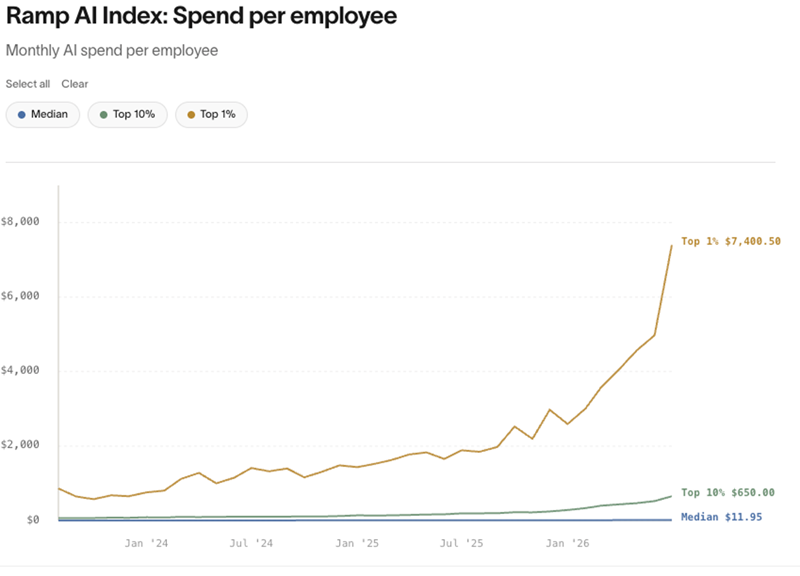
Source: Ramp
In July 2026, the difference between the median firm’s AI spend per employee ($11.95) and that of the top 10% ($650) was about 54x. A year ago, those figures were $4.55 and $190.82, respectively, or a difference of 41.9x. So we’re seeing a growing gap between the median and top 10%. This suggests AI is still in its early-adoption phase.
This is also evident when we look at how the top 1% of corporate spenders are accelerating their investment, from $1,884 per employee to $7,400 in a year. That’s a 293% gain that’s accelerating from the prior year’s growth of 34%!
We don’t have to believe that median-company spending on AI will reach that of the top 1%. But surely, as productivity gains become clearer, the gap between the median and top 10% should close, with the median coming up. And that’s before we talk about the companies that aren’t spending on AI at all—yet.
With all that in mind, the semiconductor selloff makes little sense. The market is waking up to this fact, which is why SMH (in purple below) is starting to recover. But BTX (in orange) is recovering faster, powered by that narrowing discount.
Investors Overdid It on the Fear (and They’re Starting to Realize It)
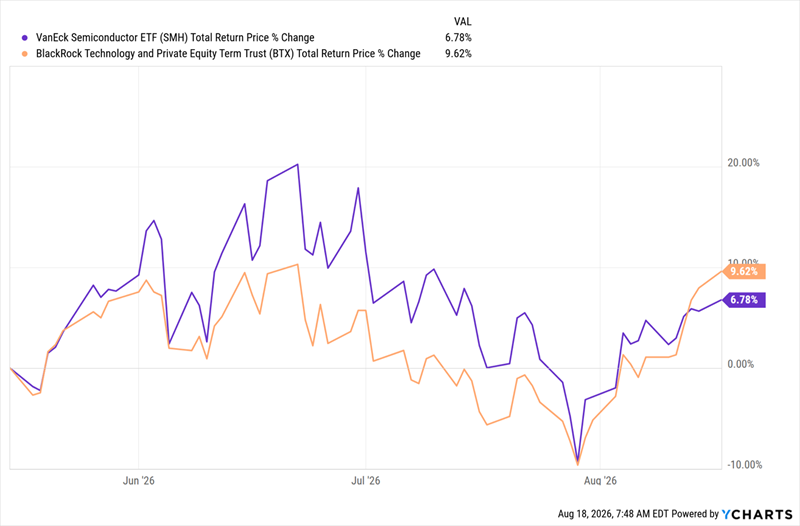
That, too, makes sense: If you wanted to invest broadly in AI being adopted by more companies, you’d want to invest in the entire AI ecosystem, not just semiconductors.
BTX is an ideal way to do that, so it’s no surprise that it’s recovering faster than SMH. And despite its still-deep discount, BTX (again in orange below) is up 48% for 2026, far ahead of the benchmark S&P 500 ETF.
BTX Outruns the Market
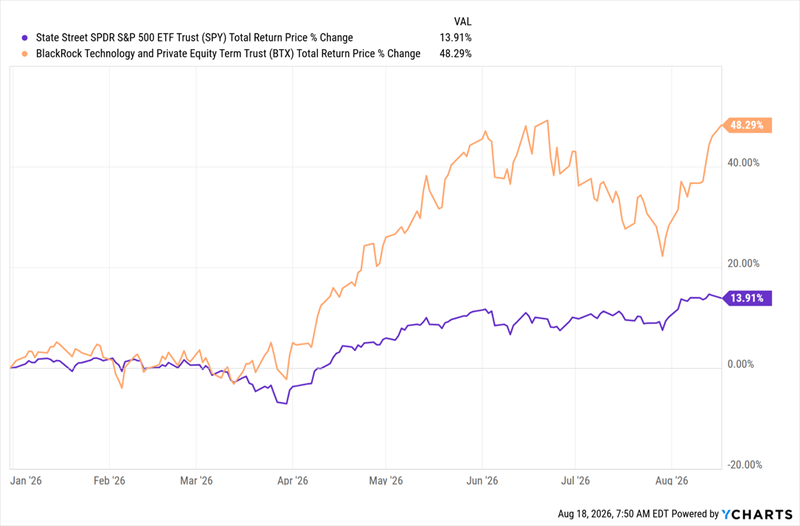
It’s no surprise, given all of these tailwinds, that BTX’s discount is shrinking. What is surprising, though, is that the discount remains this wide, at 9.3%. That’s also far bigger than the average CEF discount of 5.2%. And there’s one more thing about this fund that doesn’t get enough attention: the dividend, which yields 6.9% and is paid monthly.
Big profits and stable income are good reasons to buy a CEF like this, even before we get to the AI upside that’s still in the cards. So it’s no wonder BTX’s discount is evaporating. But it is a wonder that there’s still so much discount left to disappear. That’s our cue.
4 Ways to Invest in AI’s Next Big Surge (With Cheap 10%+ Dividends)
BTX is Part 1 of our “dividend-driven” strategy for profiting from AI’s surging growth.
Part 2 is probably pretty clear to you at this point: Buy CEFs holding companies that use AI to supercharge their businesses.
I’m talking about pharma stocks, insurance companies—and less-obvious examples, like manufacturers, which are in the early stages of employing AI-powered robots to cut costs, boost speed and improve the quality of their products.
My team and I have zeroed in on 4 such funds. I call them “pivot point” funds because they’re squarely in the tracks of the coming profit boom for AI’s business users.
The crowd hasn’t yet keyed in on these funds’ potential, so they’re still cheap. But like BTX, their discounts have been narrowing. We need to make our move.
I want to share everything—our full strategy and the names and tickers of these 4 CEFs—with you now. Click here to get the details and a free Special Report revealing the names and tickers of these 4 bargain-priced 10%-paying funds.