
Small-cap stocks have been so miserable for so long that even a healthy beating of their large-cap peers across 2026 hasn’t been enough to give them any buzz.
Good news for us, and anyone else looking for 6.7%-16.3% yields on the cheap.
It’s been a rough decade for the “junior mint” shelf of stocks! Mega-caps have been the flavor du jour. In fact, by the S&P 600’s count, small caps have only topped their big brothers once since 2016—and that was a “lesser loss” in 2022!
Wall Street is understandably skeptical that 2026’s outperformance is a sign of a bigger pivot. Mainstream pundits are panicking that the Federal Reserve will raise its benchmark rate before the year is over—a narrative that has depressed small businesses, which tend to be more sensitive to short-term rates.
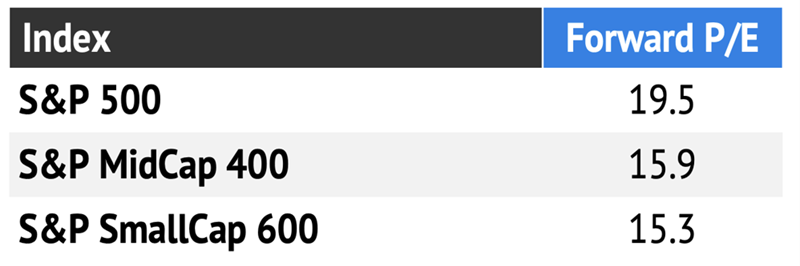
The upshot for us? Despite their gains, small caps still look like the best values in the stock market.
Broad-Market Forward P/Es:
So they’re contrarian plays, but what about income? Small caps are known for plowing money into R&D, not shareholder rewards, after all.
Don’t paint the space with too broad a brush. While many small caps chase growth at all costs, some operate in more mature markets and instead put their cash to work lining shareholders’ pockets.
Just consider the following five small caps that despite their minuscule market caps are delivering mighty dividends of between 6.7% and 16.3% right now.
Navient (NAVI, 6.7% dividend yield) is an educational loan servicer and collector that split from SLM Corp. (SLM), aka Sallie Mae, in 2014.
“Student loans” might seem synonymous with “printing money,” but Navient’s story is a little more complicated. Here’s a timeline of this mess:
- January 2017: The Consumer Financial Protection Bureau and six state attorneys general sue Navient, alleging that it misapplied payments, misled borrowers about income-driven repayment (IDR) recertifications, steered borrowers into costly forbearances and more.
- December 2021: NAVI stops servicing direct loans with the Department of Education.
- January 2022: Navient pays $1.85 billion to settle allegations by 38 states and Washington, D.C., for predatory loan practices.
- September 2024: NAVI settles with the CFPB for $120 million and is banned from servicing federal student loans ever again.
- September 2024: Navient closes on the sale of its healthcare services business
- February 2025: NAVI unloads its government services business.
NAVI’s Stock Chart Looks Exactly Like We’d Expect
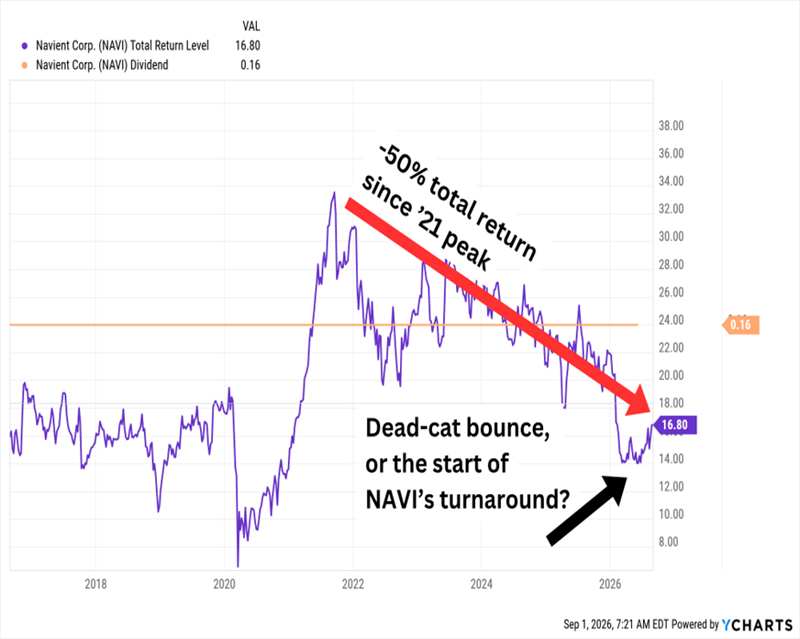
What primarily remains is a private student lending and refinancing arm, as well as a Federal Family Education Loan Program (FFELP) portfolio that’s been slowly winding down since the program ended in 2010.
This is a company with a new CEO that just started in April, a stripped-down business model and a dividend that has sat frozen for a decade. Why are we interested?
Because we’re getting a nearly 7% yield on a company that might be staging a real comeback. The COVID-era federal moratorium on student loans, then potential for loan forgiveness during the Biden administration, cramped the market for refinancing government student loans. But those headwinds are out, as is the government’s 20-year-old federal Grad PLUS loan program, which ended in July and opened up a new doorway for private lenders.
I said a few months ago that we’d want to see proof that the comeback is real, and Navient is beginning to provide it. NAVI has beaten earnings estimates in each of its first two quarterly reports of 2026, and it’s on pace to flip from a 35-cent-per-share annual loss to a 76-cent profit this year (then 97 cents in 2027), which will more than fund its 16-cent quarterly dividend. It’s not dirt-cheap, at 12.5 times earnings estimates, but that’s less expensive than the financial sector’s 15.4 forward P/E.
Master limited partnerships (MLPs) are a familiar source of high income, even when it comes to small caps like Suburban Propane Partners, LP (SPH, 7.4% distribution yield). SPH is a national propane supplier that serves more than 700 communities in 42 states and has been operating for nearly a century.
Suburban Propane has a dreadful distribution history, lopping off about two-thirds of its payout across two cuts in 2017 and 2020 as propane prices tumbled from a much higher baseline in years prior. But it delivered a small hike in 2021, and the distribution has stabilized since then. That’s likely the best we can expect from a dealer in what is an extremely cyclical energy product.
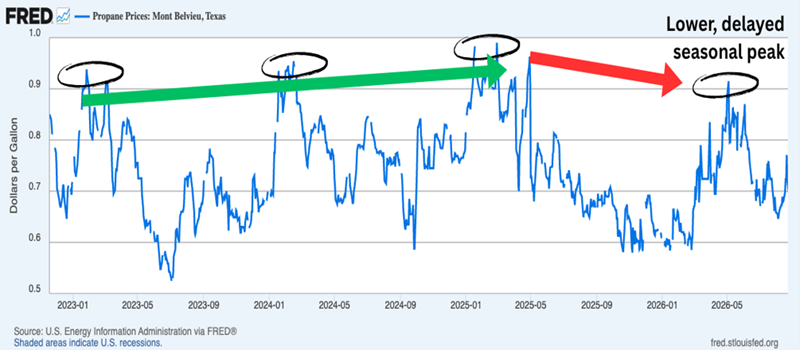
I said roughly three years ago that a number of factors—investments in other businesses like clean hydrogen and natural gas, a return to colder weather, and a renewed interest in yield—would drive interest in SPH, and it has. Shares have climbed by as much as 65% since then. But the stock has run into a wall of late amid weaker pricing in propane in 2026.
A String of Higher Highs Has Stalled Out
Source: Federal Reserve Bank of St. Louis
The risk-reward setup for new money is at least improving. The stock now trades for a little more than 9 times earnings estimates, the yield has plumped up to north of 7%, and a payout ratio of about 70% of this year’s earnings estimates is a little more comfortable than it had been of late. SPH is also getting better at squeezing fatter margins out of propane.
The question is whether this year’s propane pricing is the start of a new pattern. Propane supplies had already been plentiful for years, but if milder winter weather patterns (and thus lower seasonal heating needs) persist, lower consumption could weigh even more on prices.
Kayne Anderson BDC (KBDC, 11.8% dividend yield) is a business development company (BDC), which means it provides financing to smaller businesses that banks either won’t service without charging exorbitant rates, or won’t service at all.
KBDC, a newer BDC that began operations in 2021 and went public in 2024, operates in the “middle market”: These companies aren’t our local mom-and-pop corner store, but they’re not major corporations yet, either. It primarily invests in private equity-backed companies with between $10 million and $75 million in earnings before interest, taxes, depreciation and amortization (EBITDA).
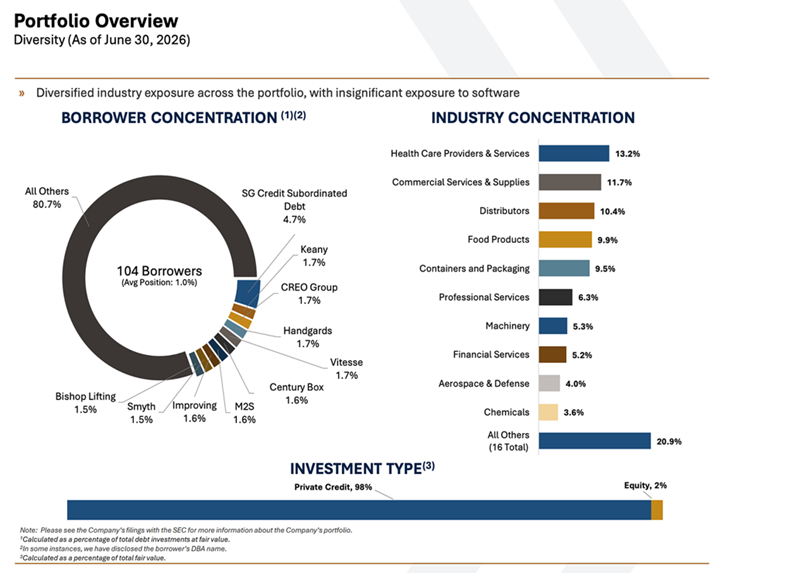
Kayne Anderson BDC stands out from its peers because of its extremely conservative stance. It predominantly deals in first-lien senior secured loans, which are paid back before all other debts. Its 104 portfolio companies are largely concentrated in defensive, stable industries. Management avoids industries with high valuations. (We can relate!)
KBDC Also Maintains a Well-Diversified Portfolio
Despite its defensive positioning, KBDC isn’t completely insulated from a weak business climate. Since I examined KBDC a year ago, non-accruals (loans that are delinquent for a prolonged period, usually 90 days) have doubled from 2.2% of the portfolio at cost to 4.4%. And while shares have slightly outperformed the VanEck BDC Income ETF (BIZD), a proxy for the BDC industry, actual bottom-line growth has been elusive, and could be for at least a couple years.
On the one hand, Kayne Anderson BDC pays us almost 12% and trades at 85% of its net asset value. On the other, future earnings are projected to shrink to the point of no longer covering the dividend—KBDC can use spillover earnings to bridge the gap, but at some point, it will need a jolt to its profits.
No corner of the market, small-cap or otherwise, pays more than the mortgage real estate industry.
While traditional real estate investment trusts (REITs) deal in physical properties like apartment buildings and strip malls, mortgage REITs (mREITs) deal in “paper” real estate including mortgages and mortgage-backed securities (MBSs).
mREITs make their money by “borrowing short and lending long,” then profiting off the difference. Naturally, management wants short-term rates to be lower than long-term rates, which they typically are. But rising rates pinch mREITs on both ends—they raise their borrowing costs and make the existing mortgages they hold less valuable.
Chimera Investment (CIM, 15.7% dividend yield), for instance, calls itself a “hybrid” mortgage REIT that owns both residential mortgage loans, as well as agency and non-agency residential MBSs (RMBSs). Agency MBSs are backed by the likes of Fannie Mae and Freddie Mac; they have virtually no default risk, but they pay less. However, agency MBSs only make up a little more than 10% of the portfolio’s net assets, so most of Chimera’s portfolio is the riskier stuff.
And Those Risks Have Not Paid Off Over the Past Few Years
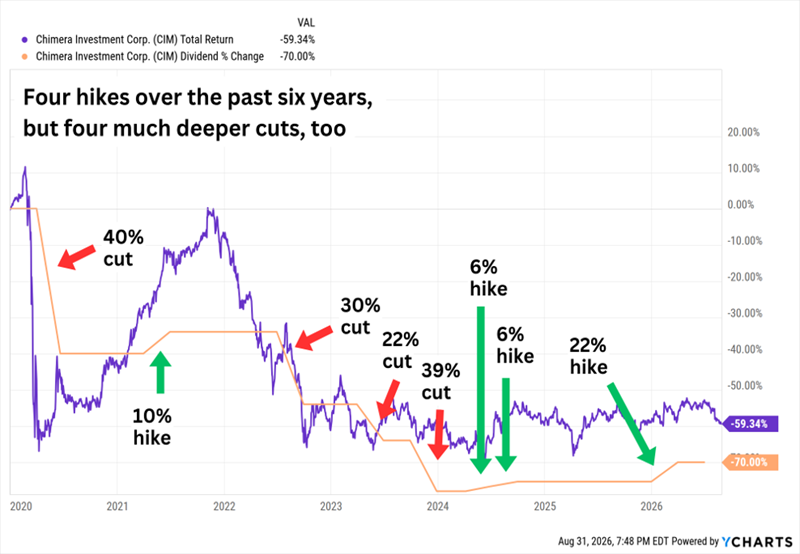
The good news, as we can see on the right side of the chart, is that Chimera’s dividend, while still miles away from where it was pre-COVID, has stabilized and even grown multiple times over the past two years. While dividend coverage had been problematic, estimates for this year and beyond have Chimera more than clearing its payout. Meanwhile, CIM has remained cheap, trading at just 64% of book value as I write this. And there are broader macro trends going in Chimera’s favor; residential delinquency rates have been low, and consumers are holding onto record-high levels of equity in their homes.
And its operational performance doesn’t exactly inspire confidence. CIM’s book value has been on the decline for several consecutive quarters, and the company is coming off another earnings miss.
We’re getting more stability out of MFA Financial (MFA, 16.3% dividend yield), which owns residential mortgage loans, RMBSs and other real estate assets, and also originates and services business-purpose loans for real estate investors through its subsidiary, Lima One Capital.
The dividend picture is similar to Chimera’s, which mostly serves as a reminder that mREITs in general suffered during the COVID crash and have gone through mixed recoveries since then.
However, MFA’s Dividend Has Held Up a Little Better
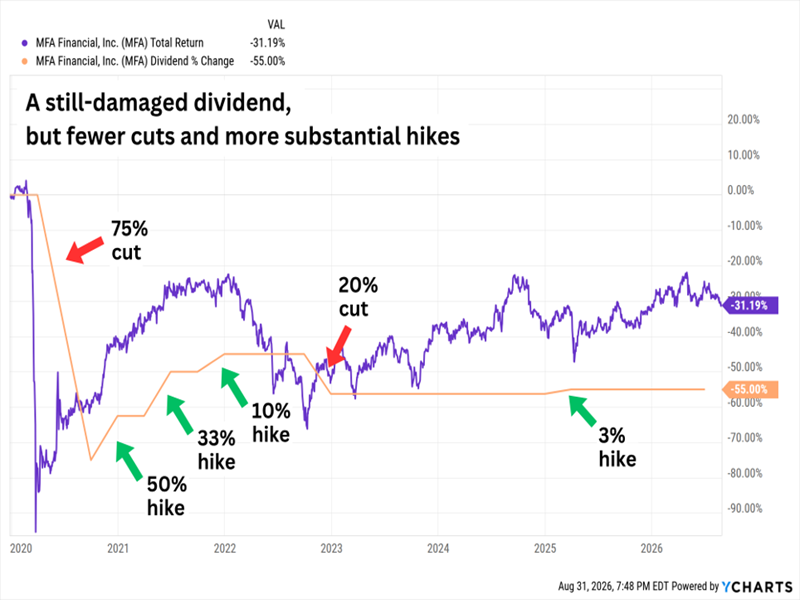
MFA trades at a similarly cheap 66% of book value, and that book value’s declines have been far shallower than Chimera’s. The company has been shedding some of the loans in its legacy multifamily portfolio, and those credit losses are already being accounted for in the book value. MFA is beefing up on safety; it now has $4.1 billion in agency MBSes, which represent almost a third of the portfolio.
Most importantly, the company is continuing to show improvement in “distributable earnings per share” (DE), a non-GAAP measure of profitability that MFA favors. The company finished 2025 with just $1.00 in DE versus $1.44 in dividends paid. But that DE has been accelerating more quickly than expected, and it should cover the dividend by early 2027.
Monthly Dividends of 11%+ We Can Actually Count On!
I’d understand stretching for barely covered dividends if we were strapped for passive income and had no better options at our fingertips.
But why sweat over whether the Federal Reserve will plug our income hose when we can find double-digit yielders that have no problem cutting checks?
My “Monthly Dividend Superstars” are a trio of incredible income plays that most people don’t even know about. And they’re built on the premise that “boring is beautiful.”
No reaching for the Pepto every time the economy hiccups.
No recoiling every time Fed Chair Kevin Warsh sneezes.
No, we just collect a high and secure level of income that lets us live our lives instead of doomscrolling our days away.
How high? Consider this: A mere $600,000 nest egg—less than half of what most financial gurus insist you need to retire—put to work in these Monthly Dividend Superstars could generate a $66,000 annual income stream.
That’s $5,500 every month in regular income checks!
Even better? While the current bull run has many stocks priced for perfection, many of these monthly dividend stocks still remain in our “buy zone” … but they might not be for much longer. So click here to learn everything you need about these generous monthly dividend payers right now!