
Usually in this space, we dig into 8%+ paying closed-end funds (CEFs) set to hand us strong returns and large income streams.
Today, we’re going to do something different and discuss a once-great fund that, sadly, is far past its glory days.
Why?
Because this fund highlights one of the dangers of high-yield investing. That would be the risk of getting too comfortable with a large payout—and ignoring the signs telling us it’s time to take our profits and walk away.
That’s not easy for those of us who invest for dividends! Especially when you have an income stream as big as the one this fund offers (a 12.7% annualized yield) rolling in.
The fund in question is the PIMCO High Income Fund (PHK), which has been around since 2003 and, for a long time, was handing investors strong total returns that were made up, in large part, by PHK’s outsized payout.
Take a look at how this fund (whose market price–based return is shown in purple below) outran the benchmark S&P 500 ETF (in orange) over its first decade of existence.
PHK Trounces Stocks
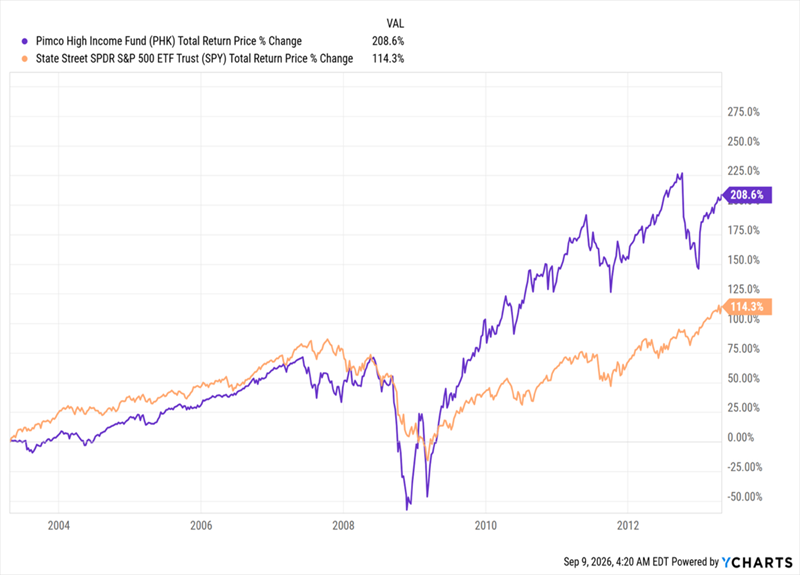
The thing to take note of here is that this is not a stock fund: PHK holds a raft of corporate bonds, municipal bonds, mortgage-backed securities and foreign bonds.
It’s certainly not a straightforward portfolio, but that’s no surprise when you consider that PHK is managed by PIMCO, which has over $2 trillion in assets under management. That makes PIMCO one of the biggest bond investors in the world, so it’s got very particular expertise here.
It’s an advantage we know well at my CEF Insider service, where we’ve held PIMCO funds in the past. In fact, we hold one now: the PIMCO Dynamic Income Strategy Fund (PDX), which has returned around 17% for us since we bought it in March 2025, despite a very challenging market for bonds.
But I digress—back to PHK, which, like many PIMCO funds, has a history of trading at a premium to net asset value (NAV, or the value of its underlying portfolio). That’s because PIMCO’s pedigree in the fixed-income space is no secret among investors.
And as you can see below, in the first few years after PHK’s launch, it bounced around par before breaking out to a big premium following the 2008 financial crisis.
2008 Mess Sent PHK’s Value Soaring
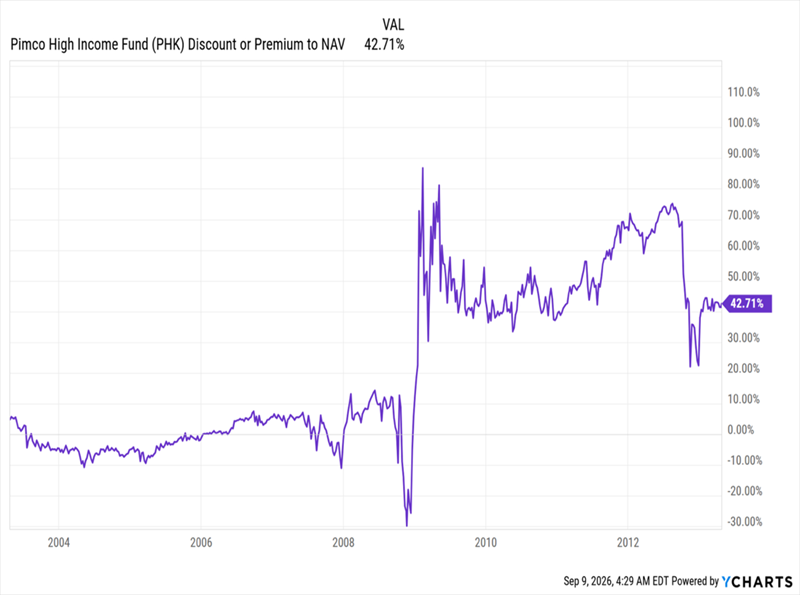
That’s because PHK not only survived that crisis but profited by picking up top-quality bonds at fire-sale prices. This drove PHK’s market price up so far beyond its NAV that it traded at a roughly 87% premium to NAV at one point. That’s right: Investors were so impressed with PHK that they were willing to pay $1.87 for every dollar of the fund’s assets!
The fact that the fund held its payout steady throughout that time certainly helped, as did its habit of paying regular special dividends. Plus, that strong payout history came despite some difficult market conditions: By the early 2010s, interest rates were low, so PHK was one of the few places where a reliable yield could be found.
But all good things must come to an end.
PHK Goes From Dividend Hero to Villain …
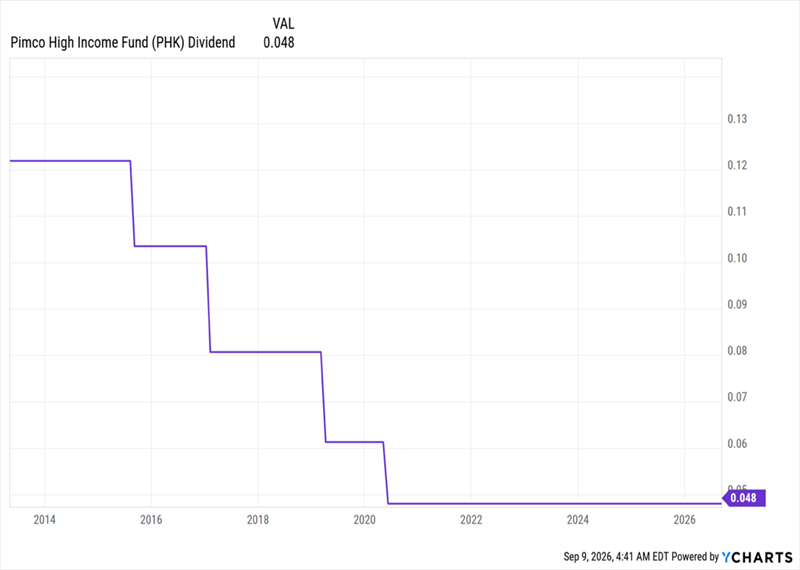
After its first decade, PHK struggled to maintain its payouts and, around 12 years post-IPO, cut the payout for the first time. That cut was followed by more, and the dividend now sits 60% below where it was at the time of the fund’s IPO.
This came as the fund’s strong outperformance, on a market-price basis, also came to an end after its 10th birthday, as you can see in purple below.
… As Its Total Return Fell By the Wayside
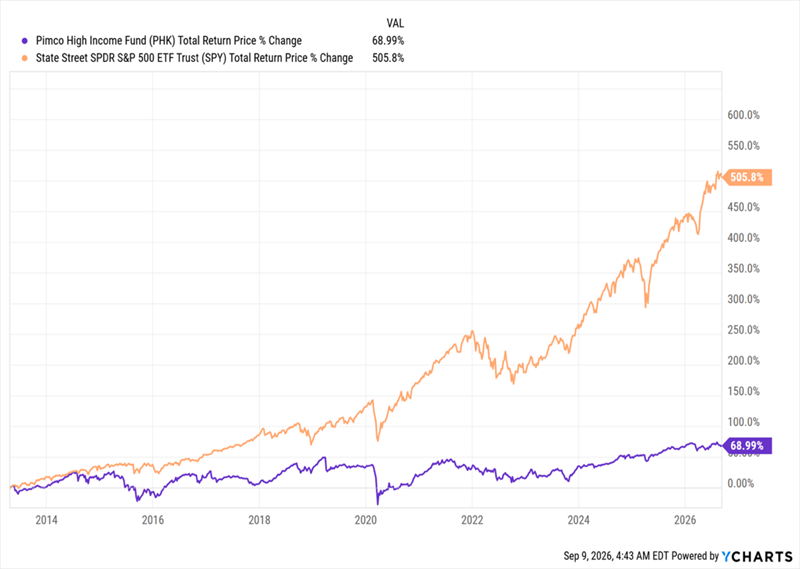
It’s no surprise that investors kept selling off as its performance got worse, and that big premium shrank to today’s 1.1%. Historically speaking, that sounds like a bargain. But based on PHK’s fundamentals, it’s still too expensive.
PHK Barely Stays in the Green
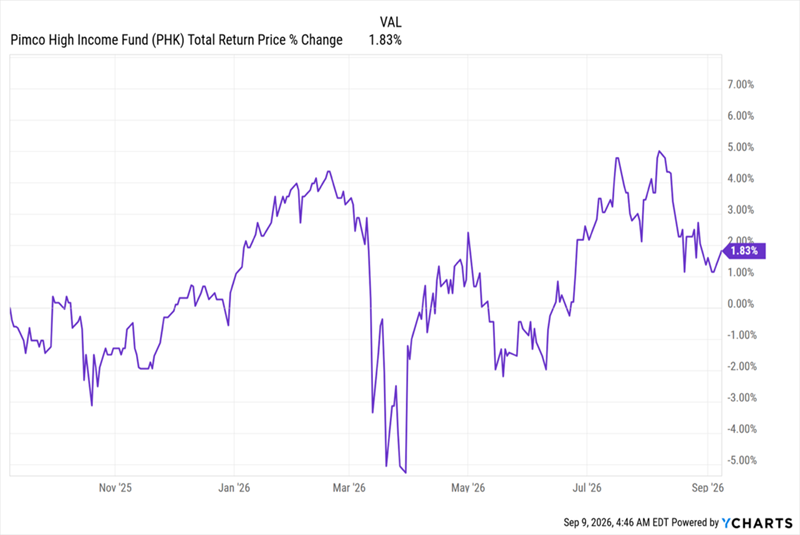
Over the last year, PHK has posted a 1.8% total return, on a market price basis—less than you’d get from a savings account at your local bank. From that perspective, any premium makes no sense—and it makes even less sense when we consider that the average CEF now trades at a 5.7% discount.
What happened?
In a nutshell, PHK couldn’t build on the timely bond buys it made nearly 20 years ago. When those fire-sale purchases matured, the fund was forced to compete in a less oversold, more rational market. And the short-term magic vanished.
That’s the real takeaway: Just because a CEF is strong today doesn’t mean we should expect it to be so forever. When the fund, or the market, changes, we need to pay extra close attention. In the case of PHK, it was a steady decline in NAV beginning in the early 2010s, compared to that strong performance in the latter part of the previous decade, following the financial crisis.
Forget PHK: These 4 CEFs Yield 9%+ (at Real Discounts)
Now that we’ve talked about what not to buy, let’s flip the script and discuss 4 CEFs I see as top buys now.
That’s because these 4 high yielders (with an average yield of nearly 10%) sport discounts that are truly undeserved. That’s benefits us in two ways:
- In a rising market, it puts upward pressure on the price, adding upside to our 9%+ income stream.
- In a pullback, it helps support the share price, letting us collect that 9%+ income stream in peace.