
Today I want to talk about something we don’t touch on very often in these columns: an obscure (yet highly profitable) situation called a “tender offer.”
I know the name sounds a bit stiff. But if one comes along when you hold a closed-end fund (CEF)—particularly a CEF you bought when it was particularly oversold—wow.
You can find yourself sitting on a fast gain as well as a high dividend payout (as I write this, the average CEF yields around 9%).
As we’ll see in the case of one CEF below, a tender offer can take a fund purchased at an 11.5% discount and let the shareholder cash in a chunk of their holding at nearly full value.
Before I get into a tender offer one group of investors is getting a shot at now, let’s break down this happy turn of events, and look at the simple way you can boost your odds of benefiting from one yourself.
We’ll do that by first putting one of the main features of CEFs on the table: the fact that these funds generally have a fixed number of shares throughout their lives. That’s why CEFs are “closed.” ETFs, by contrast, are “open,” since they can issue as many new shares as the market will buy.
The main effect of this is that CEFs often trade at different levels in relation to their net asset value (NAV, or the value of their underlying portfolios), and often at a discount.
Which brings us to the Virtus Dividend, Interest & Premium Strategy Fund (NFJ), a CEF at the center of a recent (and quite rich) tender offer.
NFJ’s shares trade at a 5.4% discount to NAV as I write this. This means we can buy the stocks this fund holds—including Alphabet (GOOGL), Advanced Micro Devices (AMD), the Charles Schwab Corp. (SCHW) and Eli Lilly & Co. (LLY)—for 5.4% less than if we’d bought those shares on the market.
Lately, that discount has been narrowing:
NFJ’s Discount Approaches Par
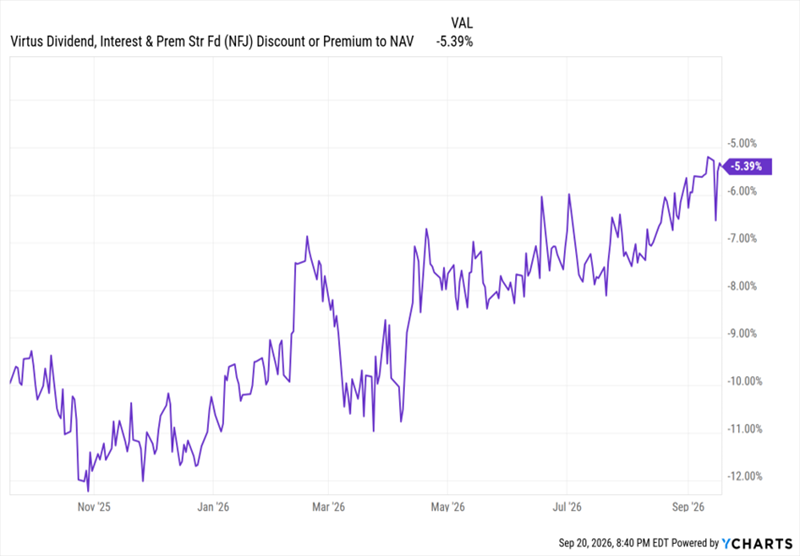
As you can see, NFJ has traded at a much wider discount in the past year, and in fact its average discount over the last decade is 11.5%.
Right now, NFJ yields 8%, which is normal for this fund. And if you buy when it’s at a wide discount and then sell at a smaller discount (or premium), you also set yourself up for gains. This is the magic of CEF investing. And a tender offer, in essence, supercharges it.
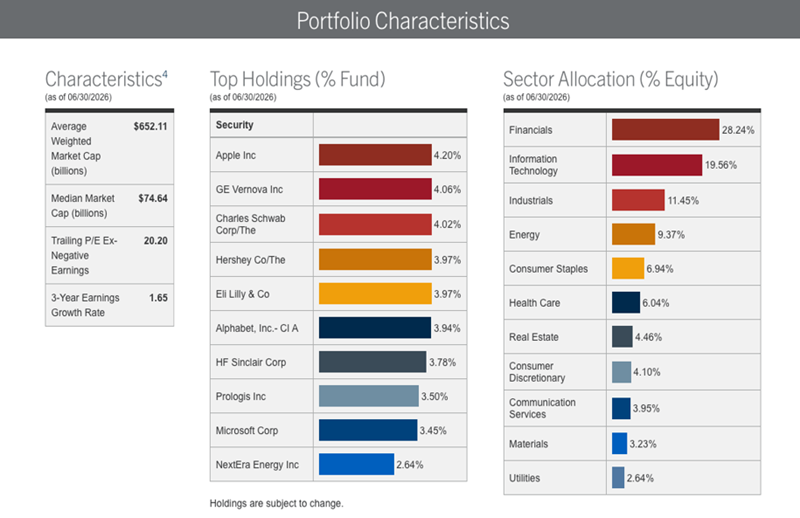
Source: Virtus Funds
NFJ, as you can see above, mostly holds large-cap stocks across sectors, making it a decent replacement for an S&P 500 index fund. That is, except for a critical detail: that 8% income stream. Most index funds pay around 1%. We’re obviously not retiring on that.
There’s a catch, though: NFJ has underperformed the S&P 500 in the long run:
NFJ: A Strong Fund, But Only for Short Periods
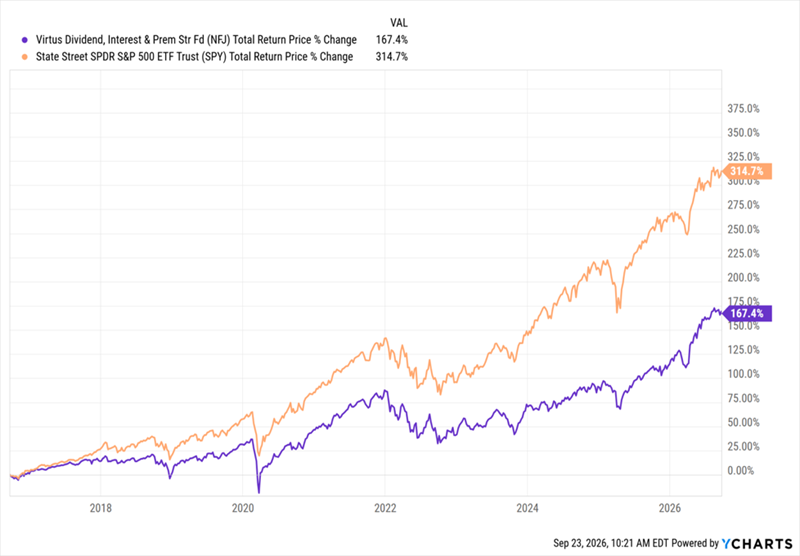
With this in mind, the best strategy is to hold NFJ for short periods and collect income while profiting from changes in the discount. CEF managers (including those at NFJ) are aware of this—and they’ll do what they can to ensure discounts don’t stay too wide for too long.
If they fail to narrow those markdowns, they open the door for activist investors to come in, buy up shares and force a vote that could remove those managers.
How NFJ’s Tender Offer Works
This was the situation for NFJ, which is why management announced a tender offer. This offer is the result of an agreement with activist investor Saba Capital Management.
Under NFJ’s offer, which opened on September 1, 2026, the fund aims to buy back up to 25% of its outstanding shares at 99% of its NAV at the close of trading on October 5 (the offer’s expiration date). If investors holding more than 25% of NFJ’s shares outstanding tender their holdings, management will buy them on a pro rata basis.
If you bought at a wider discount than that at which the fund is buying (again, just 1% below NAV)—and with a 10-year average discount of 11.5%, most long-term holders did—you get to cash in at close to full value. Essentially, the average buyer over the last decade picked up the fund for 88.5 cents on the dollar and can now tender at 99 cents.
Note that you have to elect to tender through your broker.
I think you’ll agree that this is a nice upside kicker. And of course it comes alongside any other gains you booked from the fund, as well as the dividends collected (noting, of course, that the payout has risen about 36% in the last five years, with a special dividend issued, too).
(That also, of course, means that if you buy near the current discount, you’ll get a smaller return from the tender offer than those who bought earlier, at bigger discounts, would.)
So where does that leave us? I like to think of tender offers the same way we would a takeover in a regular stock. They unlock value, but we can’t, of course, invest only with the hope of attracting one. The best thing to do is buy cheap, which puts us in a better position to profit if and when one comes along.
4 “Pivot Point” Funds (Yielding 10%) Trading at Discounts Activists Notice
You can give yourself an even stronger chance of a tender offer by doing one simple thing:
Look for CEFs quietly profiting from overlooked “local” booms in the economy—and trading at overdone discounts as a result.
The even easier path? Let me do it for you!
Exhibit A: The 4 CEFs I call “Pivot Point” funds because they’re all profiting from big changes AI is bringing to specific corners of the US economy.
These shifts—and these funds—aren’t fully appreciated yet, but when the AI-obsessed crowd eventually catches on, I expect these funds’ wide discounts to snap shut. We’ll collect their rich 10% average dividend while we wait for that to happen.
Like I said, these 4 funds profit from 4 corners of the AI revolution: faster breakthroughs in drug research; more AI-powered robots on factory floors; an increase in loan demand as AI powers corporate expansion; and AI’s voracious power demand.
These 4 funds are cheap now. But in light of the profit-making power of these 4 shifts, I don’t expect that to last. Click here and I’ll give you our full strategy, plus a Special Report revealing the names and tickers of these 4 “Pivot Point” 10% payers.