
Let’s go ahead and break down a recent “win” at my CEF Insider service: an unloved fund that handed us a 48% total return in 10 months!
Why? Because this call went our way for plenty of reasons—and we can take those reasons and “convert” them to strategies that can give us the kind of portfolio we all want: one that delivers healthy dividend income and strong price upside.
The fund in question: the Columbia Seligman Premium Technology Growth Fund (STK), which returned that 48% from our buy call in the November 2025 CEF Insider to our sell in the recently released September issue. Let’s get into it.
Step 1: Start With This “CEF-Only” Value Indicator
The first thing that made STK jump out to us was the environment in late 2025. AI-bubble fears were rampant. STK is a tech fund, and wow, did those fears register with it.
Before I get into how, a quick aside: as we’ve talked about here before, CEFs have a unique measure that tells us when they’re cheap or pricey: the discount to net asset value (NAV).
It exists because a CEF generally can’t issue new shares to new investors, so these funds’ share counts stay more or less the same for their entire lives. This means a CEF’s market price can vary from its per-share net asset value (NAV, or the value of its underlying portfolio).
This is exactly what happened as 2025 rolled on. As you can see below, STK’s total-return NAV (in purple) began to outpace its total return based on its price on the open market (orange). That was the “tell”: Investors were souring on STK, even as its portfolio performed relatively well.
STK’s Portfolio Gains, Investors Start to Wonder …
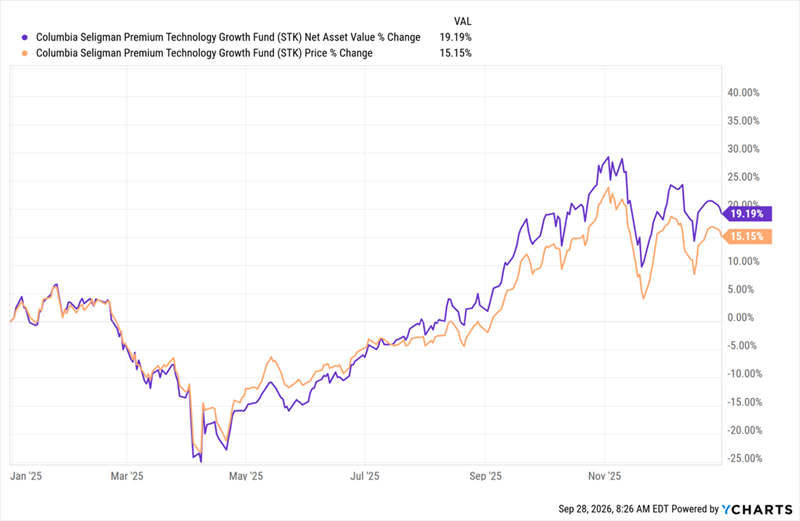
As that happened, STK’s discount broke south, to around 5.5%. This from a fund that was trading at a 5.5% premium to NAV as recently as May 2025:
… And Its Widening Discount Grabs Our Attention
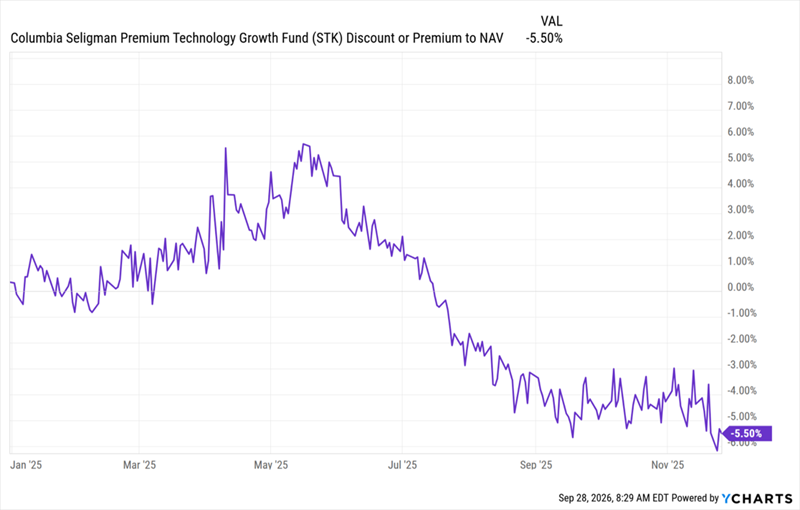
That’s the first sign that last November was a good time to buy. But as with stocks, a sudden widening discount can be a sign of trouble with CEFs. So we need to take a closer look.
Step 2: “Check In” With Management
When it comes to management, we have an advantage here at CEF Insider. Since this corner of the market is small (there are only about 400 or so CEFs, divided among a small number of management companies), I’ve talked to many fund-management teams over the years.
That includes the team at STK, which has been in place for a long time, so we can safely say this discount did not have anything to do with any major change at the fund’s headquarters.
Six portfolio managers work together to run STK. Paul Wick has been there the longest (since 2009). And even the two most recent additions, Vimal Patel and Shekhar Pramanick, have been managers at Columbia Seligman for eight years (since 2018).
The takeaway? If you see a discount, pull up the fund’s documents and make sure it’s not because of a recent management shakeup. Or better yet, let me do it for you at CEF Insider!
Step 3: Study the “Tale of the Tape”
The best measure of management’s talent? The fund’s long-term performance, of course. But we have to make sure we’re looking at the right number here. This comes back to our earlier comparison of NAV versus market-price returns.
When evaluating management, NAV matters more, as it’s more influenced by portfolio management and less by investors’ moods. There was no problem there with STK (in purple below) which had easily outrun the NASDAQ in the decade before our buy:
STK’s Portfolio Shoots Past the NASDAQ
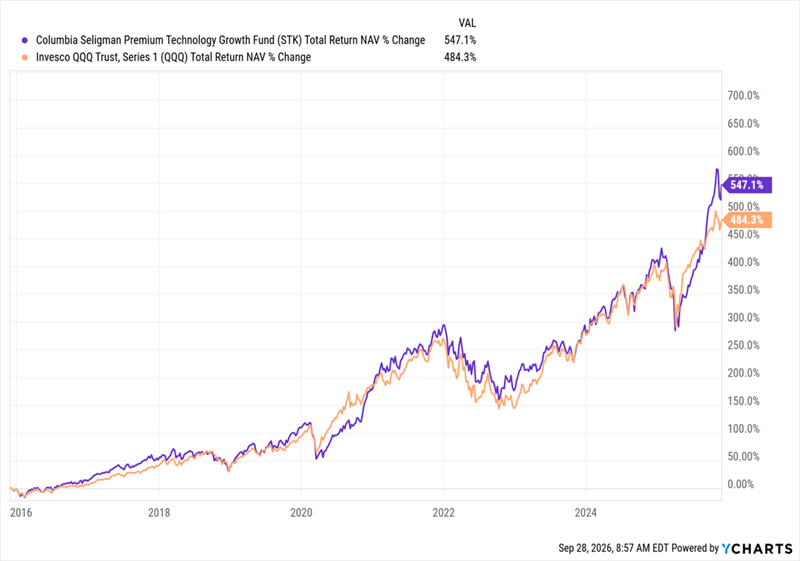
STK pulled this off by selling call options on the NASDAQ (or an ETF equivalent). That’s a relatively low-risk way to generate extra income. Beyond that, STK focuses on tech stocks, from more aggressive plays—such as fuel-cell maker Bloom Energy (BE)—to the more familiar: NVIDIA (NVDA), Alphabet (GOOGL), Apple (AAPL) and Microsoft (MSFT).
So up to this point we’ve got a widening discount, a stable management team and a history of beating its benchmark. We also have a pragmatic growth-with-income focus that was overlooked as investors fretted about an AI bubble.
Now let’s talk dividends.
Step 4: Know Your “True” Dividend Payouts (Free Stock Screeners Are No Help)
STK can fool investors who use free screeners like Yahoo! Finance and Google Finance into thinking the fund’s yield is low.
That’s because these tools don’t count special dividends, which can make a huge difference with CEFs. That’s certainly the case with STK, which leans heavily on one-time payouts (the spikes below):
A Steady Payout—With a Raft of Special Dividends
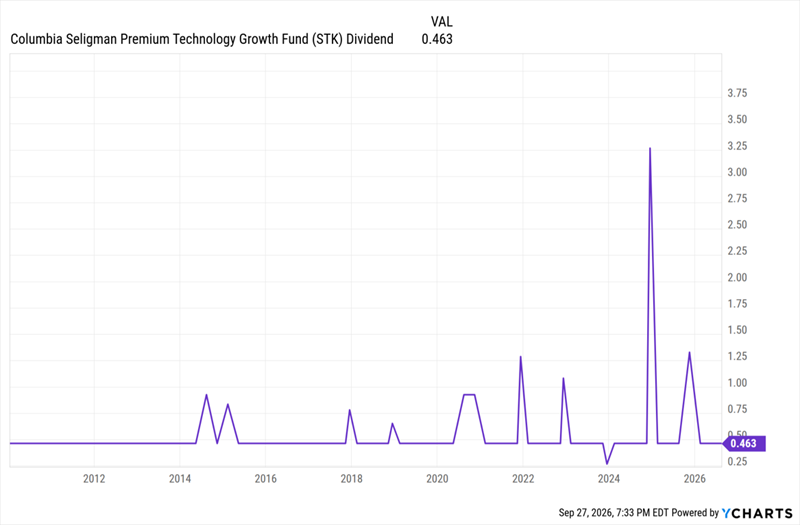
At the time of our buy, for example, you’d think the fund yielded just 5%, going by its “regular” payout. But include special payouts declared for 2025 and you get a far larger number: 8.2%.
That’s way more realistic, and something most investors miss. (But something we at CEF Insider meticulously track, thanks to our advanced research tools.)
The question then becomes, did STK have the performance to keep those payouts coming? The answer is yes. We can easily check this by looking at the fund’s long-term total-return NAV.
STK’s Portfolio Backstops Its Payout (Two Times Over)
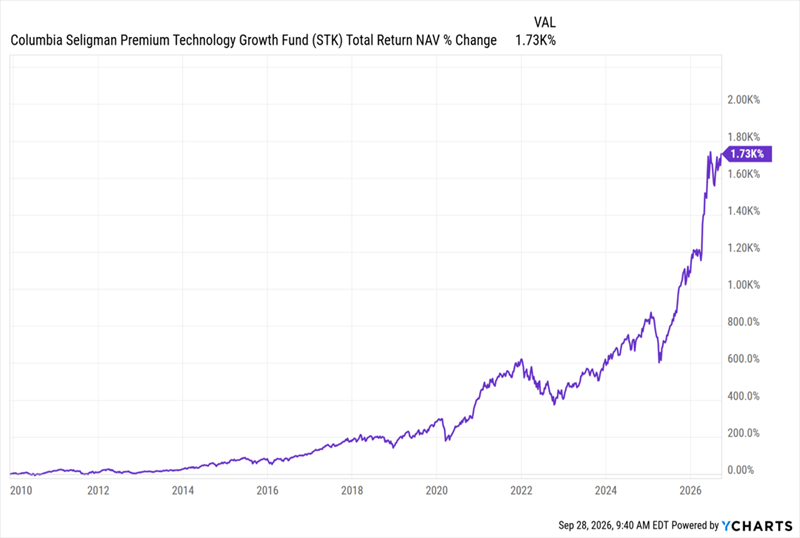
With an 18.1% annualized total NAV return since inception, STK was more than doubling the 8.2% yield on its market price when we bought, so we knew it could keep its payouts high.
Here’s the scorecard to date:
- Unusual discount? Check.
- Stable management team? Check.
- Strong long-term performance? Check.
- High dividend payout? Check.
- The portfolio performance to back up that payout? Check.
A clean sweep! And our call rewarded us with that 48% total return in just 10 months. Which leads us to our next question: How do you know when to sell and take that return off the table?
Step 5: Look to NAV, Discounts and Dividends to “Time” Your Sells
Traditionally with CEFs, we use the discount to NAV as our guide: When it widens to an unusual level, we look to buy. Then when the discount narrows, we sell and pocket the profits.
That works, for the most part, but like most rules, there are exceptions—and STK is a fascinating one. Let’s start with the discount, which actually widened from around 5.5% just before our buy call to around 7% now, a few days after our sell.
Meantime, its total return climbed 48% by market price during our holding period, while its total-return NAV gained 55%:
STK’s NAV Outran Its Market Price While We Held
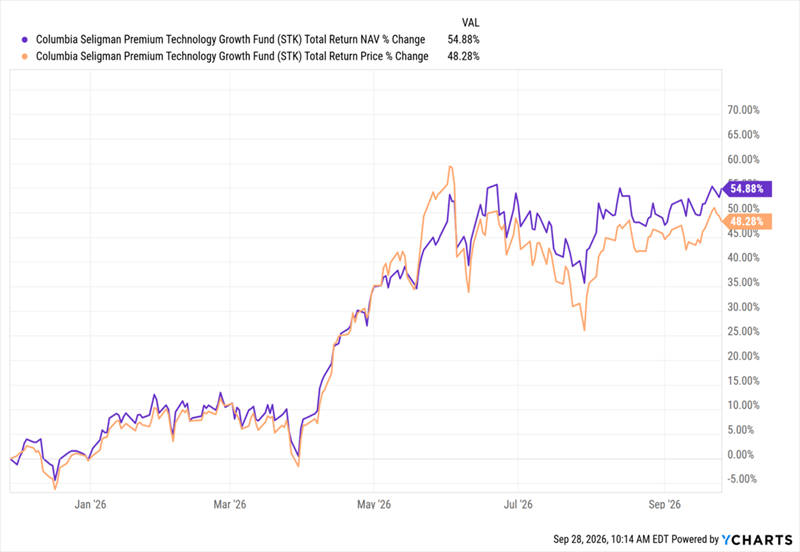
That might signal that our buying opportunity was still on the table, especially as nothing else had materially changed with the fund.
Well, almost nothing else. When we sold, STK’s yield (including special dividends) had shrunk to 5.1% (and even lower without them). That was mainly driven by the fund’s strong price gains.
This is where yield can play a key role as a value measurement. CEFs, of course, are mainly income investments, and a low yield (even one generated by price gains!) can cause buyers to take a pass on an otherwise-strong fund.
That, in turn, would take some investors out of the market for STK, and make it harder for the fund to close that 7% discount.
In other words, we want strong performance, a wide discount and a high yield to work together to attract more investors to a CEF. If one of those is missing, it’s time to sell.
Put These 5 Steps to Work in 1 Single Click (And Unlock a 10% Yearly Payout, Too)
As I said above, the best way to put these 5 steps to work is to let me do it for you.
In CEF Insider, I do just that, giving you the kind of access to the CEF world’s top managers that I enjoy: Over my career as a CEF analyst, I’ve spoken face to face with many of them, and continue to do so.
We can have this kind of access because the CEF world is so small. That smallness is a big advantage for us, not only for the access we get, but because the market doesn’t attract the big institutional players you’ll find in the stock and bond markets.
We launched CEF Insider with the express purpose of connecting investors to 8%+ paying CEFs, which I see as critical to generating strong investment income, in or out of retirement.
In CEF Insider, I use my personal connections and the advanced charting tools I’ve built to guide readers to the very best dividends and strongest upside these unique funds offer.
Now I want to invite you to try CEF Insider with no obligation.
All you have to do is click here and I’ll take you to a special investor bulletin outlining my top 4 “Pivot Point” CEFs (average yield: 10%) and an invitation to road-test CEF Insider for 60 days.
Whether you stick with it or not, everything you get in this offer, including a library of special reports giving you some of my top CEF investing strategies and picks, is yours to keep.
My 4 “Pivot Point” funds boast yields that double those of Treasuries, and these funds trade for less than their portfolios are worth.
That offers real upside potential to go with your 10% payout. And I don’t want you to miss a single bit of it. Click here to get started now.