
The volatility we’ve seen in the last few days tells us one thing: Investors are frazzled.
The whipsawing will likely continue over the next few weeks, for a simple reason: The crowd is worried the AI trade will unwind.
The midterm result—and the talk of regulating the data-center buildout that came with it—are the catalysts for those worries. That’s plain to see in the particularly big moves we’ve seen in Big Tech names.
Question is: Is this panic justified?
Well, in addition to more uncertainty around data centers, the core (and related) worry is the billions of dollars tech companies are borrowing to build them. So let’s take a look at the debt-to-equity ratios of three of the biggest tech firms: Alphabet (GOOGL), Amazon.com (AMZN) and Meta Platforms (META).
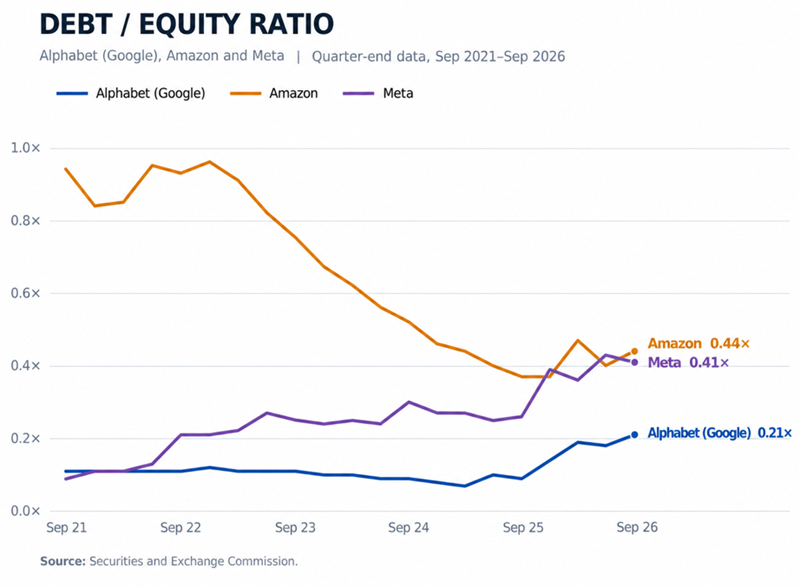
Before I get to what we see in this chart, I should point out that increased borrowing among tech firms is a new trend. For years, these companies borrowed little.
Well, most of these companies. Amazon had a near 100% debt-to-equity ratio in 2021. But that’s actually fallen to 44%. And while Amazon’s debt-to-equity ratio has inched up a bit lately, it’s still well below where it was a couple years back.
Alphabet and Meta, on the other hand, have been keen to borrow more money recently. But only in the last year has Alphabet significantly expanded its debt load, putting it at a 21% debt-to-equity ratio. Meta has been borrowing more steadily over a longer period, and now its ratio is 41%, near that of Amazon.
So, in some cases, tech firms are more indebted than they were, but these debt loads haven’t ballooned to outsized proportions. This shouldn’t come as a surprise—Amazon, Alphabet and Meta’s combined full-year revenue in 2025 was $1.3 trillion. These are massive companies.
That also makes their debt loads relatively small, and when we compare them to the market average, they look smaller. The average debt-to-equity ratio is 102% for S&P 500 stocks, according to research from LENSE Analytics, so these firms are, on average, about two-thirds less levered than the average S&P 500 company.
The bottom line here is that anyone avoiding (or selling) the major tech stocks over debt concerns is making too much of the situation.
An Oversold 11.2%-Yielding Tech Fund to Buy Now
This market misunderstanding has made one particular closed-end fund (CEF) a particularly attractive bargain.
The Neuberger Next Generation Connectivity Fund (NBXG) is a holding of my CEF Insider service that trades at a 12.3% discount to net asset value (NAV, or the value of its underlying portfolio) as I write this, after that discount made several attempts to break out of that underpriced valuation this year.
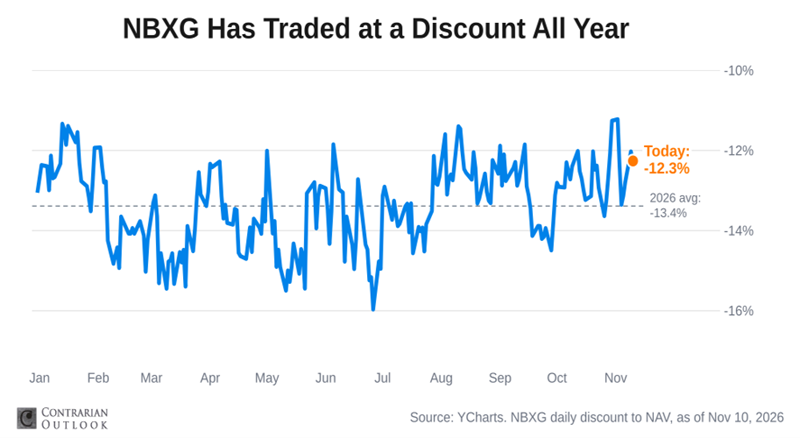
This is odd, because NBXG yields 11.2%, based on its market price, and holds Amazon and Meta, as well as many other Big Tech firms, such as Apple (AAPL), Broadcom (AVGO), Analog Devices (ADI), and fast-growing private companies like military-tech firm Anduril. The fund’s mandate centers on 5G connectivity and rising global demand for data access and internet connections.
A lot of those companies have been swept up in the AI trade, as has NBXG itself. But the recent volatility around the fund has been vastly overdone when you consider that, even with its recent dip, its total NAV return has been 63% in just the last three years.
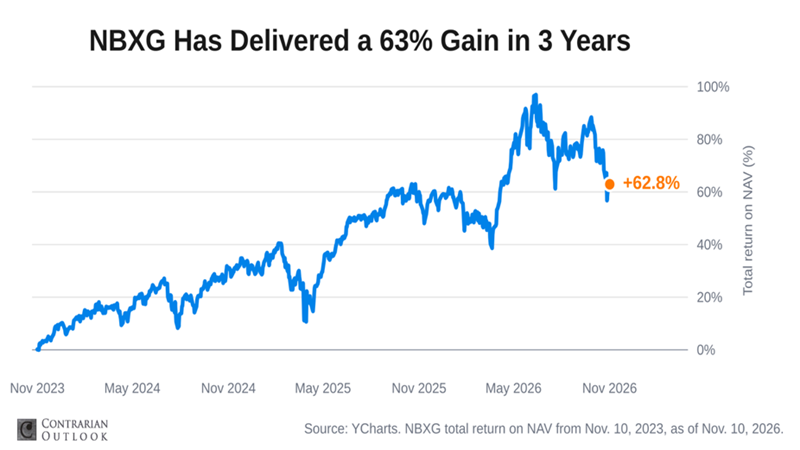
That performance breaks out to 21% on an annualized basis, which exceeds the fund’s 11.2% yield on price. That on its own suggests that NBXG’s payouts are well covered. This also suggests potential upside, as the fund’s 12.3% discount is much wider than the average CEF’s 8.3% markdown.
But the discount also means NBXG’s yield on NAV is 9.9%, which is around half of what NBXG has been earning on a NAV basis. At this point, the dividend looks more than sustainable, and could even be a candidate for another increase.
I say “another” because the payout has been on a bit of a growth tear of late:
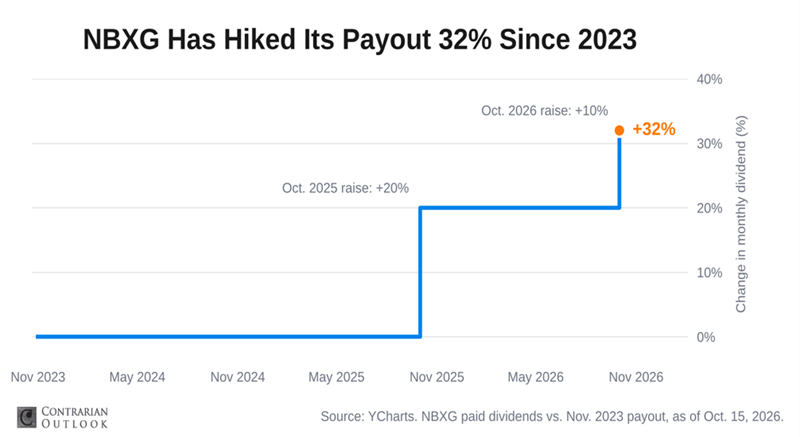
NBXG has hiked its payouts twice in roughly the past year, and that makes sense: This fund’s portfolio has been doing very well, and the fund’s purpose is to hand over those profits in the form of regular income as much as it can.
Will NBXG hike payouts again? That’s hard to say. But what we can say now is that this 12.3% discount to NAV, and 2026’s persistently large discounts, make little sense, especially in light of the two recent payout hikes.
So why hasn’t NBXG’s discount closed already? With just a $1.1-billion market cap, NBXG is too small for most activist hedge funds, and the retail investors who use NBXG to get tech exposure tend to move more slowly than your typical stock buyer.
Anyone who buys this fund today has a shot at getting in while this steep discount persists. And down the road, when investor worry about AI eventually subsides, there could be an opportunity to sell at a narrower discount. Meantime, the 11.2% dividend pays us handsomely to wait.
NBXG Pays Monthly. So Do These 9.2% Payers (They’re All Buys)
NBXG sends us a dividend every month. But it’s still a tech fund, so when AI headlines flare up, its price can swing with them.
That’s why I like to pair it with other monthly payers that spread our income further across the market.
I’ve found 5 of them. They pay every month, yield 9.2% on average and, like NBXG, trade at overdone discounts.
On a hypothetical $500,000 portfolio, a 9.2% yield works out to $46,000 per year. That’s about $3,833 in regular cash flow rolling in every month. And we can get it without selling a single share.