
We contrarians follow Wall Street analysts because we like to fade their opinions!
When most say Buy, we are cautious. There is nobody left to upgrade these shares.
When they slap a Sell label, we are intrigued. So you’re saying the next rating change will be an upgrade?
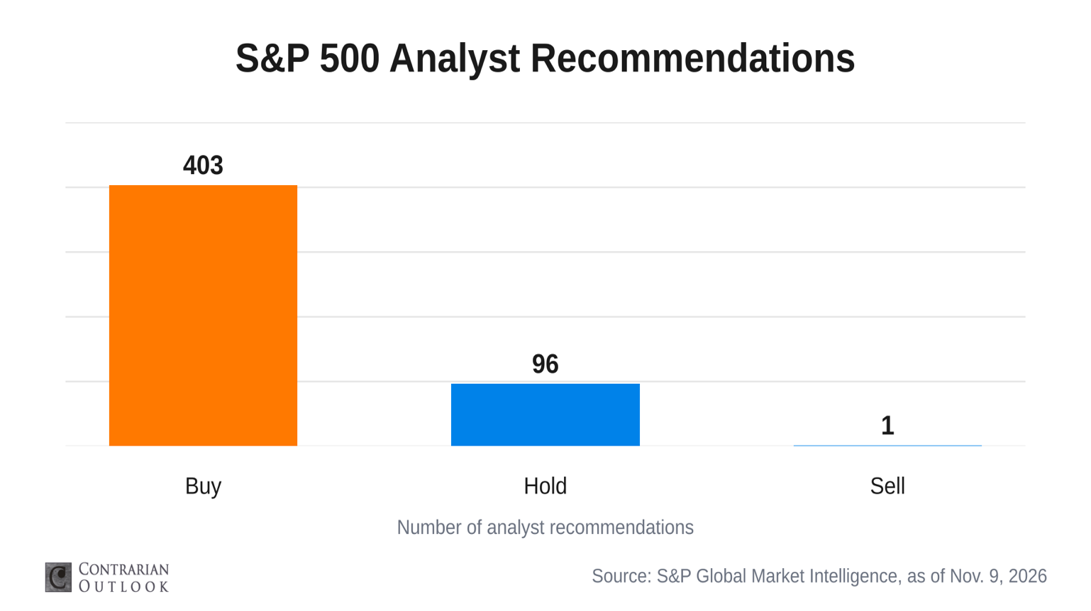
These slippery suits rate most stocks Buys because, well, that’s the business. As we speak, 403 of the S&P 500 (!) is rated a Buy!
So let’s sift through the Holds and the Sells. Today we’ll sort through a five-pack yielding between 5% and 15.8%.
Dillard’s (DDS)
Dividend Yield: 5.0%
Dillard’s (DDS) is one of the most improbable retail success stories of the past decade or so. While Amazon (AMZN) and the growth of e-commerce broadly have made mincemeat of countless brick-and-mortar shops, taken down department stores and gutted malls, Dillard’s found ways to rejuvenate its top and bottom lines. That has resulted in stunning performance for DDS, which has more than doubled Amazon and Walmart (WMT) on a total-return basis over the past decade.
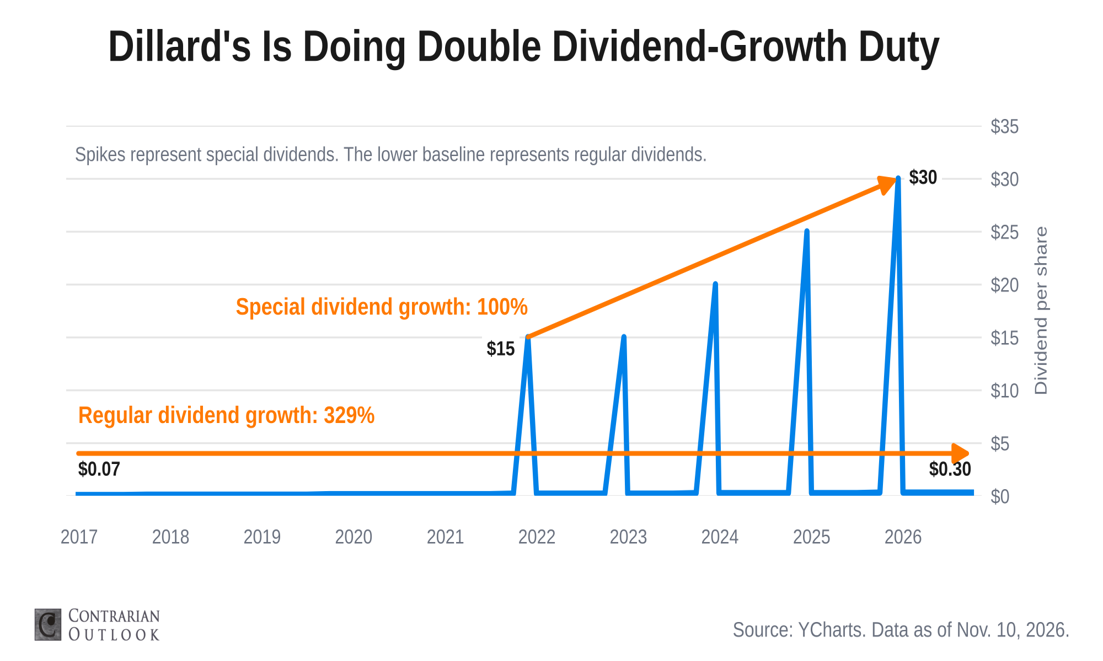
That total return includes a minuscule-but-improving regular dividend—as well as a massive annual special dividend that it has been paying and growing for years. (And its next announcement should be coming any day!)
The “pros” don’t seem to care.
Unloved stocks also tend to be thinly covered—many analysts live by the idea that if you can’t say anything nice, it’s better not to say anything at all. But the three pros still assigned to Dillard’s have a pair of Sell calls and a Hold among them and think shares should be trading about 15% lower than where they are now. That’s a dour outlook.
Dillard’s, while resilient, has watched some of its post-COVID pop fade away. Revenues are starting to stabilize, but expected growth is almost nonexistent. The company’s profits are on pace to improve year-over-year, but that bottom line has been helped by a one-time tariff refund.
The problem isn’t with DDS, which is arguably the best operator in the department-store space and has continued to shore up its debt while rewarding shareholders. Dillard’s issues are external: consumers are facing stiffer pressure, and other channels (namely e-commerce) continue to look better to value-minded buyers.
And speaking of value: A forward P/E of 18 doesn’t look great given the bottom line is expected to slide a bit after 2027.
JBG Smith Properties (JBGS)
Dividend Yield: 5.7%
JBG Smith (JBGS) is a regional real estate investment trust (REIT) that owns and operates mixed-use properties in and around Washington, D.C. Its portfolio comprises nearly 12 million square feet across 38 buildings, and includes multifamily, office and retail assets.
That D.C. focus makes it a bit of an oddball in that its greatest tenant is the U.S. government, at 29 leases, followed by the likes of Amazon (AMZN), Lockheed Martin (LMT), Accenture (ACN) and Science Applications International (SAIC). In other words, the government and government contractors make up a little more than half of annualized rent.
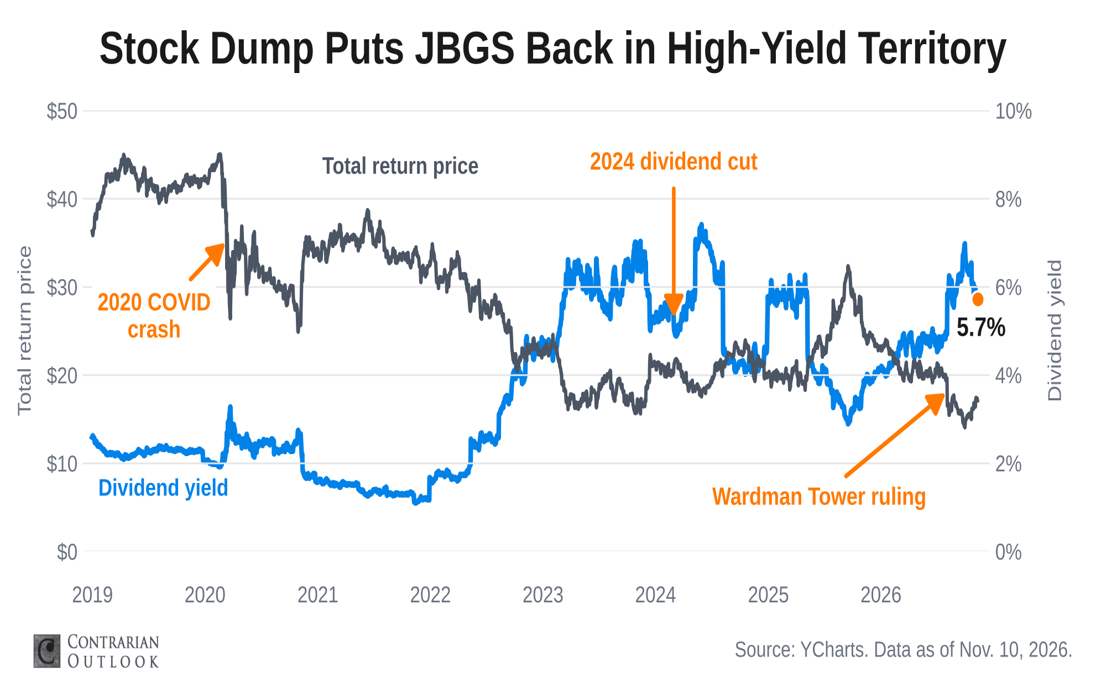
JBGS was spun off from Vornado Realty Trust (VNO) in 2017, then took off for a couple of years before being crippled by COVID and forced into announcing a 22% dividend cut in 2024.
The REIT has been combatting weakness in its commercial portfolio by turning some of its commercial properties into residential and mixed-use properties. For instance, in May of this year, it began converting 2200 Crystal Drive—an 11-story office building built in 1968 with more than 315,000 square feet of space—into 195 multifamily units.
However, the property mix has been the least of JBGS’ problems. In November 2020, the condominium association of Wardman Tower sued the developers (including JBG Smith) for alleged design and construction issues with the Woodley Park building. That hung over the REIT’s head until July 2026, when the court ruled in favor of the association and awarded about $119 million in damages, which were tripled to $356 million under the D.C. Consumer Protection Procedures Act.
That ruling sent JBGS reeling even further and lifted the REIT’s yield to roughly 7% before retreating toward a current payout of closer to 6%.
Analysts have checked out—JBGS has two Sells and a Hold—but they could be missing out on a potential bounce. JBG Smith not only plans to appeal, but in its delayed earnings report filed after the ruling, it didn’t set aside a liability charge, saying that “while we maintain substantial insurance coverage, we also believe that JBG SMITH should not have been named as a defendant in this case and should not bear any liability with respect to this matter.”
Anyone wanting to wait around would be earning a yield that’s much richer than the REIT sector average. But they’d also be relying on a dividend that accounts for most of this year’s projected adjusted funds from operations (AFFO) … and they’d be buying at an elevated 14 times those AFFO forecasts.
Cricut (CRCT)
Dividend Yield: 10.4%
If we stroll into a Michaels or Hobby Lobby, chances are we’ll come across a Cricut (CRCT)—a machine that lets users turn their ideas into professional-looking handmade goods, such as cards, mugs, T-shirts, even large-scale interior decorations. Software helps integrate its machines with design apps (including its own Cricut Joy App) and a pair of subscription plans.
This product was created in 2006 by Provo Craft & Novelty, and it developed such a fervent and loyal user base that the company changed its name in 2018 to reflect the machine’s success. It went public a few years later, in March 2021—right as its financial performance peaked. Revenues and earnings plunged by more than half within a couple years, and what few analysts covered the stock told investors it wasn’t worth holding.
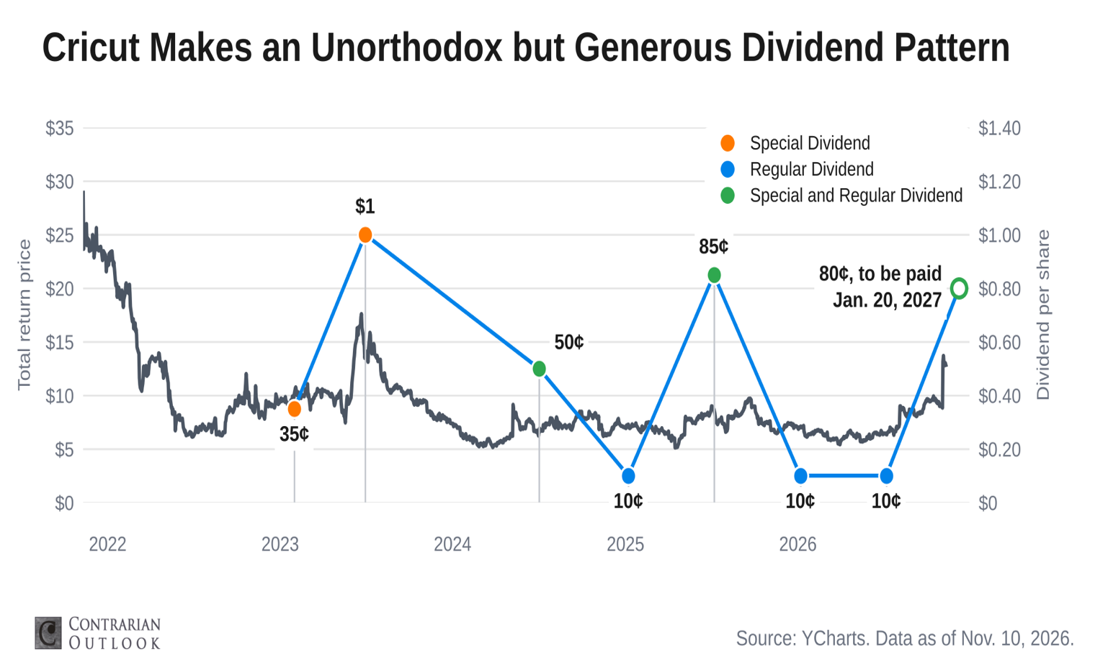
Then in 2023, as its profits were flagging, CRCT paid a couple of special dividends. In 2024, it stepped things up by launching a modest 10-cent semiannual dividend program that it paired with large special distributions.
Around this same time last year, I pointed out that despite a 20% yield, “every analyst covering the stock says we should ditch it.” The stock was effectively dead money in 2025, and the pros expected its profits to fall off a cliff.
CRCT has silenced its haters. The stock has delivered 80%-plus returns in 2026, including a big recent spike after reporting a monster Q3. Profits jumped 36% year-over-year, paid subscribers reached nearly 3.1 million, and management announced a special dividend of 70 cents to be paid to anyone holding the stock as of Jan. 7, 2027. Full-year earnings are now expected to grow by 30%.
The pros haven’t relented. The three that have stuck around still say to sell, and they see another profit drop in 2027. While the special dividends aren’t great for investors who need consistent income, and the price (19 times 2026 earnings estimates) make it difficult to suggest biting, I also wouldn’t join the bears in betting against Cricut.
Hess Midstream LP (HESM)
Distribution Yield: 10.5%
Hess Midstream LP (HESM) is an energy master limited partnership (MLP) that owns midstream assets such as pipelines, gas processing facilities, terminals and gathering pipelines, predominantly in the Williston Basin area of North Dakota.
But that geographical range is spreading. Since 2025, Chevron (CVX) had owned a large (38%) stake in HESM following the 2025 close of its deal to acquire Hess Corp., but just last month, the companies agreed to a transformative deal. CVX is handing over not just all of its ownership interest but also its general partner interest, as well as its crude oil and natural gas gathering and storage assets in the Denver-Julesburg (DJ) Basin.
Hess Midstream, which becomes an independent, multibasin company as a result, will in exchange pay $200 million, as well as reduce Chevron’s tariffs in the Bakken by roughly half between 2027 and 2033. They’ve also extended their gathering and processing contracts with CVX through 2045.
So, why have HESM shares attracted just one Buy call against three Holds and three Sells?
It’s not all puppies and rainbows for HESM. The deal will drastically reduce estimated earnings before interest, taxes, depreciation and amortization (EBITDA) by $400 million, and turn off the spigot of fixed reservation payments after 2029. But perhaps more importantly, it will drastically alter one of the greatest distribution charts on the market.
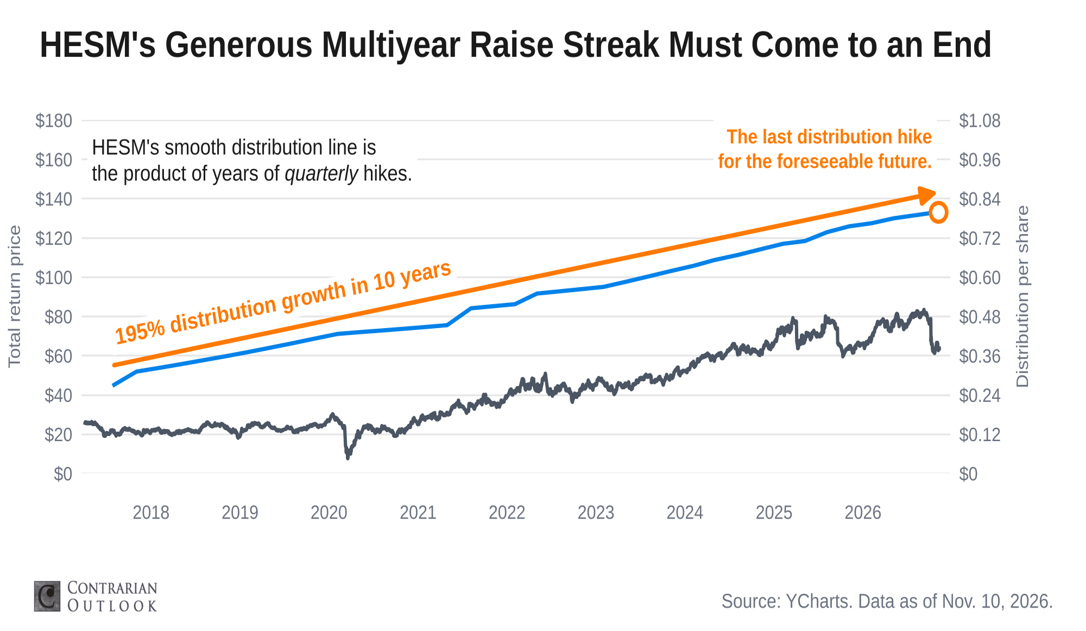
“We continue to target annual distribution per Class A share growth of 5% per share on an annualized basis in the fourth quarter of 2026,” Jonathan Stein, Chief Executive Officer of Hess Midstream, said in a late October release announcing its Q4 increase. “Looking forward, we expect to maintain quarterly distributions in 2027 consistent with the expected fourth quarter 2026 distribution amount and intend to maintain at least that distribution level going forward fully funded by Adjusted Free Cash Flow.”
Read differently: Distribution growth will be paused for at least a year starting in 2027. Maybe it will grow farther down the line. Maybe it won’t.
The payout should still be well within Hess’s guidance for adjusted free cash flow in the short term. The eventual loss of the fixed reservation payments could put pressure on the distribution, but the hope is that will be offset by growth and efficiencies, with retained free cash flow helping to pick up the slack.
It’s a stickier situation than HESM had been in. But Chevron’s deal (should it close) has at least eliminated the uncertainty that had been hanging over Hess Midstream’s head for more than a year. It has also knocked HESM’s enterprise value (EV)/EBITDA down to 5.4, below its 5.6 five-year average, and shot its yield up into double-digit territory. (But buyers must be willing to deal with the dreaded K-1 tax form.)
Goldman Sachs BDC (GSBD)
Dividend Yield: 15.8%
2026 hasn’t exactly been friendly to business development companies (BDCs), which provide financing to small and midsized businesses that big banks and other major lenders often won’t service. The recent Fed rate hike was actually something of a small boon to BDCs, whose debt deals tend to be variable-rate in nature, but a combination of pinched consumers and high costs have largely kept BDCs’ portfolio companies in check all year.
To wit: Goldman Sachs BDC (GSBD), which invests in companies with annual EBITDA of between $5 million and $75 million and currently has 168 firms under its financing umbrella, is barely above breakeven this year despite its gargantuan dividend … and it’s still a few points ahead of a popular BDC index.
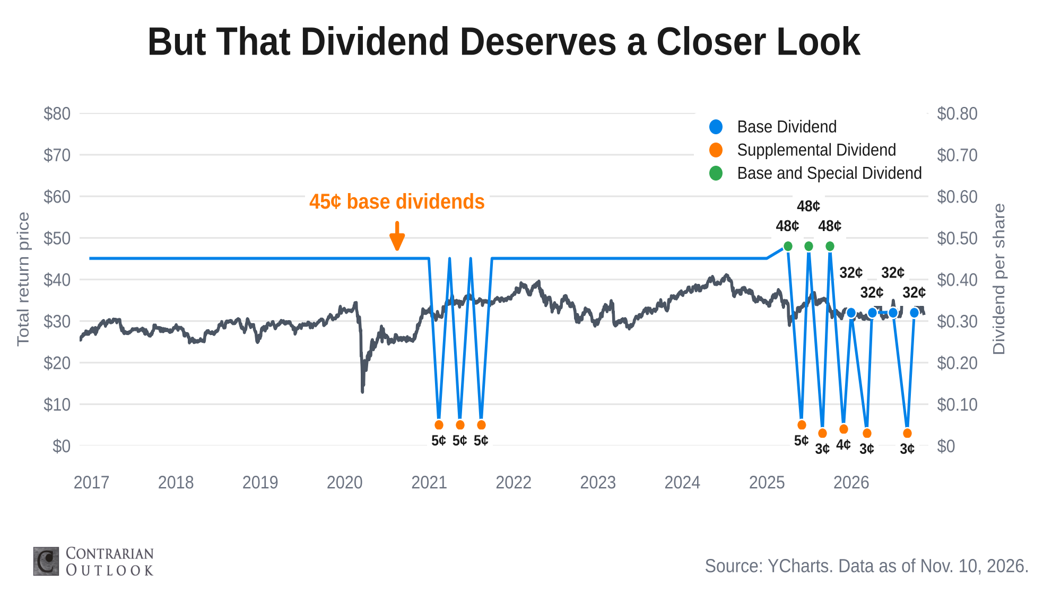
GSBD currently has three Holds and two Sells, and it’s easy to see why Wall Street isn’t enamored.
We’re dealing with specials again. Unlike Dillard’s and Cricut, regular dividends make up the lion’s share of Goldman’s large yield, but the distribution still has warts. GSBD slashed its core payout by 29% in 2025, switching to a base-and-supplemental system in which its 32-cent base dividend was temporarily boosted by 16-cent special dividends (so, 48 cents). Those went away. And GSBD has only paid supplementals in the first and third quarters of this year—it failed to do so in Q2, and it hasn’t announced one for Q4.
Even then, we’re earning an insane yield of nearly 16% on a small-business portfolio that trades at a 27% discount to its net asset value (NAV). And this is a BDC that has been heavily responsive to potential artificial intelligence disruption, putting together an AI risk framework within which it evaluates all new underwriting, ditching at-risk investments, and even exiting a longtime software loan despite no signs of deterioration.
GSBD still might not be out of the woods, though. Net investment income (NII) is suffering because of credit-quality issues, which are largely coming from a legacy portfolio that management is trying to pare down. But that could take time that the dividend doesn’t necessarily have.
My 2027 Dividend Plan: Book Big Income Every Single Month
While my investment gameplan for next year absolutely involves owning double-digit payers, we’re going to need more than what Goldman Sachs BDC has to offer.
I don’t mean more yield—I mean more frequency, and more reliability.
My “Monthly Dividend Superstars” also pay sky-high levels of income, but they also pay us each and every month, and they’re built on much sturdier foundations.
That gives us more confidence that these generous dividends will actually stick around.
How generous? If we invest a mere $600,000 nest egg—less than half of what most financial gurus insist you need to retire—into this trio of 11%+ payers, we can generate a wild $66,000 annual income stream. That’s $5,500 every month in regular income checks!
More importantly, these are truly stable businesses, which means we don’t have to freak out over every last jobs report, Fed meeting or global flare-up. We just sit back, relax and live our lives instead of doomscrolling our brokerage accounts every day.
I’m loading up on these monthly dividend stocks ahead of 2027 as long as they remain in our “buy zone” … which they might not be for much longer! So click here to learn everything you need about these generous monthly dividend payers right now!