
At times like these, we want to own a particular kind of asset. One that:
- Gives us a high payout (I’m talking 9%+ here).
- Trades at a discount.
- Comes with a built-in inflation hedge.
One closed-end fund (CEF) gives us all three.
Not just in the form of its 9.1% dividend (which outraces both inflation and the 5%-ish yield on the 10-year Treasury). This one also carries a carefully crafted selection of pipeline stocks in its portfolio.
These assets have gained alongside rising US oil production (as oil demand and, of course, prices tend to rise in periods of high inflation). That’s helping offset softness in its corporate-bond portfolio (as bond prices and rates tend to have an inverse relationship) while those bonds keep paying high coupons.
Result? A fund with a reliable 9.1% payout, an inflation “shock absorber” and a 10.7% discount to net asset value (NAV), too.
That fund is the PIMCO Dynamic Income Strategy Fund (PDX). It not only gives us a hedge against inflation—it actually benefits from the specific type of inflation we’re dealing with now.
By that I mean inflation that comes in large part from a strong consumer buying more goods in the economy. That’s a key (and overlooked) piece of the inflation puzzle today.
Now this may sound like an overly optimistic take on today’s bout of rising prices, but it is what we’re facing. To be sure, high energy prices are a clear and obvious driver of today’s inflation. But take a look at this:
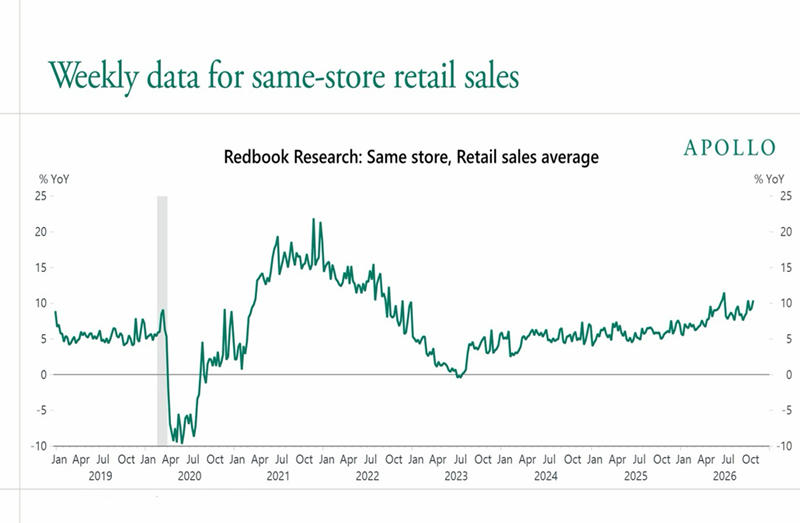
An analysis of Redbook Research data on same-store sales by Apollo tells us that consumers are still spending freely. After crashing in 2023, growth in same-store sales has been steadily increasing. This means more Americans are buying more things from the same shops, and that rising demand tends to push up prices.
This suggests that goods prices are rising at least in part because the American consumer is doing well.
Of course, if you look at the stock market, it doesn’t feel that way. Concern about a further pullback dominates the business press. We contrarians know that fearful times like these are often a good time to buy.
But the current mood also signals that this is a good time to zero in on CEFs that hold corporate bonds, like PDX, which is a fund we hold in the portfolio of my CEF Insider service.
PDX: A 9.1% Payer Built for Today’s Inflationary Environment
Two interesting things have happened to this fund in 2026. First, its underlying portfolio (its net asset value, or NAV, in other words) has posted a strong return, to the tune of 14.8% year to date.
That’s because PDX isn’t just a corporate-bond fund. As mentioned, its portfolio also includes shares of energy-infrastructure companies, like pipeline operators Energy Transfer (ET), MPLX (MPLX), Enterprise Products Partners (EPD) and Enbridge (ENB).
In total, bonds account for two-thirds of the fund, with an average 6.2% coupon and a four-year duration. This helps it earn most of its payouts, while the upside from the stocks it holds (22% of total holdings) helps round out the rest. (Beyond stocks and bonds, PDX holds cash, commodities and short-term instruments).
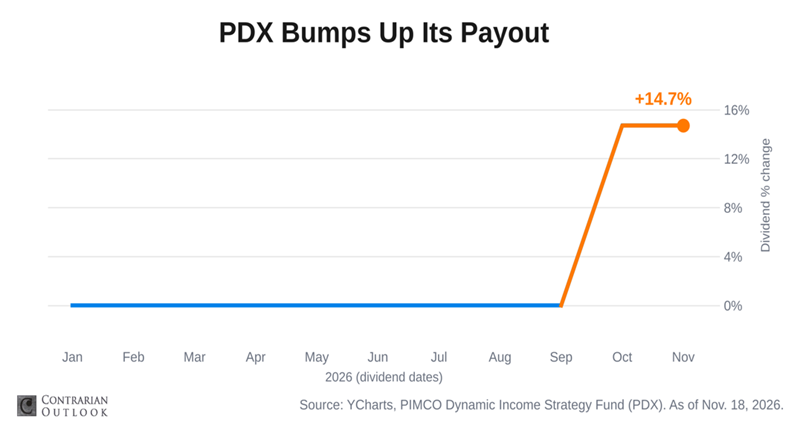
The fund’s payout is so strong that it was recently hiked: In September, the fund announced a 15% payout hike, from $0.133 a share to $0.153, paid monthly.
PDX’s holdings are also benefiting from AI’s rising energy demand, which has generated reliable income and growth regardless of investors’ occasional panics over exactly what the technology means for the economy in the longer run.
Which brings us to the second interesting thing that happened (or more accurately didn’t happen) to the fund this year: Its discount to NAV, now at 10.7%, has barely budged all year. It’s right about where it started 2026, and about a month ago it hit 12.3%, its widest point since March.
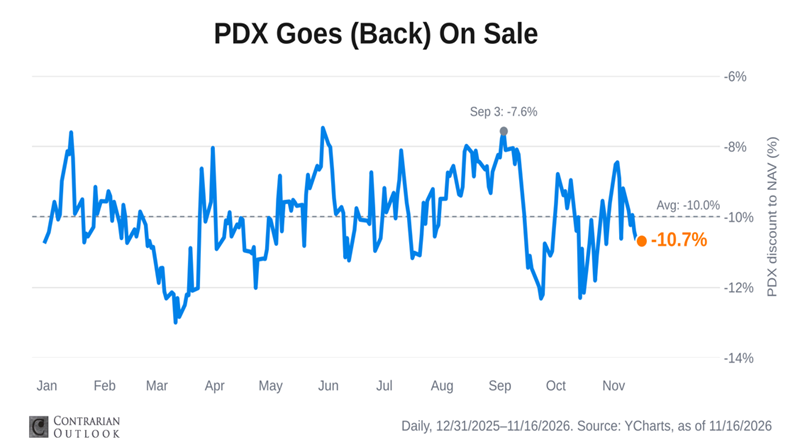
That’s despite PDX’s strong year-to-date performance.
This fund is undeservedly oversold, and that makes it a bargain—a bargain I suspect won’t last long, especially as investors look for reliable income and a fund that can benefit from AI without the AI-driven volatility we’re all so familiar with.
Note, too, that energy has historically been a strong inflation hedge. This helps PDX benefit from the higher price trend we’ve been seeing. And while it’s true that the end of the Iran conflict would likely cause energy prices to fall, PDX’s assets mainly benefit from rising US production and demand, and lower prices could spur the latter.
The bottom line here is that this fund is well-positioned for today’s environment, with a robust economy driven mainly by Americans buying more things (even if, yes, that is spurring inflation).
Investors should be valuing PDX according to its suitability for such an environment. Instead, this 9.1% yielder carries a 10.7% discount we’re more than happy to take advantage of.
PDX Pays Us 12 Times a Year. Here’s How to Get Paid 60
PDX sends us a 9.1% dividend every month. That’s 12 paychecks a year, with pipelines in the portfolio to help cushion us when inflation flares up.
Now imagine holding 5 monthly payers just like it. That’s 60 dividend “paychecks” a year.
I’ve found 5 CEFs that do just that. Together, they yield 9.2% on average, and they spread our income across different corners of the CEF market.
On a hypothetical $500,000 portfolio, a 9.2% yield works out to $46,000 a year. Spread across 60 paychecks, that’s about $767 each, without selling a single share.