
This market is in a three-way “tug-of-war”—and it’s set up some sweet deals on our favorite 9%+ dividends.
The Fed. The White House. Iran. A peep from any of the above and stocks soar (or tank).
But we contrarians can see through the short-term fog here.
We’re buying this volatility, in part because we’re playing the long game on AI, and the likelihood it’ll cap wage growth and inflation in the long run (more on that below).
But in the here and now, we need to play it smart—and zero in on payers that cushion our downside so we can collect their rich payouts in peace. I’ve got two closed-end funds (CEFs) that do just that—and throw off huge 9%+ yields, too.
Plus, these two funds help us avoid the mistake most investors are making now.
1 Click to 9X the Payouts Your Friends Are Booking
That mistake? When markets come under pressure, many investors look to a “plain vanilla” index fund, like the State Street SPDR S&P 500 ETF Trust (SPY), to take advantage.
The problem? SPY’s current yield is … 1%. One percent!
Want a $50,000 yearly income stream from SPY? Hope you’re prepared to invest around $5 million.
It’s too bad because SPY holders can easily grab dividends 9X bigger when they go just a bit past ETFs, to CEFs. Our first one holds the stocks in SPY, but instead of a sad 1%, it pays a 9.1% dividend that gets safer when markets turn stormy.
Swap the “Y” in “SPY” for “XX”—and Unlock a 9.1% Payout
That CEF is SPY’s high-yielding “clone,” the Nuveen S&P 500 Dynamic Overwrite Fund (SPXX).
The tickers are similar because like SPY, SPXX holds the stocks in the S&P 500, such as Apple (AAPL), Microsoft (MSFT) and Visa (V). But instead of SPY’s 1% dividend, you get SPXX’s sweet 9.1%.
Why the difference? SPXX sells call options. These give the buyer the right to buy SPXX’s stocks at a fixed future date and price. That generates extra income because SPXX keeps the “premiums” these buyers pay, no matter how these trades play out. The value of these options also rises with volatility.
SPXX then uses this cash to fund our payouts.
This strategy can cap upside in a rising market, as some of SPXX’s holdings get sold. But it also gives us most of our return as dividends, which is one way it cushions volatility.
SPXX has lagged SPY this year, with a 7.4% total return based on market price (in purple below), compared to 9.9% for the ETF. You’d expect that, as the bulls ran through the first half of ’26, despite the many whipsaws we’ve seen along the way.
But over that time, something curious happened: The performance of the fund’s portfolio (that is, its net asset value, or NAV), which strips out sentiment, has more or less matched SPY, returning 9.8% year-to-date (in orange below).
NAV Pops, Price Trails … and a Buy Window Opens
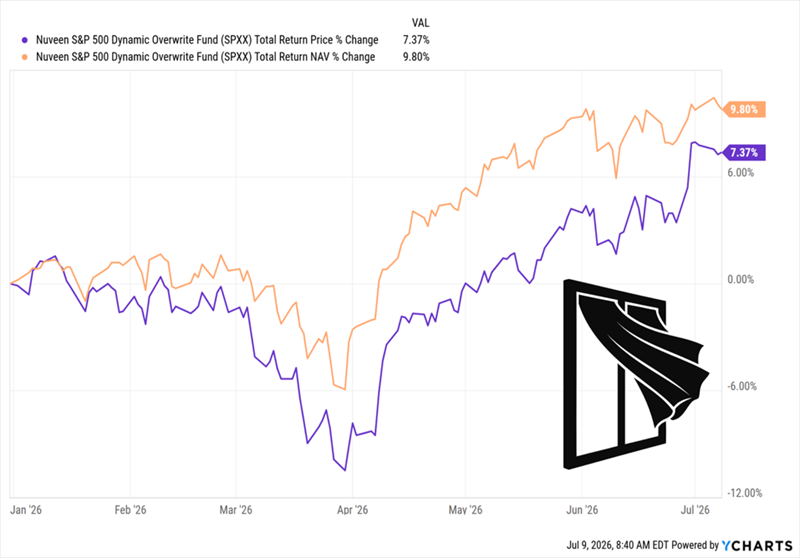
That gap has teed up a 9.1% discount to NAV on SPXX (which by coincidence matches the fund’s yield), much wider than the SPXX’s five-year average of 3.9%.
And if you look at the right side of the chart below, you’ll see that SPXX’s discount is starting to narrow again. That’s a sign that investors are placing more value on SPXX’s options strategy and are starting to buy in as volatility picks up:
SPXX’s Cheap (for Now) Valuation
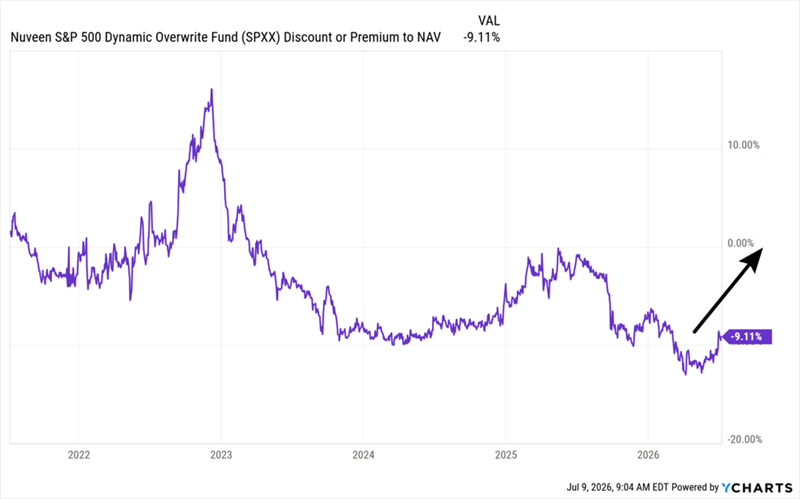
This setup—a below-average discount that’s starting to narrow—is generally a smart time to buy a CEF. And while we wait for SPXX’s markdown to close, this “SPY clone” will pay us 9X what the original does.
Swap Your Bond ETFs for This 10%-Paying CEF
This opportunity isn’t only coming our way in stocks. It’s handing us deals in bonds, too. That’s because the herd is wrong on the direction of interest rates in the long run.
We already touched on AI, which provides a sweeping level of automation to white-collar work that is highly deflationary.
In the 1990s, the Internet acted as a similar “deflator” on prices. The move from snail mail to email and from fax machines to web browsers made businesses wildly more efficient, which kept a lid on consumer prices—and a floor under bond prices. They rallied throughout the entire decade.
Oil? Despite the latest tit-for-tat, prices are still well below their 2026 highs. And this conflict will end. Neither side can afford any other outcome. That’ll lead to a further drop in the price of the goo, and another gut-punch to inflation.
But the crowd doesn’t fully grasp any of this yet, so bonds are hated. That’s our cue.
One thing you do not want to do at a time like this is pick up a corporate-bond ETF like the SPDR Bloomberg High-Yield Bond ETF (JNK), which pays 6.6%. That’s not bad, but it pales in comparison to the payout of a corporate-bond CEF like the 10%-yielding DoubleLine Yield Opportunities Fund (DLY).
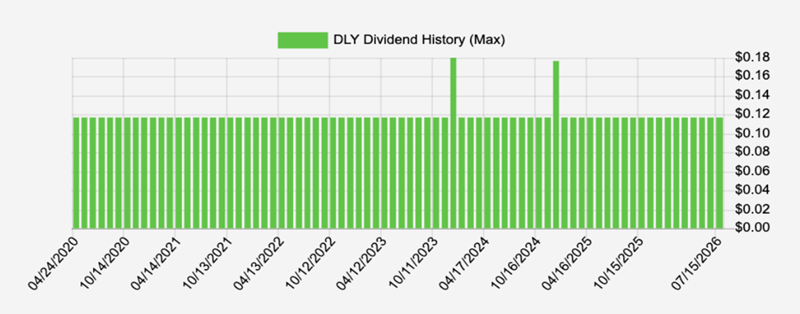
Not only is DLY’s yield 50% larger than that of the index fund, but it comes our way monthly, with the odd special dividend thrown in:
Source: Income Calendar
When it comes to performance, there’s no comparison. DLY is run by Jeffrey Gundlach, the so-called “Bond God,” who’s as connected as they come. DLY launched in February 2020, as the COVID dumpster fire was starting to rage. That let it buy the dips while the world went into lockdown.
And since bonds started to get up off the mat in late 2022, DLY (in purple below) has routed JNK, as typically happens with CEFs, which are actively managed.
The “Bond God” Grabs an Extra Jump in the Rebound
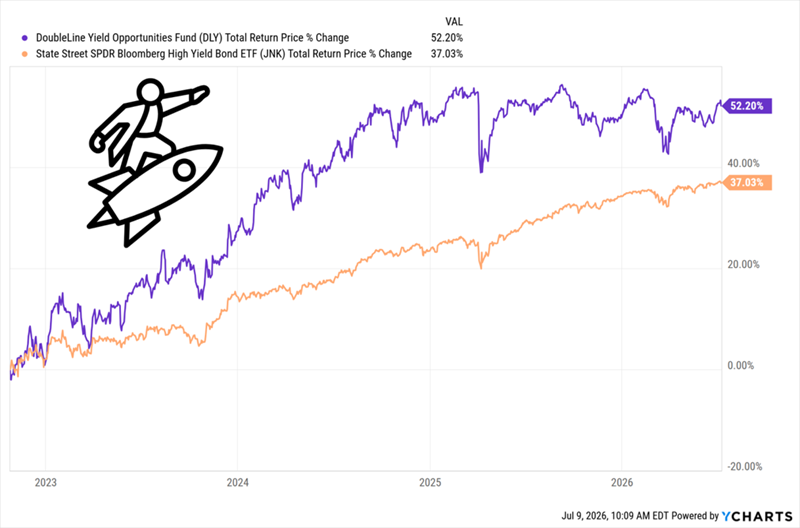
Even so, we can grab DLY at a 7.3% discount today, wider than its five-year average of 5.1%. That’s also cheaper than JNK, which, as an ETF, never gives us a discount.
A Complete “9% Monthly Dividend Portfolio” You Need to Own Now
There’s one more thing DLY shows that I want to build on here: the power of monthly payouts—especially large, steady ones.
Case in point: The huge monthly dividends you get from my “9% Monthly Payer Portfolio.”
With payouts that size rolling in every month, you don’t need to invest seven figures to bring in an income stream that pays your bills—and lets you forget about the market’s daily moves.
After all, when you’re collecting 9% yearly payouts that roll in alongside your bills, you open the door to something we all crave: the ability to retire on dividends alone.
As mentioned, this diverse portfolio yields 9% on average. And the highest yielder of the bunch yields even more: an outsized 14.9%.