
I’m a contrarian at heart—but sometimes even contrarians have to go along with the mainstream opinion.
This (as much as it pains me!) is one of those times. You see, like most of the pundits out there, I expect another strong year for stocks in 2026. I see a roughly 12% gain for the S&P 500 this year, to be exact.
That bothers me. A lot.
I know that four strong years in a row is rare, indeed. But that’s what the data is telling me, and I’m not going to argue with it.
Still Plenty of Cheap CEF Dividends Out There—Even in This “Pricey” Market
Now this doesn’t mean there’s a lack of bargains waiting for us in our favorite income plays: 8%+ closed-end funds (CEFs). Far from it!
The beauty of CEFs is that there are always some of these funds trading at unjustified discounts to net asset value (NAV, or the value of their underlying portfolios).
At times like this, I look for CEFs with deep discounts and strong returns. We love “disconnects” like that because they give us a clear way to ride the stock market’s momentum without buying in at nosebleed levels.
A CEF like the Central Securities Corporation (CET) is a good example. It trades at a 17% discount (so for 83 cents on the dollar, in other words!) while focusing on high-quality public firms with big margins and strong cash flows: Alphabet (GOOGL), Progressive Corp. (PGR) and Amazon.com (AMZN) are its top stock positions.
That makes it a great way to ride another strong market year while gleaning a 5.3% dividend that grows with the fund’s portfolio returns, as management pledges to pay “substantially all net investment income and realized capital gains” as dividends.
But let’s back up for a second, because we need to talk about the data behind my bullish call here, before we get too far into this smartly run fund.
Real-Time Indicator Says Something Shocking
One of the most eye-catching things I’ve seen lately is the Atlanta Fed’s GDPNow indicator, the most up-to-date measure of economic growth we have.
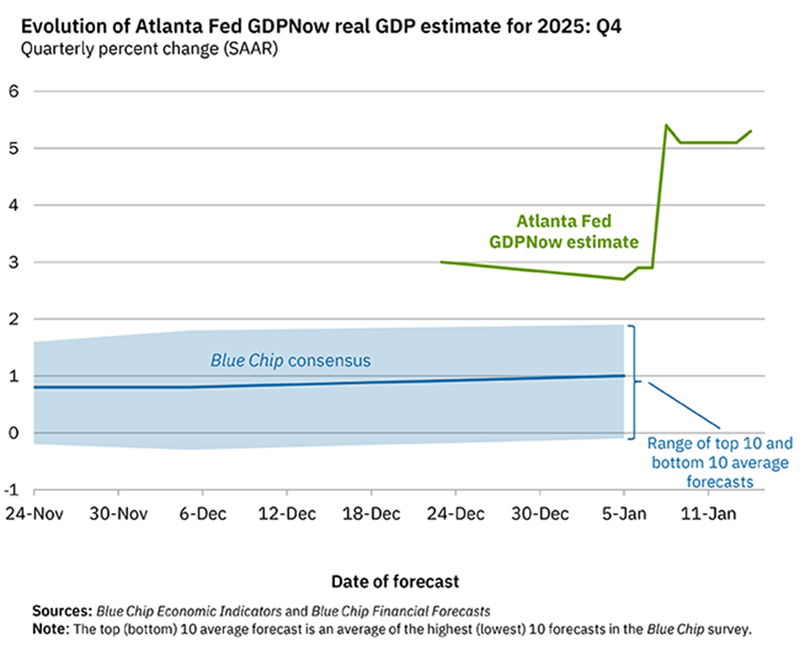
As of now, it’s pointing to an incredible 5% gain in GDP in the last quarter of 2025. That’s far ahead of the roughly 1% growth most economists are calling for.
Now, that 5% call may end up being way too bullish (and, indeed, I expect it to). But the key point is that expectations for growth are strong, driven mainly by big companies investing for the future (yes, AI investment is playing a role here).
More spending on big projects means more money going to other firms and to workers, who then spend in the economy. This, in fact, might explain why our worst economic indicator is suddenly turning around.
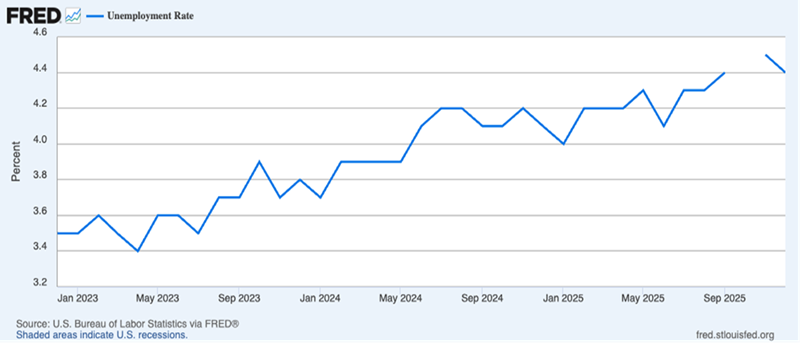
The labor market is the economy’s weak spot now, with unemployment rising since the start of 2023. Note, however, that stocks have soared since, with about a 78% gain in just three years. So this by itself isn’t necessarily bad for the market.
Moreover, as you can see above, the unemployment rate, which peaked at the end of 2025, looks like it’s beginning to fall (the gap in the chart above is due to a lack of jobs data during the government shutdown).
A small move like that does not signify a trend, so let’s look at a couple other labor measures to see if we can get a more complete picture.
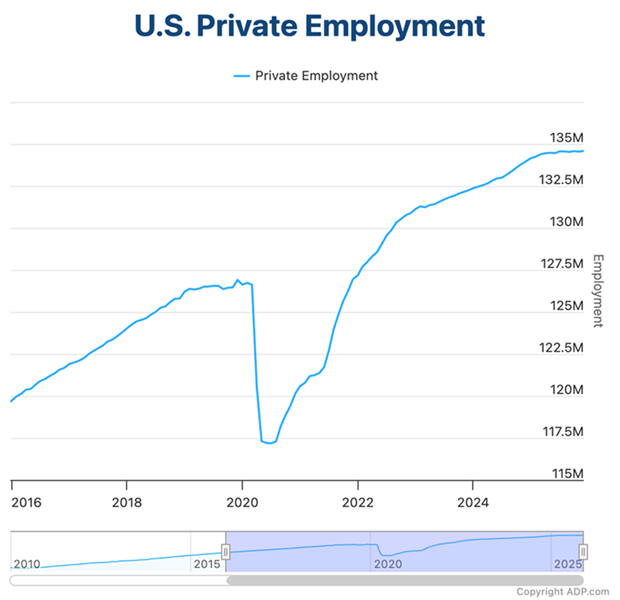
Here we see the total number of people in private employment in the US, according to ADP. Before the pandemic, that was about 126.6 million people, or 38.2% of the population. Afterward, that rose to 134.6 million, or 39.6% of the population.
This data is also a bit noisy, though, and it doesn’t show government-employee numbers. Fortunately, we do have more reliable data on that front.

It’s true that the total number of government employees peaked in mid 2025, but the decline since has been small and had fully transpired by October 2025, when the shutdown and DOGE layoffs took effect. Since then, Uncle Sam’s workforce has started to grow again.
Put together, we see that both public and private labor markets are showing no alarming signs—and these are the biggest risks to the economy in 2026.
To be sure, things could (and likely will at some points) get upset by unpredictable shocks. But there is one predictable shock that could upset stocks: earnings.
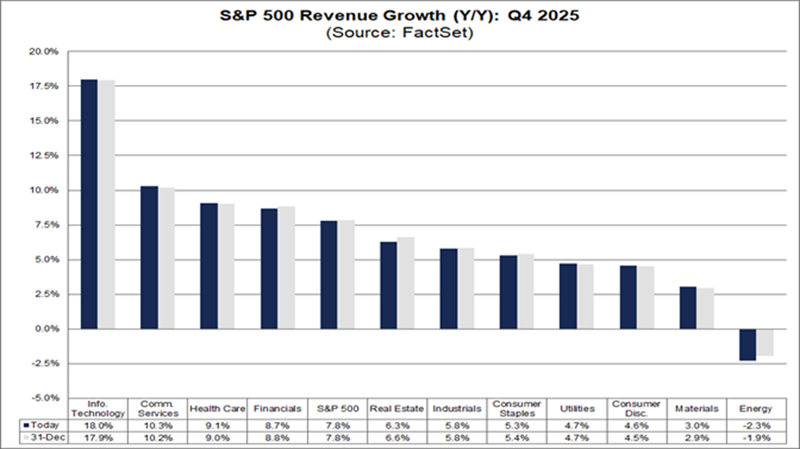
So far, earnings have been okay, but what’s really key is sales, which rose 7.8% across S&P 500 companies in the fourth quarter. That, again, is a sign the economy is doing well.
This brings me back to CET, which has delivered a solid return over the last three years, as markets moved away from the aftereffects of the pandemic and looked more toward the future, including productivity gains from AI.
CET’s Solid Gains
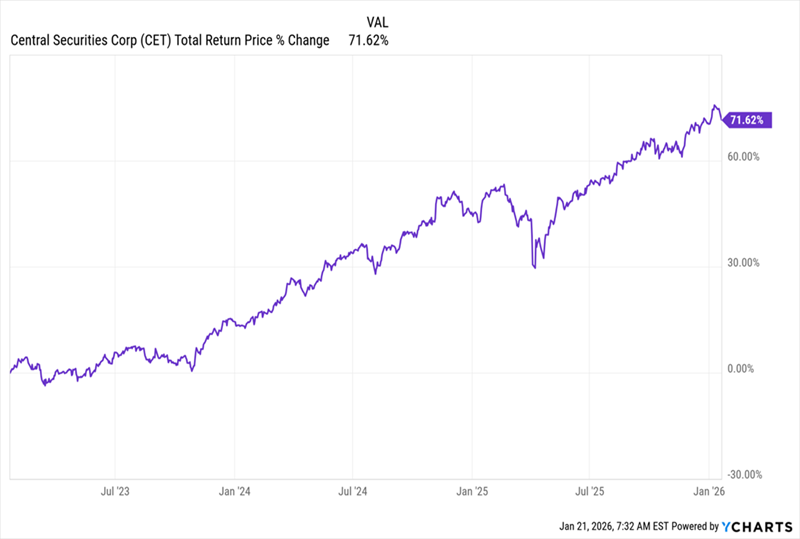
At the same time, CET’s discount to NAV has been unusually generous, although that discount has been fading (in its usual up-and-down fashion) since bottoming out at over 20% about two years ago.
CET’s Big Discount Begins to Evaporate
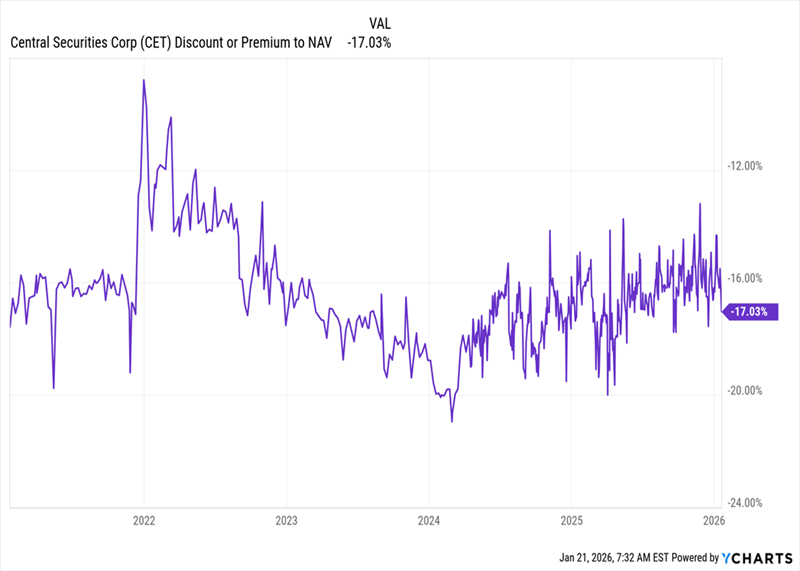
That’s the discount setup I hinted at off the top: a markdown that’s wide now, and has momentum as it moves back toward par.
That sets up the fund to rise with the market in 2026, and to grab an extra bounce from its closing discount. Moreover, we can look forward to dividend growth as management “translates” its portfolio gains into payouts (those payouts typically come as a smaller dividend paid in June and a larger one in December).
And with all signs pointing to another strong market year in 2026, that’s a very sweet setup for anyone looking for income and growth.
These 4 Funds Beat CET, Pay a 9.2% Dividend
My 4 top CEFs to buy in 2026 yield much more than CET—a rich 9.2% between them, and I’ve got them pegged for faster growth this year, too.
Plus they’re diverse—holding stocks, bonds, REITs and more. That gives us critical downside “insulation” against any unexpected market shocks that may come our way this year.
These 4 funds are bargains now, but I don’t expect that to last—especially as interest rates fall and investors go on the hunt for income. Don’t miss out. Click here and I’ll introduce you to these 4 cheap 9.2% payers and give you a free Special Report revealing their names and tickers.