
We’ve got a very nice buy setup in 7%-paying closed-end funds (CEFs) in front of us. Few people realize it.
It stems from the fact that, while stocks have taken a breather after booking strong gains so far this year, many CEFs are lagging more than they should be. The cause? Overdone investor fear around, you guessed it, AI.
That dour mood has set up a particularly interesting dynamic in CEFs holding US stocks:
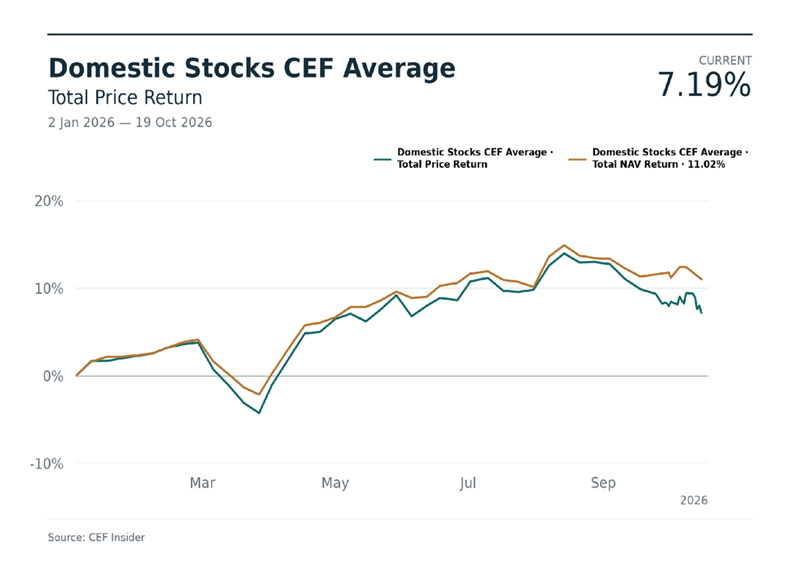
The chart above, from my CEF Insider service, shows that these funds’ average return based on their market prices (in green) is up about 7.2% so far this year. That’s okay, but it’s well behind their roughly 11% returns on net asset value, or NAV—the value of these funds’ underlying portfolios, in other words.
That gap has resulted in attractive discounts to NAV among these funds. The silly thing is that investors should at least be bidding equity CEFs up in line with their portfolios.
As we’ve discussed recently, corporate earnings and revenue are up sharply and are expected to keep rising. Equity CEFs’ returns based on market price should reflect that—and a 7.2% return on the year just doesn’t cut it.
4 Popular (for CEFs!) Equity Funds, Ranked
The thing to bear in mind is that not all discounted equity CEFs are attractive, and some of their discounts are well-deserved. It’s up to us to separate the contenders from the pretenders.
With that in mind, we’re going to examine four high-yield CEFs you may have heard of. All focus on equities and all sport high payouts. But only one is a buy.
They are the 23.7%-yielding (!) BlackRock ESG Capital Allocation Term Trust (ECAT); the 10.9%-paying Gabelli Utility Trust (GUT); the BlackRock Technology and Private Equity Term Trust (BTX), with a 7.3% yield; and the BlackRock Science and Technology Term Trust (BSTZ), which yields 7.1%.
These funds all have their specialties, but that’s not what we’re going to focus on here. Instead, we’ll base our analysis on the recent movements of their discounts to NAV:
GUT’s Shocking Premium
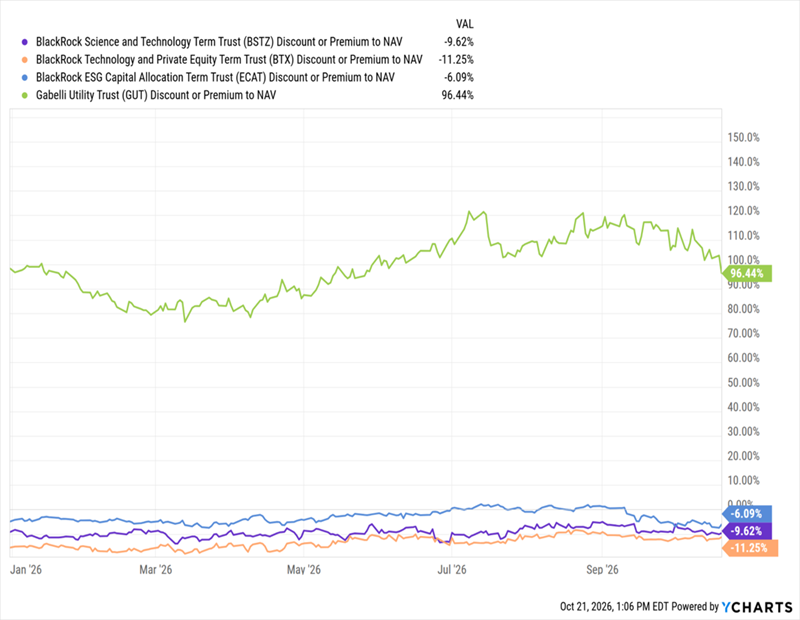
I’m going to start with GUT (in green above) because it’s the obvious standout here, with a sky-high 96.4% premium to NAV.
GUT is a utility fund that holds some of the biggest power generators in the US, including NextEra Energy (NEE), Duke Energy (DUK) and Wisconsin-based WEC Energy Group (WEC).
Income investors (me included) love utilities. They are, after all, a lower-risk way to generate income and potential upside. But we don’t love them so much that we’d pay nearly $2 for every $1 of assets! But that’s what anyone who buys GUT now is essentially doing.
So our first elimination is an easy call: Dramatically overpriced GUT is out.
That leaves ECAT, BTX and BSTZ. Two of these—BTX and BSTZ—are highly tech-focused, as their names suggest. If you’re worried about tech because it’s been falling faster than other sectors, I’d urge you to reconsider. Because historically, tech pullbacks have more often than not been buying opportunities.
But even if you want to buy ECAT to avoid tech, I’d still say you’re out of luck. For one, its top-three stock holdings are NVIDIA (NVDA), Alphabet (GOOGL) and Taiwan Semiconductor Manufacturing (TSM). So even though ECAT doesn’t have tech in its name, it’s still a tech-heavy fund.
There is another concern here: ECAT’s absurdly high 23.7% yield is quite simply unsustainable. The fund’s 9% annualized total return since its IPO is far short of the profit needed to maintain payouts.
One reason why that return is likely to stay low is the fund’s ESG mandate, which requires that 80% of its assets be in assets that fit the fund’s environmental, social and governance requirements. Politics aside, this requires an extra level of research and oversight that is not free, and those costs weigh on returns.
More worrying, ESG has been falling out of favor even among investors politically aligned with ESG goals, which is likely going to drag demand on the fund and keep its discount from closing.
These aren’t the only reasons ECAT has relatively weak portfolio returns, though.
Tech “Latecomer” ECAT Lags the Pack
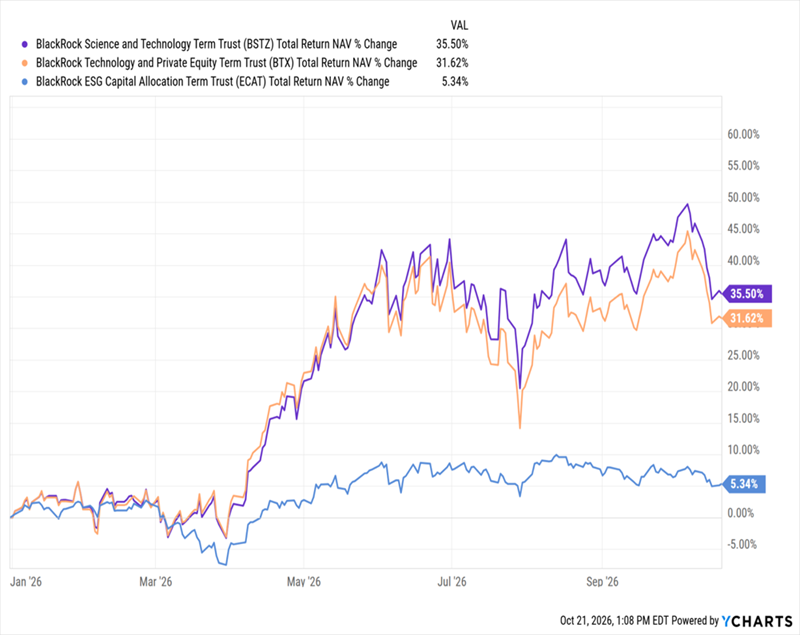
If we look at the last year’s total NAV return for each fund, we see a problem with ECAT (in blue above): Its fundamentals are weak compared to those of BTX (in orange) and BSTZ (in purple). This is a concern with ECAT: It has been pivoting to tech recently, to follow the trend, and it’s done that only after the trend was apparent.
This isn’t the biggest red flag, because sometimes an asset manager dips into an opportunity slowly, out of caution. But the CEF market can punish that slow action by giving the fund a bigger discount.
BTX’s Discount Widens. It’s Still Not Cheap Enough
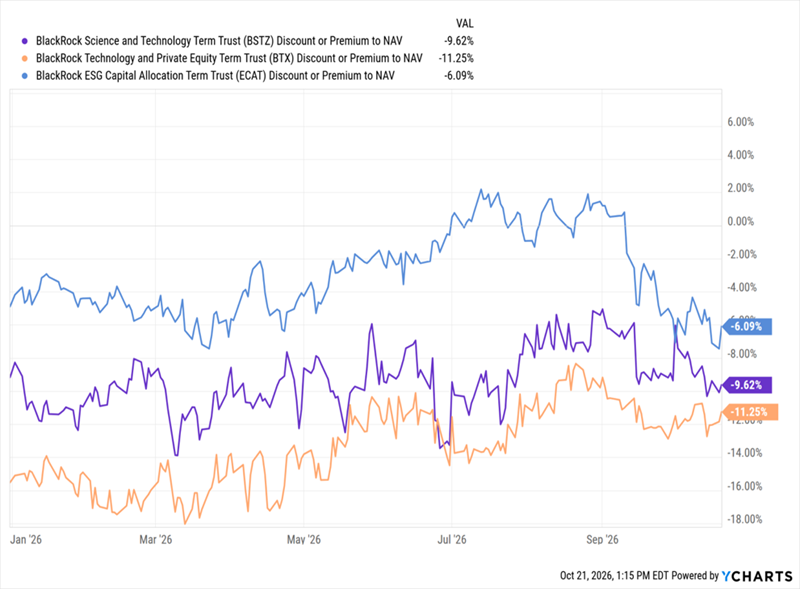
This should have happened naturally with ECAT, as equity CEFs’ NAV returns outpaced their returns based on market price. And it did—but only to a point. The blue line in the chart above shows that this fund traded at a slight premium a little over a month ago, and that premium has now evaporated, with a steep drop to a 6% discount.
But that discount is still less generous than those of BSTZ (in purple) and BTX (in orange). This suggests the market hasn’t fully priced in ECAT’s weaker fundamentals, setting up the risk of its discount widening in the coming weeks and months.
So ECAT is out.
If we look just at the BTX and BSTZ discounts above, something else becomes clear: They look like they’re stabilizing, and perhaps shifting back to narrowing, with a 9.6% discount for BSTZ and 11.3% for BTX—narrower than they were just a few days ago.
So which one are we picking here? Ultimately, the one whose discount has greater momentum.
In the case of BSTZ, its current discount is around where it was at the start of the year. That’s not bad, but we want to buy discounts that are still wide but boast momentum.
And that’s where BTX wins. Its current 11.3% discount is still attractive, and it’s heading the right way: much narrower than the 15.5% at which it started the year. That suggests the discount could keep narrowing as this latest round of tech panic fades, putting upward pressure on BTX’s share price.
5 Real CEF Bargains Paying 9.2%, Monthly
As we just saw, not every discounted CEF is a buy. Some, like GUT and ECAT, are traps, with unsustainable yields, sky-high premiums—or both.
These are the kinds of funds CEF Insider flags right away. Every month, I do the digging for you and only send you the tickers to buy for high, sustainable CEF dividends. (I also tell you when it’s time to sell).
I’ve zeroed in on 5 monthly-paying funds yielding 9.2% on average, several of them trading below NAV. That gives us income now, plus upside as their discounts close.
On a $500,000 portfolio, a 9.2% yield works out to about $3,833 a month in dividends. And you can get this monthly income stream without having to sell a single share.
I’ve put all 5 in a free Special Report, 5 “Must-Own” Monthly Dividend Funds Yielding 9.2%.
Click here and I’ll tell you more about these 5 high-yielding monthly payers. You’ll also get your own copy of this Special Report and the chance to try CEF Insider—and get immediate access to its complete portfolio—for 60 days.