
There are three stories moving markets right now:
- The Iran War.
- The AI revolution, as heavy investments in the tech cause both excitement and worry, particularly around how AI affects software companies.
- The private-credit market. Because many software companies relied on credit from private, non-bank lenders, the world of private credit (which went from about $500 billion a decade ago to about $3 trillion today) is wobbling.
All three are combining to put pressure on private-credit funds. That, of course, is a headache for private-credit investors, especially because they were marketed on the idea that they offer lower volatility.
We are now seeing managers of private-credit funds field redemption requests that exceed these funds’ withdrawal “caps.” (They’re officially “semiliquid,” allowing for withdrawals up to a certain limit, though their redemption policies vary.)
In other words, the key flaw of these funds is now out in the clear light of day—and it’s one that most investors probably didn’t even read.
Situations like this are exactly why we prefer closed-end funds (CEFs) for generating high, predictable and often monthly paid dividends. In a moment, we’ll talk about one that gives us liquidity, a high dividend and lets us participate in the growth of private firms, too. Plus it trades at an unusual (and in my view temporary) 9.2% discount to net asset value (NAV, or the value of its underlying portfolio).
That liquidity point is key: CEFs trade on the public markets, like stocks, and are subject to the same regulatory requirements as any other publicly traded entity.
And the dividends on offer are exceptional—an average yield around 9%. And with around 400 CEFs out there, investing in everything from stocks to convertible bonds, you can build an income stream backed by a diverse portfolio. That’s something private-credit funds simply can’t offer.
A good example of this at work is BlackRock Science and Technology Term Trust (BSTZ), a holding of my CEF Insider service that yields 8.8% as I write this. And, yes, BSTZ trades at that 9% discount I just mentioned.
The beauty of a yield that size is that it’s high enough to let us avoid selling into a downturn, since we can simply collect it while we wait for the storm to pass.
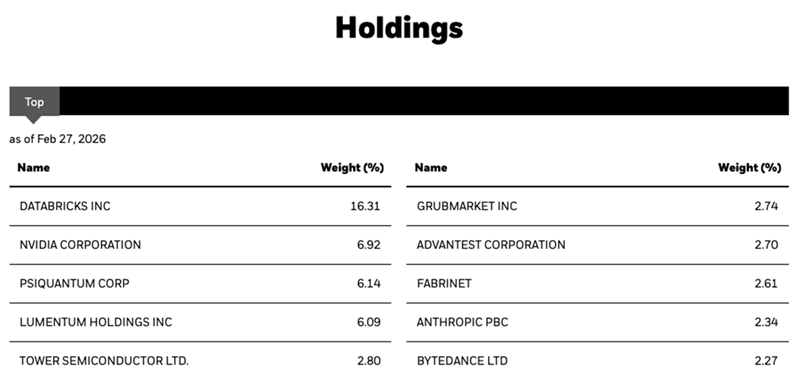
BSTZ’s top holdings (which as the name says, are tech-focused) help drive that dividend, with management timing their buys and sells, then handing over the gains to us in cash.
Source: BlackRock
As you can see above, the fund holds well-known publicly traded tech stocks like NVIDIA (NVDA) and Tower Semiconductor (TSEM) alongside growth private tech firms like ByteDance (the company behind TikTok) and Anthropic (maker of the AI chatbot Claude).
In other words, BSTZ gets us the best of both worlds: access to top publicly traded tech stocks and growth-focused private tech firms—all while maintaining liquidity for us. Now let’s turn back to the dividend:
Big Payouts From Big Tech
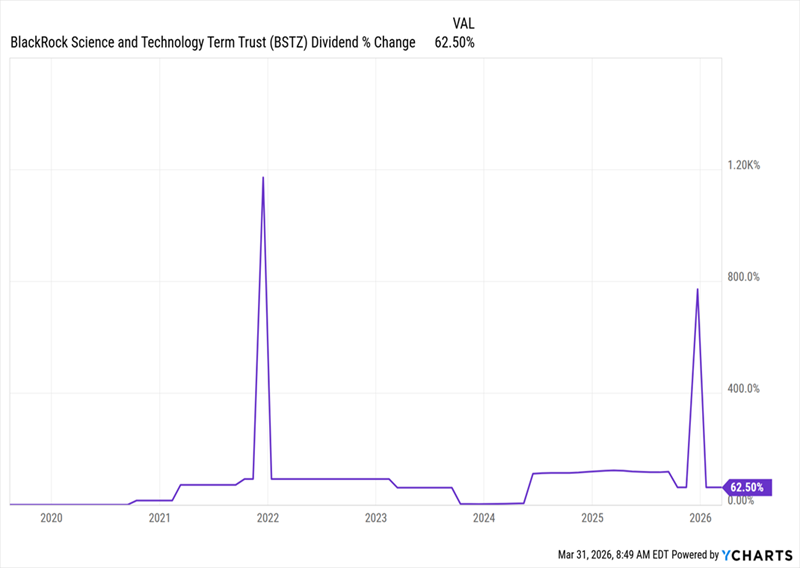
As you can see above, while BSTZ’s regular payout has moved around somewhat, management has grown it by nearly 63% in the last decade, as the tech sector has grown—a trend I see continuing as AI continues to move out from the tech sector and into the broader economy.
That’s in addition to the big special payouts management has offered (the spikes in the chart above). There’s another aspect of BSTZ’s portfolio that’s key, too: Its private-company investments are equity, not loans. That lets us directly benefit from these companies’ growth, and it’s not the case with private credit, where investors take on the risk of the creditor struggling to repay the loan without fully participating in their growth if they succeed.
This is why private credit funds have struggled, while those that mix public and private equity have performed well.
Finally, let’s talk about BSTZ’s discount to net asset value (NAV, or the value of its underlying portfolio). Below is a chart of both the fund’s market price–based return (in purple) and its NAV return (in orange). (The fact that a CEF can trade at different levels in relation to its holdings is a unique benefit of these funds.)
BSTZ’s Portfolio Outruns Its Market Price …
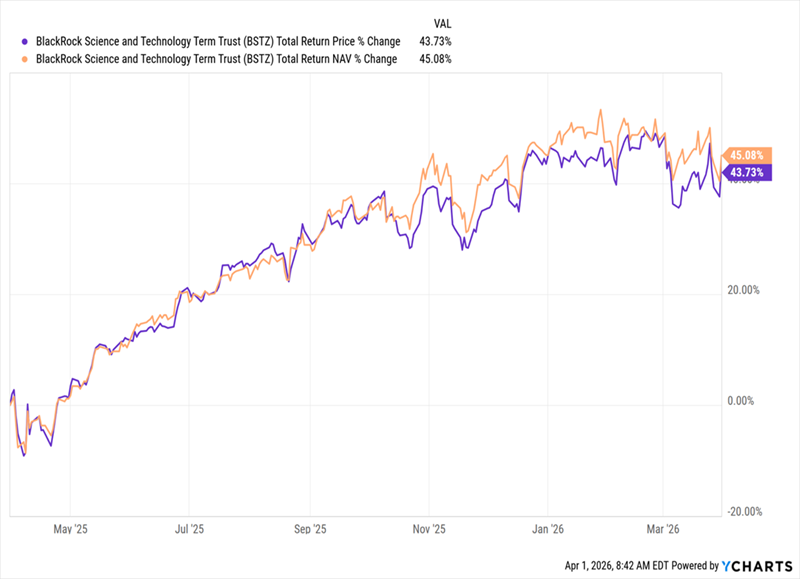
As you can see, BSTZ’s total return based on market price is up 45.1% over the last year, while its total NAV return is up 43.7%. That gap doesn’t sound like much, but it’s enough to give the fund that 9.2% discount to NAV:
… Giving Us an Attractive Discount
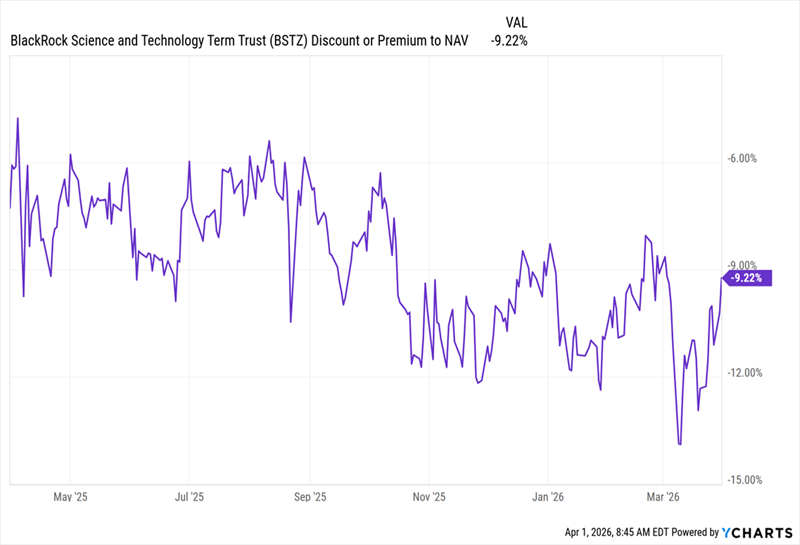
That gap between NAV and market price has resulted in that 9.2% discount on the fund, despite its strong gains over the last year.
This gap exists because fearful investors have discounted just about everything these days, as markets remain unpredictable. But the key thing to remember is that the average discount among CEFs is now around 7%, so BSTZ is overly discounted, despite its strong one-year return.
That’s a sweet setup that lets us take advantage of private-credit woes, grab stakes in the growth of public and private tech firms and get a steady dividend. I don’t expect BSTZ’s discount to stick around for long, but even if it does, those who buy now will get paid handsomely to wait.
BSTZ Pays Dividends Monthly. So Do These 5 Funds (and They Pay More)
BSTZ isn’t the only monthly paying fund I’m pounding the table on. I’ve assembled 5 other CEFs that pay even more on average—I’m talking about a 9.7% dividend—and pay dividends monthly, as well.
Think about that for a moment: With these 5 funds, you’re getting paid around 5 times a month. That’s a total of 60 dividend payouts a year!
I’ve put all 5 of these reliable monthly payers together in a “mini-portfolio” all their own. I’m urging all investors to take a close look at it now.
Oh, and there’s more for us here than “just” that 9.7% average payout. Like BSTZ, these funds also trade at big discounts, putting strong upside on the table, too.
Now is the time to buy them and start your 60 “paycheck” income stream. Click here and I’ll tell you more about these 5 stout monthly income plays. I’ll also give you a free report revealing their names, tickers and my full analysis of each one.