
Investors are flipping back into buy mode, which has been a boon to the equity funds we hold at my CEF Insider service—especially on the tech side.
Our position in the BlackRock Technology and Private Equity Term Trust (BTX) is a good example. We bought this closed-end fund (CEF) in late February—the day before the Iran conflict started—and it’s already returned around 25% for us as of this writing.
BTX Pops On Our Latest Recommendation
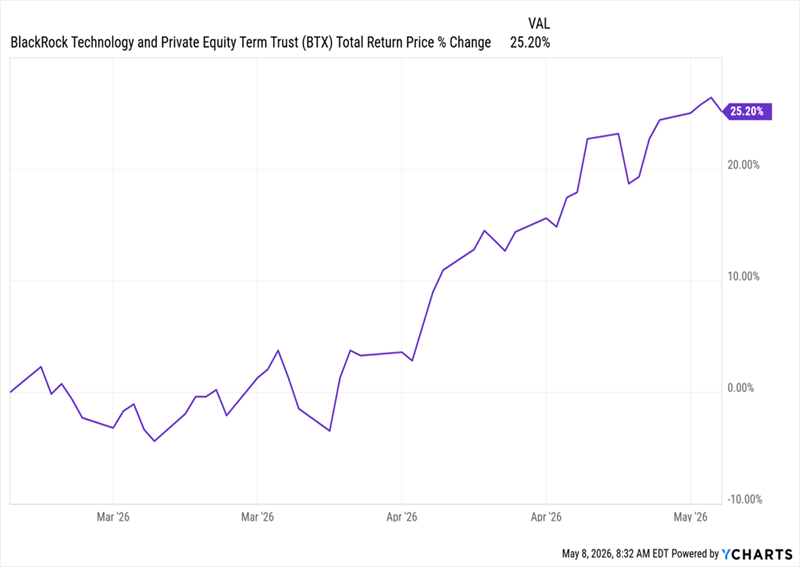
This monthly payer has only issued one dividend in that time! When we bought, it yielded around 9.5%. That’s down to 7.7%, as current yields move down as prices rise.
Moreover, that dividend is even safer than it was when we bought, since BTX’s net asset value (NAV, or the value of its underlying portfolio) gained roughly the same amount, which is enough to cover its current yield multiple times.
That’s the kind of rise we love to see in a CEF. Even better, the fund’s discount to net asset value (NAV) sits at around 15% now, roughly where it was when we bought. This tells us that our 25% return is driven solely by the fund’s portfolio of tech stocks, which were oversold back in February.
The fact that its discount is still wide means we still have some upside ahead as investors bid it closed.
The 6.6% Income Play That Lets Us “Anchor” Big Tech Gains
When you consider that CEFs yield 7% on average right now, you can see the power of reinvesting a gain like that, and further building your income stream.
It also pays to “anchor” your more aggressive funds (like BTX) with steady, lower-volatility options—especially those that offer reliable, tax-free income backed up by state and local governments.
Those would be municipal bonds—issued by states, cities, counties and other arms of government, such as school districts. These agencies use the proceeds to fund public projects, mainly infrastructure like schools, bridges and toll roads.
The best way to hold municipal bonds is through CEFs. Today we’re going to take a close look at three: the RiverNorth Flexible Municipal Income Fund II (RFMZ), which, yields 7.3% as I write this; the Neuberger Berman Municipal Fund (NBH), which pays 6.3%; and the PIMCO Municipal Income Fund II (PML), a 6.2% yielder.
That’s a 6.6% average yield—far more than the average stock pays and about the same as the yield on the typical high-yield corporate-bond fund (which, of course, entails higher risk than a municipal-bond fund).
It gets even better when you consider that the dividends paid by munis (and muni-bond CEFs) are tax-free for most Americans. Factor that in and your taxable-equivalent yield rises significantly. For those in the highest tax bracket, for example, that 6.6% could flip to 9.7%, according to Bankrate’s taxable-equivalent yield calculator.
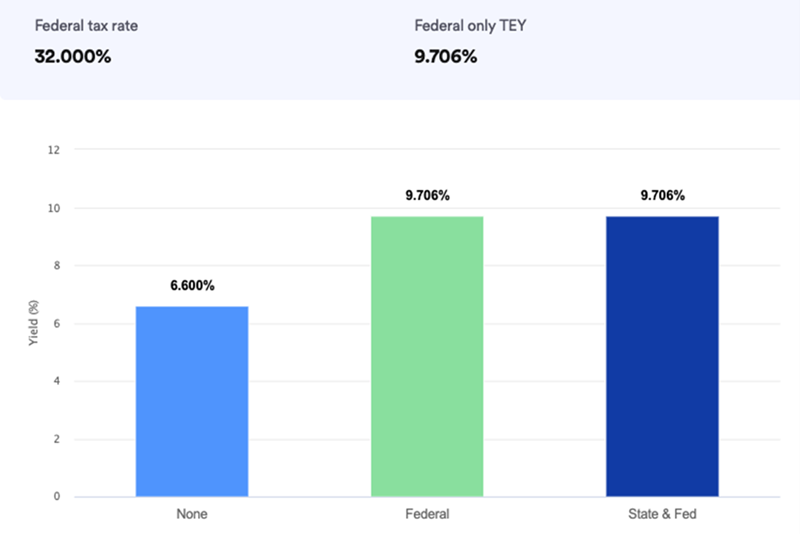
Source: Bankrate.com
Then there’s the safety factor: There are strict regulations in this market, and meticulous care is put into ensuring these bonds do not default. This is why only about 0.1% of muni bonds do so over the long haul. More recently, that rate has been lower.
We can cut our risk even further by buying municipal-bond funds containing hundreds of such issues. Since these funds are actively managed, we can be sure that our diversified muni-bond portfolios are analyzed by a pro, too.
Another way we can hedge our downside, and build in upside potential, is to target muni-bond CEFs trading at wide discounts to NAV. Which is exactly what we get with this trio: as I write, RFMZ trades at a 9.6% discount, so we’re essentially paying 90 cents for every dollar of its assets. NBH is our next-cheapest option, at a 7% discount, followed closely by PML’s 6% markdown.
Those discounts are available to us for two main reasons:
- The move toward riskier assets (the AI trade, in other words) has drawn investor attention away from “boring” assets like munis.
- Higher interest rates have reduced the value of older muni bonds as new ones are issued at higher rates. That’s weighed on muni-bond funds in the last few years. But at current discount levels, I see this factor as already priced in.
That leaves us with a nice time to add to our muni holdings, because when the next panic inevitably arrives, it will drive up interest in high, steady, tax-favored payouts like these. The same thing will happen when rates move lower, making a 6.6%+ tax-free yield look a lot more attractive to income seekers.
When either of those conditions are met, a high earner who bought today will already be sitting pretty, having collected their 9.7% taxable equivalent yield and getting set for their capital gains accrue as their muni-bond funds’ discounts start to disappear.
Do This to “Anchor” Tech Gains Even More (and Get Paid Monthly, Too)
As contrarians, we love to go where the mainstream isn’t. That’s the core of our muni-bond CEF play here.
There are plenty of other overlooked dividends on the board now, too, as the herd refocuses on the AI trade. Like monthly dividend CEFs.
Few people realize it, but most CEFs pay monthly—and I’ve hand-picked 5 that have been left behind in the last few weeks. Their discounts are wide, their yields are high (I’m talking 9.7%+ here), and, of course, they pay dividends monthly.
As AI’s rapid growth prospects become more normalized in the coming months, I expect more investors to look to other options, including high-yielding monthly payers like these five. The time to act on them is now.
I’ve prepared a webpage that tells you more about this ignored (for now) 9.7% monthly dividend opportunity. You can read it right here. You’ll also get a free Special Report revealing these funds names, tickers and my analysis of each one.