
These worries around private credit are giving us CEF investors a nice “bonus”: They’re throwing a very positive light on our favorite 8%+ income plays.
After all, the CEFs we hold in the portfolio of our CEF Insider service offer transparency, high (and often monthly paid) dividends and attractive discounts, too, in part due to geopolitical worries.
We’ll get to a specific bond fund that’s giving us a generous discount and an 11.6% dividend in a moment. First, let’s take a closer look at what’s really happening with private credit, and the opportunity that concerns around it are setting up for us now.
Inside the Private-Credit Drama
Here’s the key difference between private credit and the bonds held by our CEFs: Our funds’ holdings are far more transparent. Their assets tend to be publicly traded, with prices that are easily accessible by the general public.
Private credit, on the other hand, tends to be tougher to value, as these loans are not traded regularly. That can create a false sense of security among some investors, who may feel that just because a loan’s market price doesn’t change regularly, its actual resale price on an open market wouldn’t change, either.
Some billionaires see opportunity here: Activist Boaz Weinstein, for example, is taking a break from targeting CEFs to go after private-credit funds, offering to buy out shareholders at big discounts to these funds’ NAV.
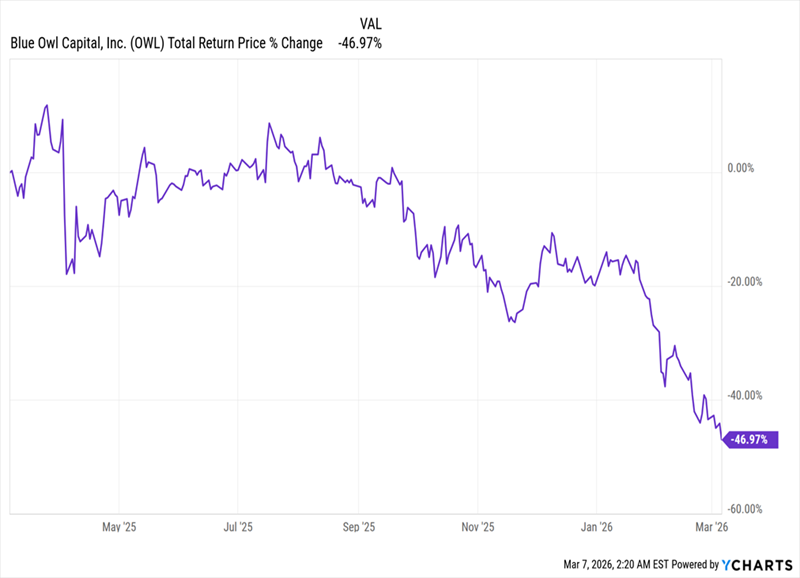
His moves are justified: Private-credit mainstay Blue Owl Capital, for example, recently halted redemptions in a fund that holds billions in private loans, causing the firm’s shares to plummet.
Private-Credit Poster Child Collapses
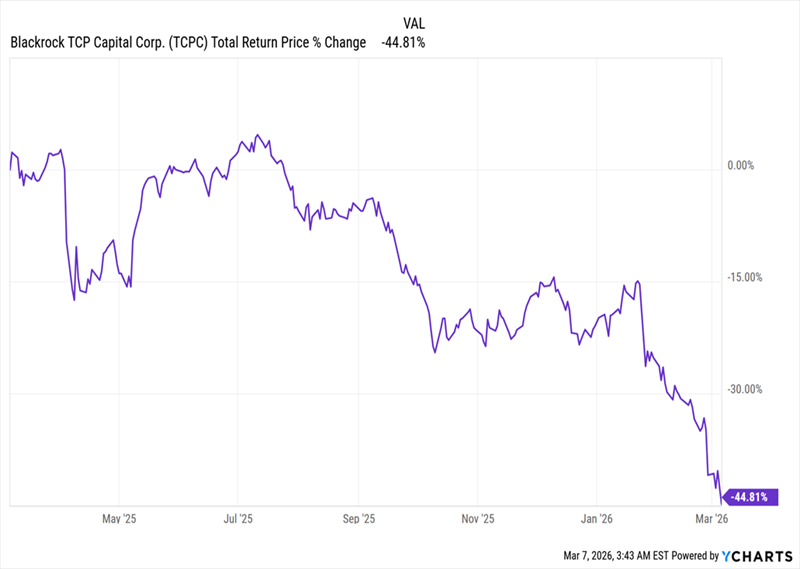
Meanwhile, BlackRock limited withdrawals from its $26-billion HPS Corporate Lending Fund, while elsewhere marking down a loan from 100% of its presumed fair market value to zero in months. The firm also cut the dividend on the BlackRock TCP Capital Corp. (TCPC) fund, causing that fund’s shares to crater, even as they were already falling.
TCPC Drops on Dividend Cut
Private-credit worries have caused downward pressure on business development companies (BDCs) more generally. These lenders issue loans to small- and mid-sized firms. And since BDCs get a pass on corporate tax if they hand at least 90% of their income to investors as dividends, they tend to offer high yields (hold that thought for a moment).
Consider the VanEck BDC Income ETF (BIZD), a good BDC benchmark, which yields around 13% now. Over the past year, though, BIZD’s total return has declined about 16%, as of this writing.
This shows that, when it comes to BDC investing, we need to be selective, since the small- and mid-sized companies these firms lend to are riskier than larger businesses.
But let’s bring this back to CEFs. What I really want to highlight here is the fact that weakness in private credit stands to push income investors toward CEFs. That goes double for funds holding highly transparent corporate bonds.
That’s because these funds can go toe-to-toe with any asset class when it comes to dividends. Consider the Nuveen Core Plus Impact Fund (NPCT), a CEF Insider holding that currently yields 11.6%. That payout comes our way monthly, too.
Yields like that are likely to catch the attention of investors looking for alternatives to private-credit funds. And here’s something else that stands out about NPCT as an alternative to private credit: The fund gives us its value every day through its public discount to net asset value (NAV, or the value of its underlying portfolio).
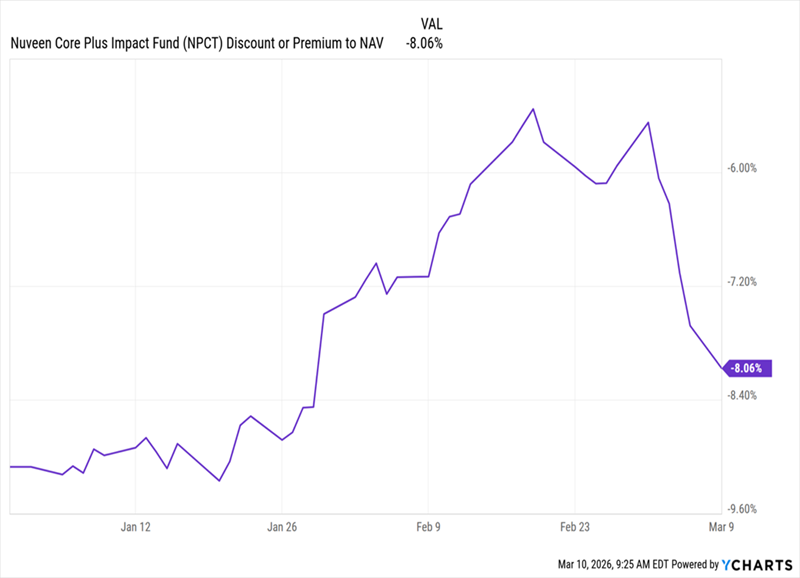
As I write this, the fund trades at an 8.1% discount to NAV, much wider than the 5.5% discount it offered prior to the start of the war in Iran:
NPCT Goes on Sale
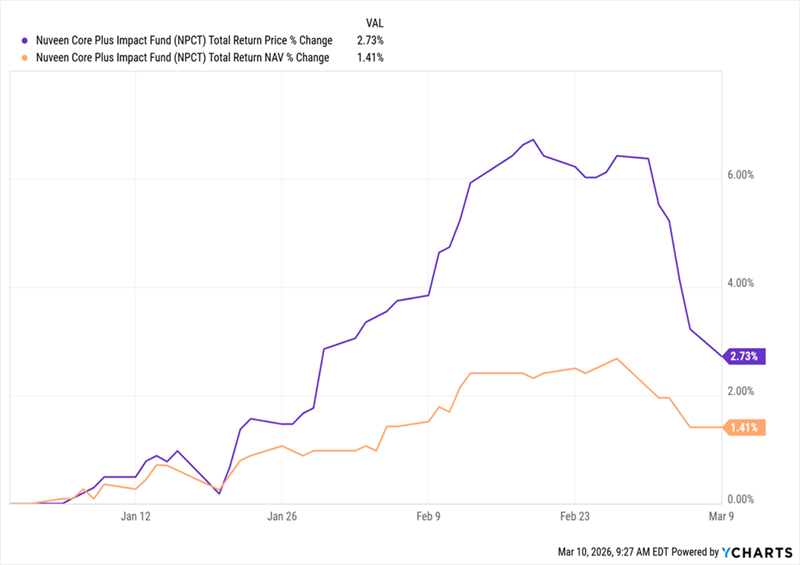
And as we can see below, this discount is almost entirely sentiment-driven: While the fund’s market-price return (in purple) has declined, its underlying portfolio value, including dividends collected (or total return NAV) has held steadier:
Sentiment, Not Portfolio Value, Gives Us a Deal on NPCT
That’s the kind of setup we love—and it’s why I continue to recommend NPCT. I expect some private-credit investors may feel the same in the near future, if they don’t already.
My 5 Top Monthly Dividend CEFs Pay Out 60 Times a Year (and Yield 9.3%, Too)
NPCT is just the start. Truth is, high-quality corporate-bond CEFs are at the heart of my “60 Paycheck Dividend Plan.”
As the name suggests, the 5 CEFs that make up this plan each pay dividends monthly. That’s 5 dividend payouts a month, or 60 every year! They throw off a 9.3% average dividend, too.
I’ve put all 5 of these monthly payers together in a “mini-portfolio” all their own. I’m urging all investors to take a close look at it now.
Oh, and there’s more for us here than “just” that 9.3% average payout. These funds also trade at unusual (and undeserved) discounts, putting strong upside on the table.
Now is the time to buy them and start your 60 “paycheck” income stream as soon as possible. Click here and I’ll tell you more about these 5 stout monthly income plays. I’ll also give you a free report revealing their names, tickers and my full analysis of each one.