
Stocks are up, and the media is finally coming around to what we’ve been saying at my CEF Insider service for months now.
Last week, The Economist wrote a breathless piece about how the US economy is firing on all cylinders—and fears that a recession will sideswipe stocks are just plain wrong.
We’re happy to see a leading publication like The Economist come around on this point, of course. Even better, we now we have the data to prove it:
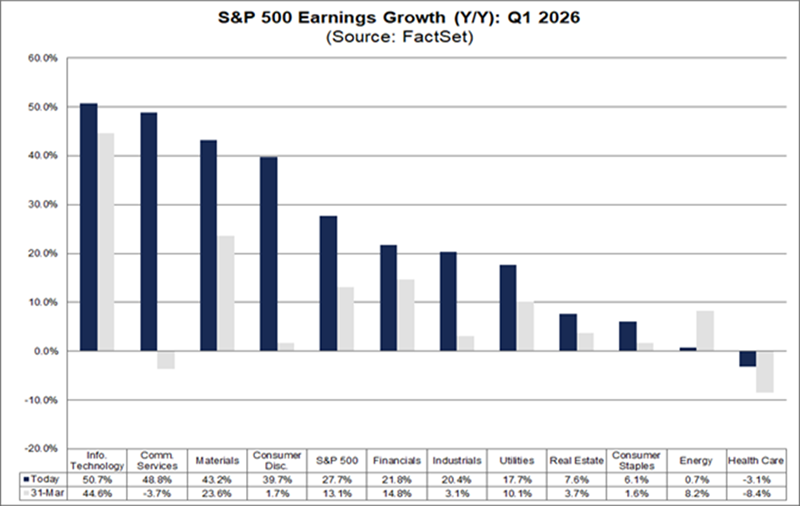
Across the board, the S&P 500 saw a 27.7% earnings gain in the first quarter. That’s shocking when, historically, profits have risen in the 5% to 8% range.
So it should come as no surprise that the S&P 500 benchmark State Street SPDR S&P 500 ETF Trust (SPY) has gained nearly 9% this year, as of this writing. It should also be no surprise that the tech-focused NASDAQ, as tracked by the Invesco QQQ Trust (QQQ), is up around 15%. The numbers tech firms are putting up are nothing short of jaw-dropping:
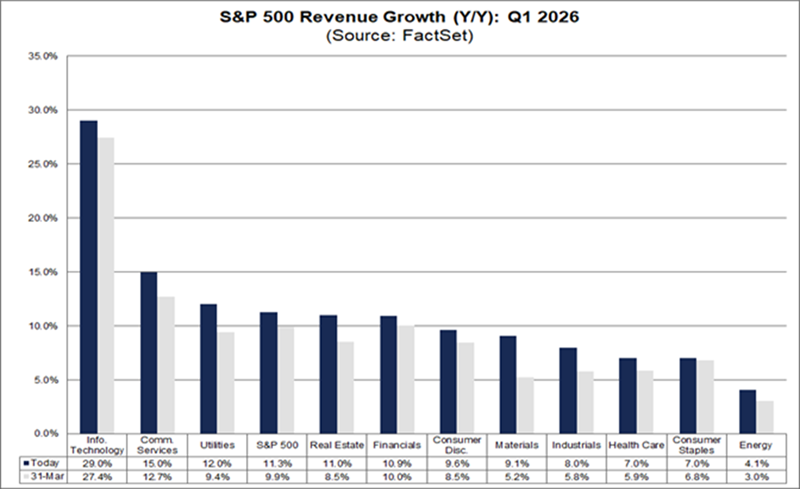
Take IT, where earnings are up 50% from a year ago, while sales (shown in the chart above) have spiked 29%. Communication services, which includes companies like Alphabet (GOOGL) and Meta Platforms (META), has also seen profits pop 48.8% on 15% higher revenue.
These big gains should put an end to bubble fears: They clearly show that the market’s strength is backed by profit and sales growth. And that’s before we talk about stock valuations, which give us one of the clearest indications this market is not in a bubble:
Earnings Pop, Valuations Drop
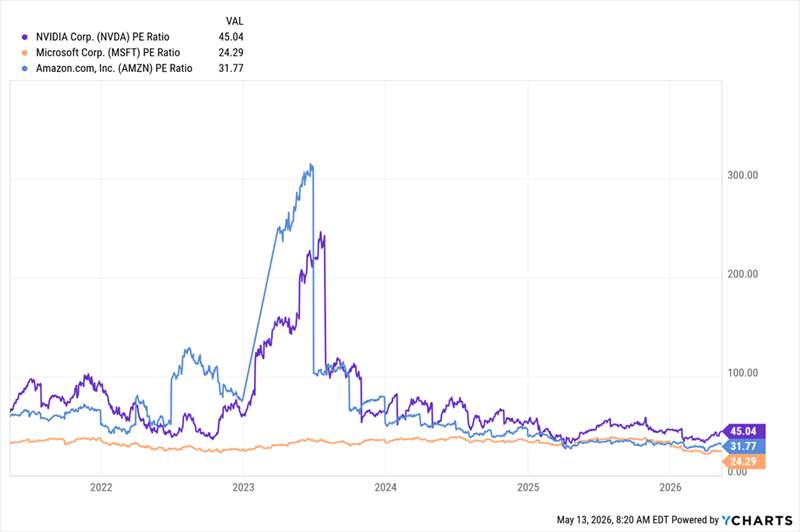
Here are the price-to-earnings (P/E) ratios of three of the biggest public companies in the AI world over the last five years: NVIDIA (NVDA), in purple; Amazon.com (AMZN), in blue; and Microsoft (MSFT), in orange.
While these stocks have what might be considered “high” P/E ratios compared to the market average, those ratios aren’t skyrocketing. Indeed, they’re falling as earnings rise and investors take a more rational view of these companies.
In fact, the chart above shows us that the “bubble” really occurred in 2023, and it didn’t pop. It slowly deflated, thanks to earnings rising, rather than prices falling.
Too Late? No Way. This Run Is Just Getting Started
Of course, looking at stocks’ gains lately, you might feel it’s too late to buy. That’s understandable. But let’s take a closer look at what’s happened in the last five years, with SPY again in purple and QQQ in orange:
Big Gains, Most of Them Recent
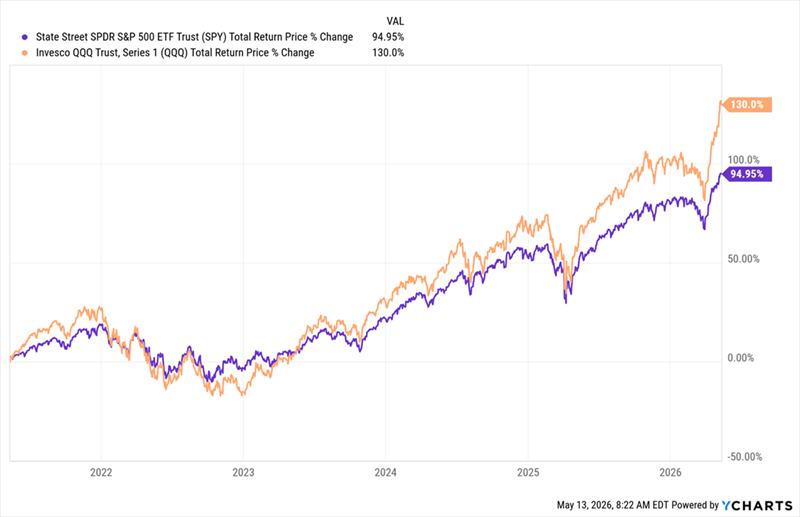
The recent jump in stocks is partly due to fresh AI-driven productivity gains—that’s the spike on the right side of the chart. But if we strip out that pop, what we really see is a rational recovery from the irrational 2022 selloff, not a bubble.
The 9.4%-paying closed-end fund (CEF) we’re going to talk about next is the perfect way to take advantage of this situation. It comes our way at a discount that should go a long way toward easing any bubble fears you may have. But there’s more to this high-yielding investment vehicle than just that.
The 9.4% Dividend Play
I’m talking about a CEF called the Neuberger Berman Next Generation Connectivity Fund (NBXG).
NBXG, as the name suggests, holds tech stocks. Its top holdings include Meta, Amazon, Microsoft, Taiwan Semiconductor (TSM) and NVIDIA. That tech lean has resulted in a triple-digit total return in the last three years:
NBXG’s Strong 3-Year Run
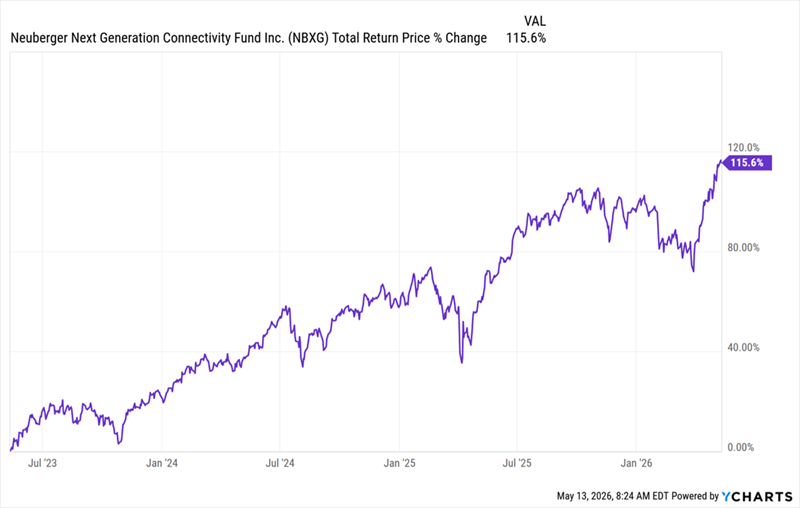
This is a much better proposition than buying an index fund like SPY, which yields around 1% now. NBXG, with its 9.4% payout, cuts the need to sell into a downturn if you need to tap your investment for cash. That’s our first reason why we see this fund as attractive now, even if you’re worried you’re late to the party. The second reason is more important, and more subtle.
NBXG Gets Cheaper—Even as It Surges
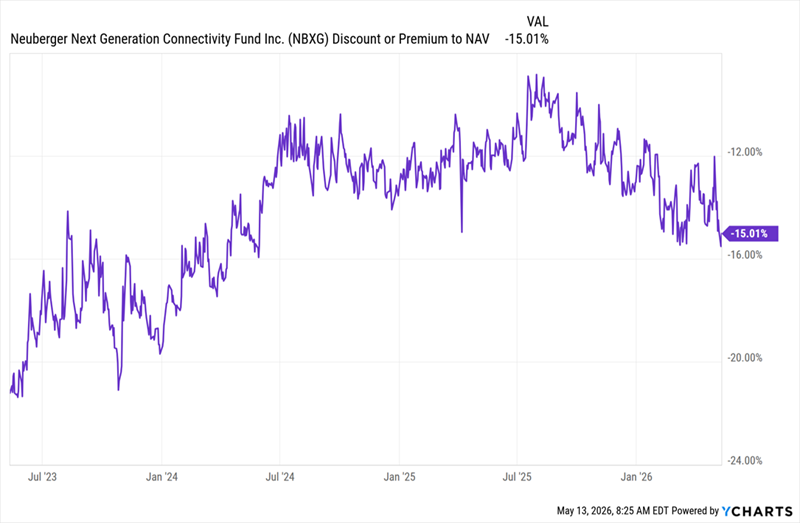
As we saw with individual tech stocks above, NBXG is getting cheaper, going by its discount to net asset value (NAV—the key valuation measure for CEFs) while it delivers bigger returns. Except here, the effect is more pronounced.
With a 15% discount, we’re getting NBXG’s portfolio for 85 cents on the dollar. That gives us more upside potential and more downside insulation if the market hits a speed bump. It also means the fund’s 9.4% dividend is very sustainable (and positioned to grow).
Here’s why: As I just mentioned, NBXG yields 9.4%. That’s calculated on the CEF’s per-share market price. But remember that this price is discounted 15% from NBXG’s NAV, or its portfolio value.
If you calculate the fund’s yield on NAV, you get a much lower number: around 8%. This means management needs to earn 8%—a much lower bar than 9.4%—to keep the payout steady.
NBXG’s return in the last three years is far more than enough to do that. In fact, its return is so large that it puts another dividend hike on the table (after management already raised the payout 20% with the October 2025 payment).
That potential payout hike caps off a solid package: An investor buying NBXG today gets a portfolio of stocks with rising sales and profits, held in a fund that growth “translates” that into a 9.4% dividend (paid monthly). All of this comes at a discount, to boot.
And NBXG is just one of the funds we’re looking at to profit from the productivity boom AI is spurring.
5 Urgent CEF Buys That Are Even Better Deals Than NBXG
I’ve pulled together 5 other CEFs I like even more than NBXG as plays on AI’s productivity surge.
These 5 unsung funds pay up to 9.6%, and they trade at even more unusual discounts.
I call them my “AI 2.0 plays.”
“AI 1.0” was built around the providers of AI: the NVIDIAs of the world, in other words.
AI 2.0 harnesses the ongoing gains in those stocks, but crucially it also adds the winners from across the economy as AI sends productivity soaring.
I’m talking about the banks, insurers, pharmaceutical companies, manufacturers and other firms best positioned to harness AI—and use it to unlock fast sales growth across their businesses.
And the 5 CEFs I’m pounding the table on now are the best ways to tap into them.
These 5 high-yielding CEFs all sport ridiculous discounts now. But that won’t last as more investors clue into the surging economic growth we just talked about. The time to make a move is now.