
When it comes to our favorite income investments—8%+ yielding closed-end funds (CEFs)—there are a lot of misconceptions out there.
It’s critical that we put those right, because they’re causing some investors to miss out on CEFs, and the big (and often monthly) dividends they provide. And I know I don’t have to tell you that in turbulent times like these, high payouts like those are a lifesaver.
Two of the biggest misunderstandings surrounding these funds are:
- CEFs have higher expense ratios than passive funds, and …
- You’re better off to buy stocks, such as Microsoft (MSFT), direct, on the open market, than through CEFs.
Let’s address both of these concerns because they could lead you to avoid CEFs and invest in ETFs, like the popular S&P 500 index fund, the SPDR S&P 500 ETF Trust (SPY). Unfortunately, doing so can cost you significant dividends: CEFs yield around 8% on average, while SPY, the largest ETF by market cap, yields a paltry 1.1%.
So, let’s dig into the first issue.
CEFs Have Higher Fees … Right?
I am not going to entirely disagree with this. On average, CEFs have management fees of 2.9%, which sounds high compared to what you’d pay on the average index fund.
I should note before we go further, though, that the two CEFs we’ll get into below—the BlackRock Science and Technology Trust (BST) and the Columbia Seligman Premium Technology Growth Fund (STK)—have much lower fees: about 1.1% each.
Even so, that is much higher than what index funds charge: Almost all are well below 0.5%.
While we’re on the subject, there’s another common misunderstanding about CEF fees: that they’re taken out of the income and total returns these funds provide. In other words, if the fee were to be taken out of BST’s dividend, its 7.7% current yield would be 6.6% net of fees.
But this isn’t how CEF fees work.
Let’s take the most important detail first: The fees CEFs charge are taken out of the fund’s portfolio before distributing dividends. The fund will not remove it from the yield you receive: If BST yields 7.7%, that means you’d get $770 a year for every $10,000 you invest. The fees are taken care of on the back end, before BST reports its capital gains and pays out distributions, so all the profits I’m about to show you are net of fees.
Are the fees justified? In my opinion, getting $77,000 on a million-dollar nest egg is worth it, since the “low-fee” alternative offers $11,000 in dividends on that same million bucks.
Also, I should point out that those CEF fees tend to remain as low as possible because of competition. The fees that CEFs charge are a combination of administrative fees, payment to fund managers (which is often the smallest part of the fund’s assets, typically around 0.07%), and payment for things like leverage costs. Neither of these funds use leverage, which is why their fees come in below the CEF average.
In the end, though, this one chart shows why I think the fees are justified, even without accounting for these funds’ much higher yields.
These 2 CEFs Outrun the Index—Even With Fees Included
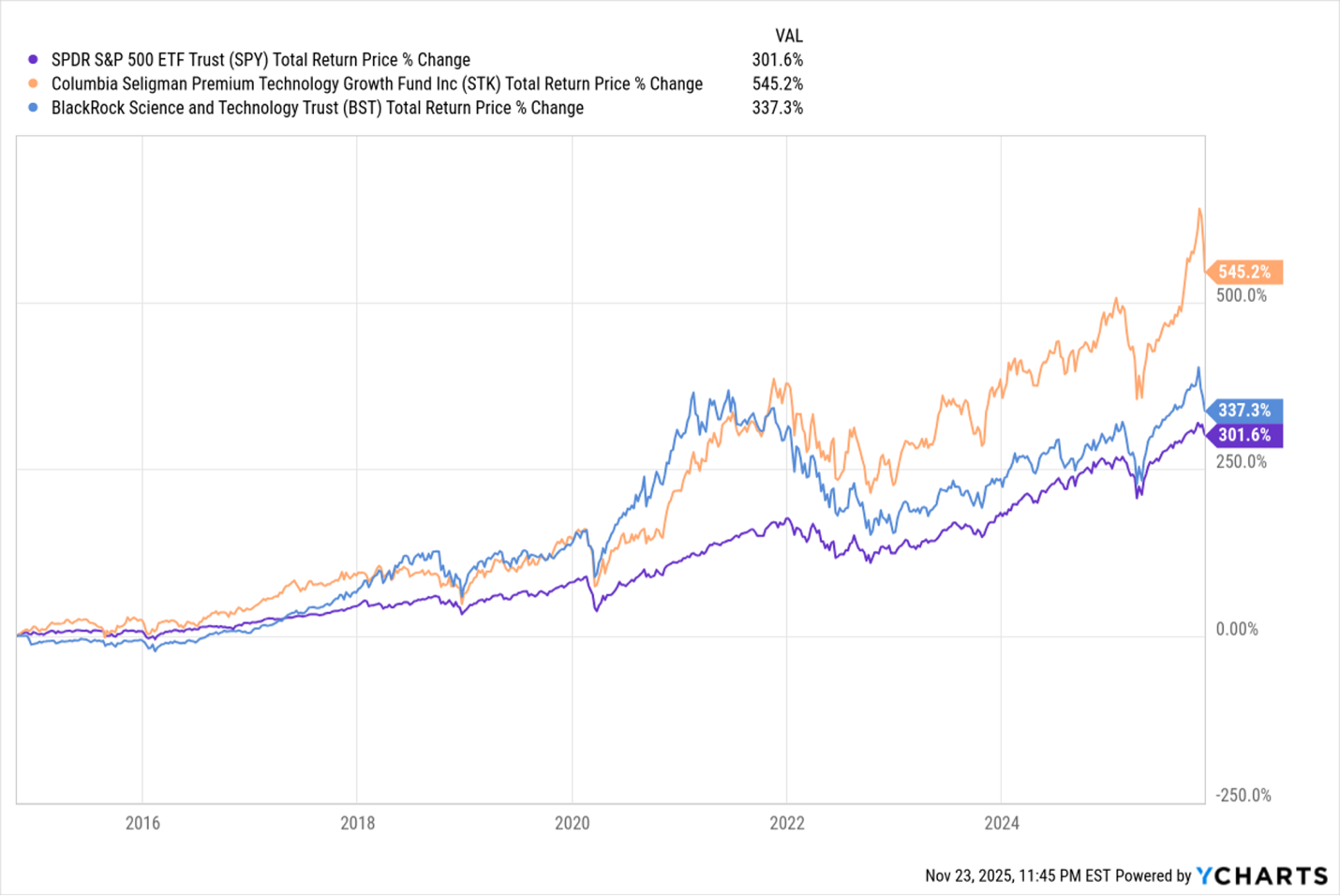
Both BST (in blue) and STK (in orange) have outperformed the S&P 500—shown by a popular index fund, the SPDR S&P 500 ETF Trust (SPY), in purple—since BST’s inception. (BST was released in 2014, which is why this chart only goes back that far). STK’s outperformance goes back much further.
STK Demolishes the Index Fund
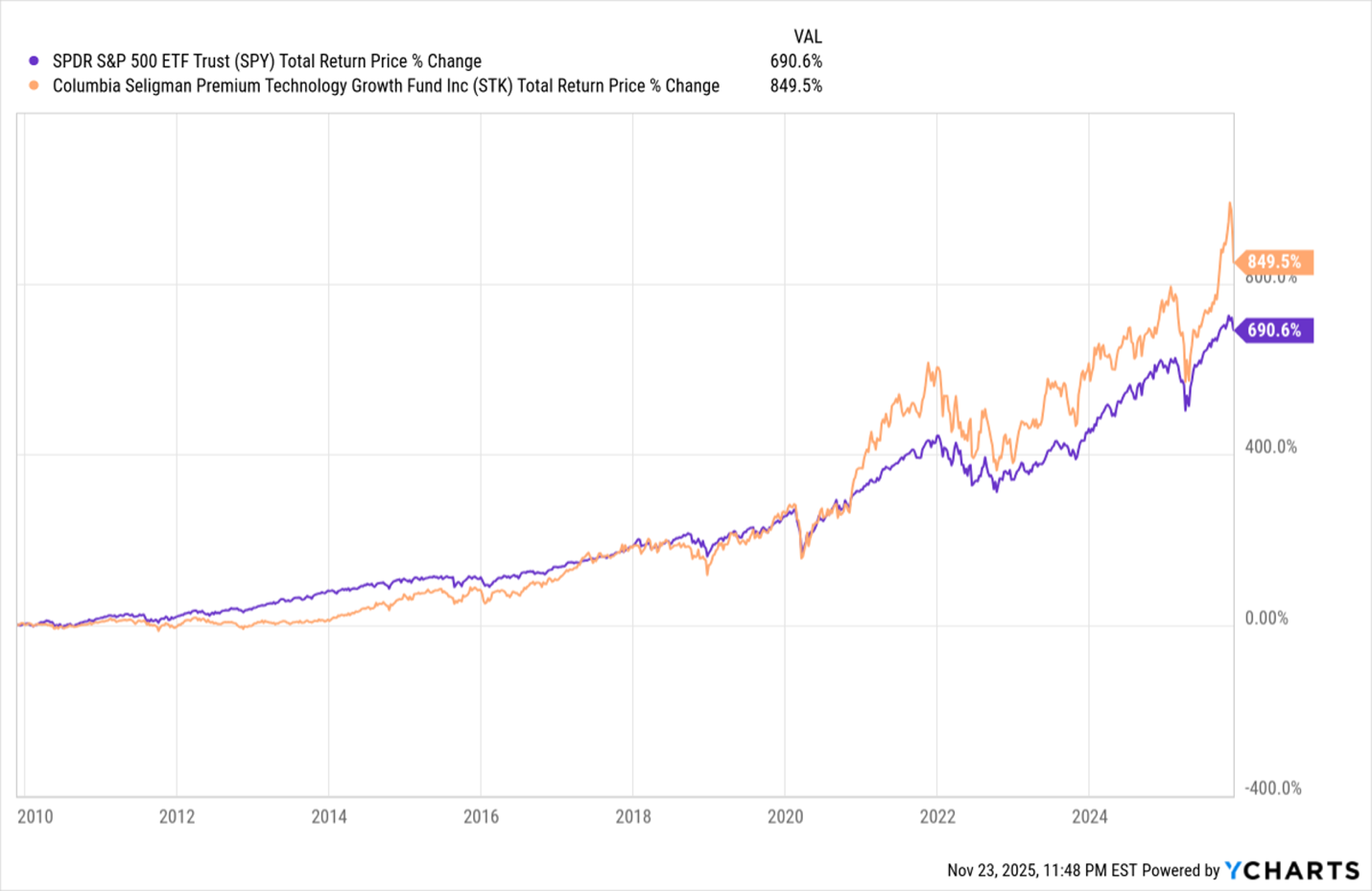
Now, to be sure, these funds are weighted toward tech, but it is also worth pointing out that the S&P 500 has been increasingly weighted to tech stocks (now about 45% of the index), which explains some of the outperformance here.
But with fees much higher than those of the go-to index fund, you’d expect SPY to be more competitive (again net of fees). To be sure, the SPY shareholder paid less in fees. But they also missed out on the far greater returns they would have reaped from STK since it launched.
Cheaper Ways to Buy Stocks?
The second criticism also has some merit, although maybe not in the way most people think. Let me explain.
2 Big Dividends, 2 Sweet Discounts
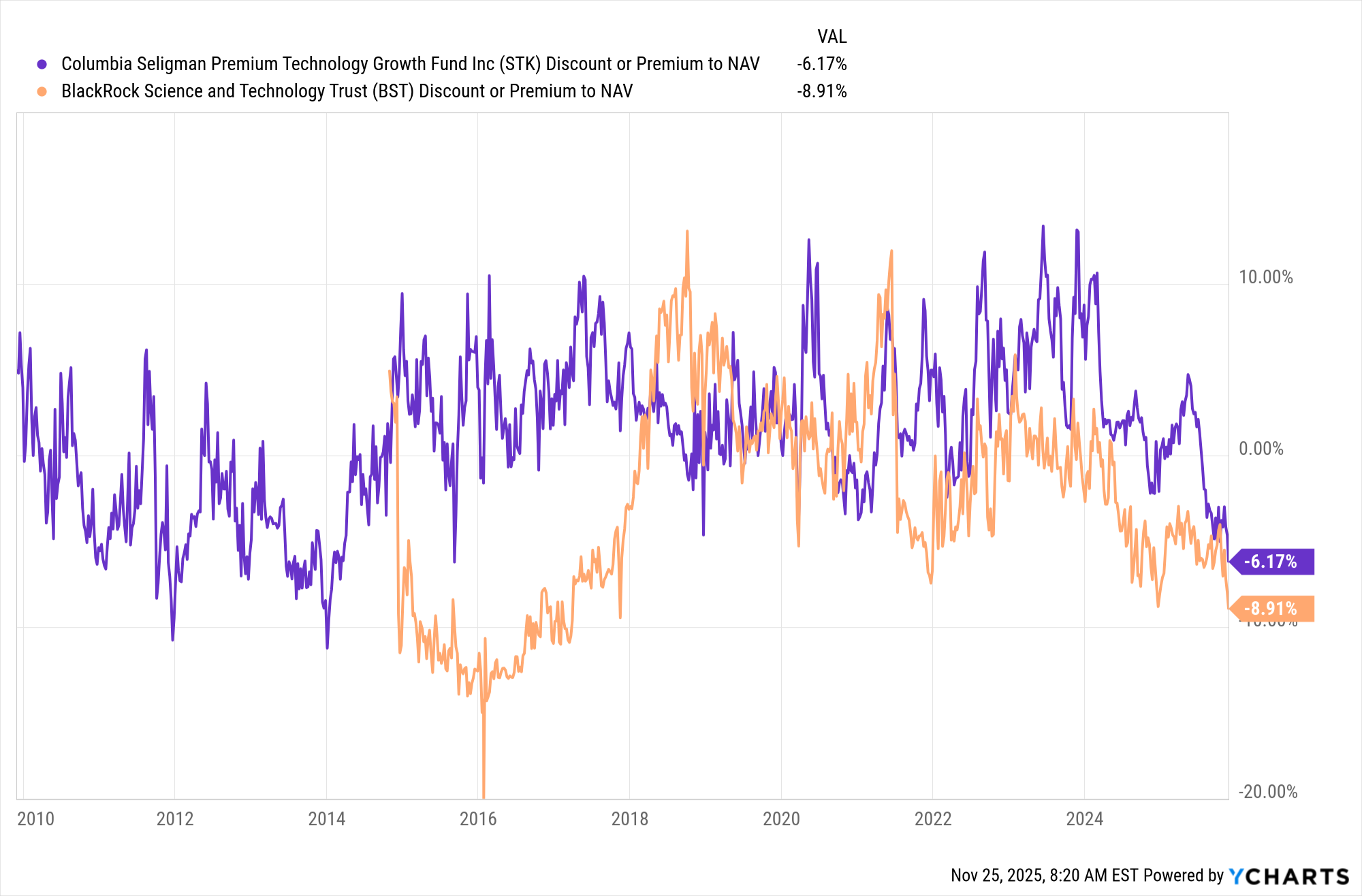
Both of these funds have a fixed number of shares they issue to the public (this is fixed at the IPO). This is why they’re called closed?end funds. While their shares trade on exchanges, like any stock, the fund can’t issue new shares to new investors.
The price of a share of a CEF will fluctuate according to supply and demand, which means its market price can drift up or down in relation to the liquidation value of all of its assets on the open market—a measure called the net asset value, or NAV.
Above you can see BST (in orange) is trading at an 8.9% discount to NAV as I write this, while STK has a 6.2% discount. In other words, even accounting for both funds’ fees (which are far less than their discounts, so we’re essentially getting their management for free), we’re ahead of our open-market stock buyers here.
So, yes, you can get Microsoft cheaper with STK (which holds 4.2% of its portfolio in Microsoft; its sixth-largest holding). And you can get it cheaper still through 8.9%-discounted BST, which has 7.6% of its portfolio in Microsoft—its second-largest position.
And check this out.
“Swappable” CEF Discounts
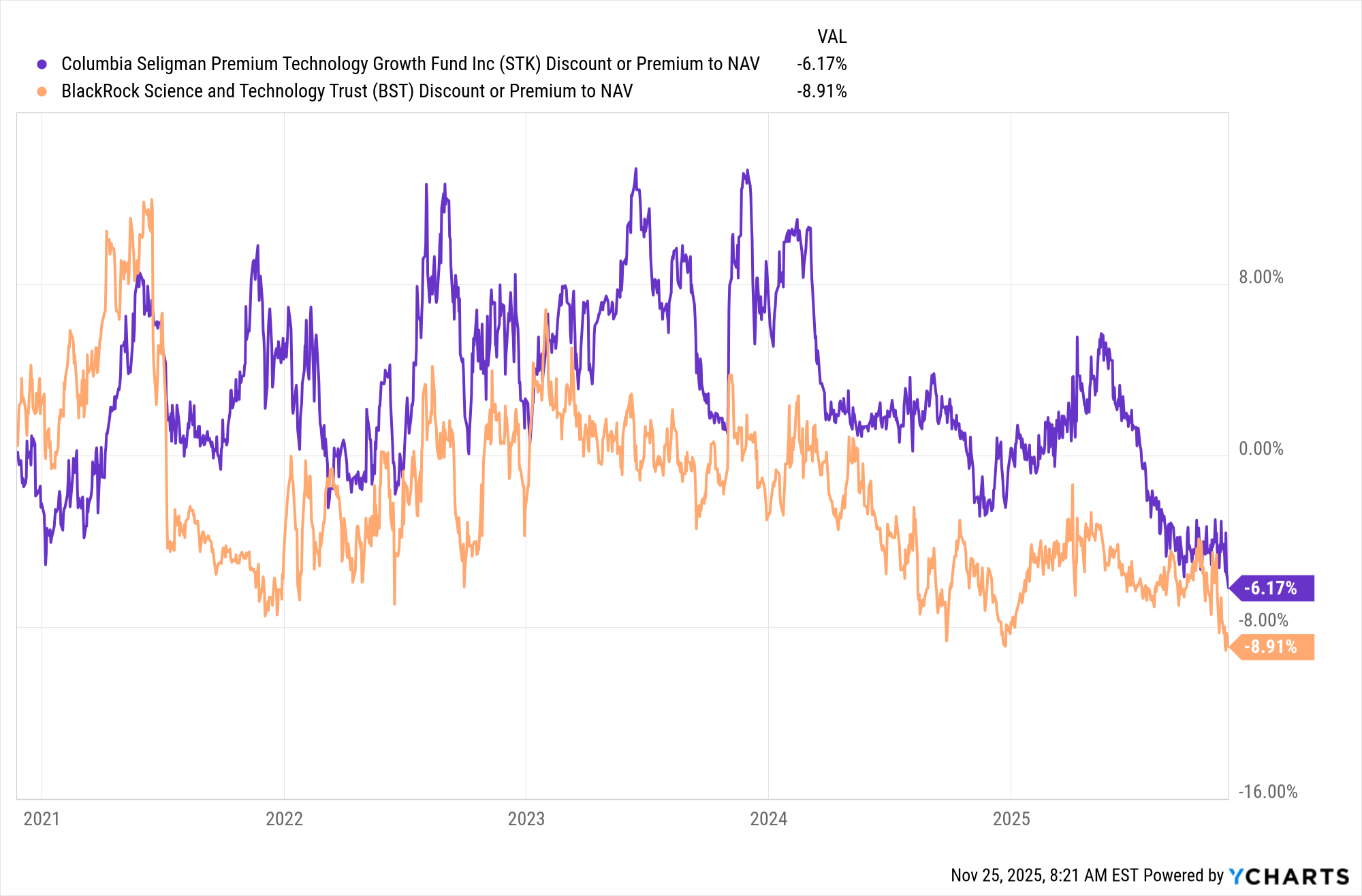
See how BST (again in orange) had a premium in 2021 while STK (in purple) had a discount? If you held BST at that time, this was a chance to sell it and buy the discounted STK. Then you could have done the reverse in 2023 or 2024, when STK mostly had a premium and BST regularly traded at a discount.
The bottom line with this strategy is that you’re always holding tech stocks and getting a high yield, but you’re selling funds when they’re overvalued and buying when they’re undervalued. This is the kind of strategy we regularly use in CEF Insider—and few investors know about it. That’s fine with us. We’re happy to go after the upside (and dividends!) on offer here.
Start Your “CEF Rotation” With These Bargain CEFs Paying 9%+
To get you off to a strong start with this strategy, I’ve put together 5 of my best buys from the portfolio of my CEF Insider service. All 5 are bargains now, hold everything from stocks to bonds to REITs—and yield an incredible 9% between them.
Buy these 5 funds now and you’re instantly diversified. And thanks to their bargain valuations, they’re set to hold their own in a pullback, too, giving us peace of mind as we collect their big payouts.
Then you can go ahead and rotate between them as they move from premiums to discounts (and back again!). AND you can reinvest your dividends in these or other CEFs, building up your income and upside potential further.
Or you can use your dividends to pay your bills, put toward your savings goals—it’s all up to you.
The longer you wait to get started, the more dividends (and upside potential) you’re leaving on the table. Don’t wait. Click here for more on these 5 powerhouse 9%-paying CEFs, plus a free Special Report revealing my complete research on each one.