
The spreadsheet jockeys on Wall Street have it all wrong—and their blunder is dragging down the average investor’s returns (and income!).
Their mistake? Looking at “old school” measures, like the recent spate of soft jobs reports, and jumping to the conclusion that the economy is hitting the skids.
Trouble is, this take is totally disconnected from reality, especially when it comes to the nation’s small businesses. Because these mom-and-pop shops are still upbeat—and many of them are looking to grow.
The proof is in the numbers. First up, even though small biz optimism did tail off a bit in October, according to the NFIB Small Business Survey, it’s still above its historical average, where it’s been for the past six months.
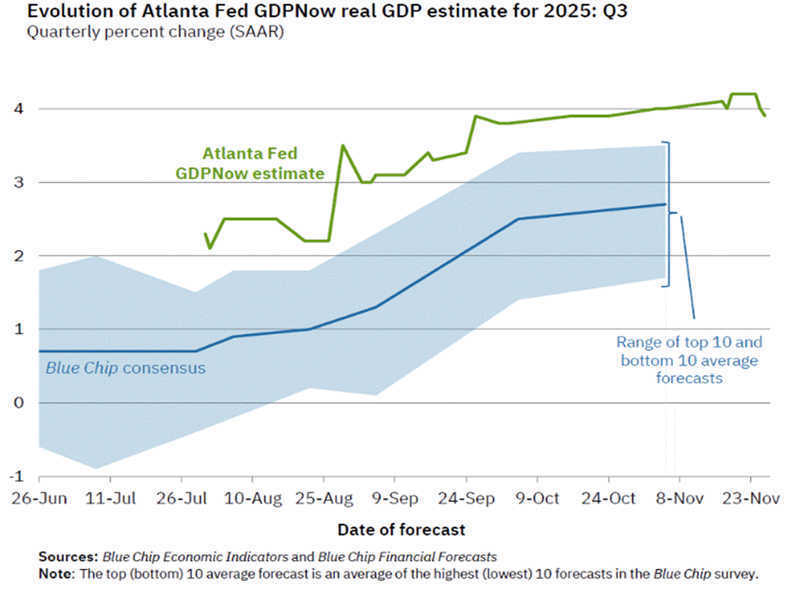
And then there’s the Atlanta Fed’s GDPNow measure, the most up-to-date indicator we have, which shows the overall economy growing 3.9%. Cooking along just fine, in other words.
When small biz grows, profits at business development companies (BDCs)—which loan money to these companies—sizzle! That means big divvies for those of us who hold BDCs: The two we’ll delve into below pay a hefty 9.4% and 11.7% (!), respectively.
Luckily for us, Wall Street’s unwarranted gloom is prompting investors to toss BDCs over the side. You can see that in total return of the benchmark VanEck BDC Income ETF (BIZD), which is down this year (see purple line below), as of this writing. That’s despite the fact that other income plays, like real estate investment trusts (REITs), in blue, and utilities, in orange, are up:
REITs and Utilities Surge. BDCs? Not So Much
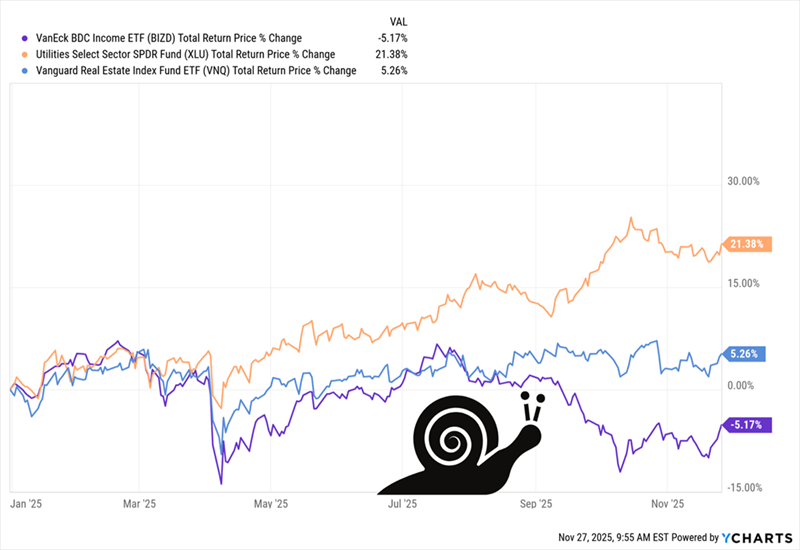
BDCs are in the cellar precisely because of those sluggish jobs reports. But the truth is, this setup is bullish for small business. Ask any small biz owner about their biggest challenge these days and they’ll likely all tell you the same thing: They can’t find good workers!
Now, thanks to the slower job market, they’re more likely to find the help they need, and at a lower cost, too. Then there’s AI, which small businesses are diving into with abandon: According to a recent study by Reimagine Main Street, more than 50% of these firms are looking at adopting AI—and one in four already have.
Beyond the labor front, there’s reason for hope around another small-biz bugbear: tariffs.
You likely know about the Trump administration’s recent removal of tariffs on around 200 food items. This shows that the administration is sensitive to price pressures. More easing seems likely, especially if inflation remains stuck around current levels.
With all this in mind—small-biz optimism, a still-strong economy, more (and cheaper) labor and a potential easing of supply chain woes—it’s prime time to move into BDCs.
Below are two that should be at the top of your list. The first is a newer player with that monster 11.7% dividend I mentioned a second ago. The other is what I call the “BDC bully”: It pays a gaudy 9.4%, and its sheer size lets it be very picky about who it lends to.
High-Yield BDC #1: A “New Kid” Crashing the BDC Party
The Morgan Stanley Direct Lending Fund (MSDL), payer of that 11.7% divvie, has all the markings of an overlooked bargain: It’s new, at least to investors, as it started trading on the NYSE in January 2024; it’s small, with a $1.5-billion market cap, and it’s cheap (of course!), trading at 84% of book value.
That price-to-book measure only shows the BDC’s share price in relation to its physical assets and its loan book. It doesn’t account for MSDL’s hidden value—of which there is a lot.
Start with management. As the name says, the BDC is backed by Morgan Stanley (MS), more specifically, by MS Capital Partners Adviser, a Morgan subsidiary. That gives MSDL the expertise and resources of the 90-year-old investment bank. That’s an edge few other lenders—especially those as young as MSDL—can match.
Management knows how to control risk, too: In the third quarter, 96.3% of MSDL’s overall loans were “first lien” and 100% of the new loans the firm made in that quarter were of this variety. This means that if bankruptcy hits one of these borrowers, MSDL is first to be repaid.
But the team at the top has taken steps to minimize even that outcome, with a portfolio spread across 33 industries in all:
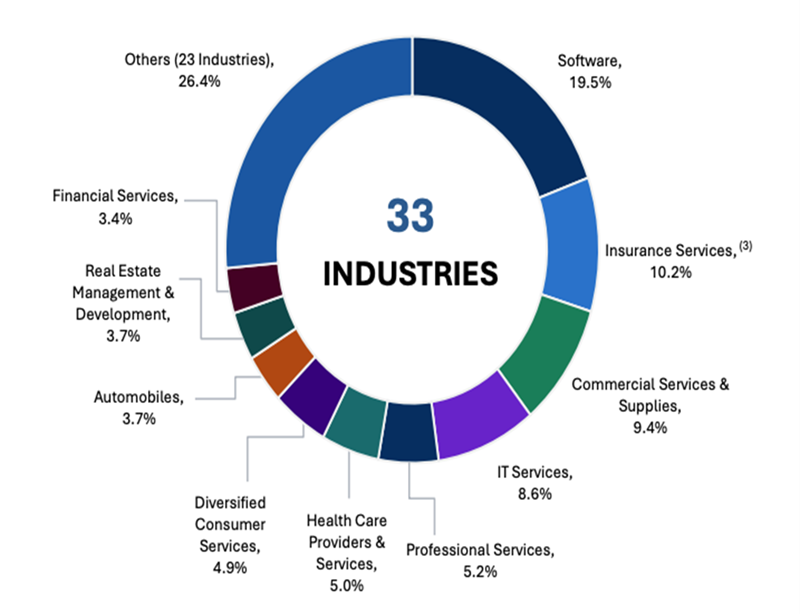
Source: MSDL Q3 earnings presentation
The dividend? It’s paid quarterly and covered by net investment income (NII), with $0.50 in NII over the last quarter matching the $0.50 quarterly payout.
There’s good reason to think that this coverage will improve, starting with the direction of interest rates, which is always key to BDC profits.
Here too, there’s a disconnect” for us to profit from. When the Fed cuts its policy rate, BDC loan income typically falls, especially on floating-rate loans, an MSDL specialty (99.6% of its portfolio).
As I write this, futures traders see an 85% chance of a December Fed rate cut, and rates are likely to move lower after May, when Jerome Powell’s term expires (and he’s replaced by someone—potentially Kevin Hassett, director of the national economic council—likely to back the administration’s call for lower rates).
This seems like bad news for BDCs, but we need to remember that lower rates drive up loan demand, especially when businesses plan to grow (see small-biz optimism above). This, in turn, helps offset lower loan income and gives BDCs more floating-rate loans on which to collect a rising income stream when rates inevitably move up again.
MSDL is already seeing this: In the past year, as rates have fallen, it’s grown its loan book from 200 borrowers to 218—a 9% jump. I expect that to continue as small-biz optimism rolls on.
High-Yield BDC #2: The King of BDCs (With a 9.4% Yield)
Next up is Ares Capital (ARCC), a holding in my Contrarian Income Report service that we love for one main reason: scale.
ARCC is the biggest BDC by far, with $28.7 billion in assets. This brings a steady stream of deal flow, helping management dictate favorable loan terms.
That’s why Ares is our “BDC bully”: Its size helps it be picky and grow quickly. As of September 30, it had 587 borrowers. Plus, the biggest borrower accounted for just 1.9% of ARCC’s assets under management, further lowering its risk.
ARCC’s ability to grab the “pick of the litter” among borrowers has also let it build a diverse portfolio, with a lean toward those lower-risk first-lien loans:
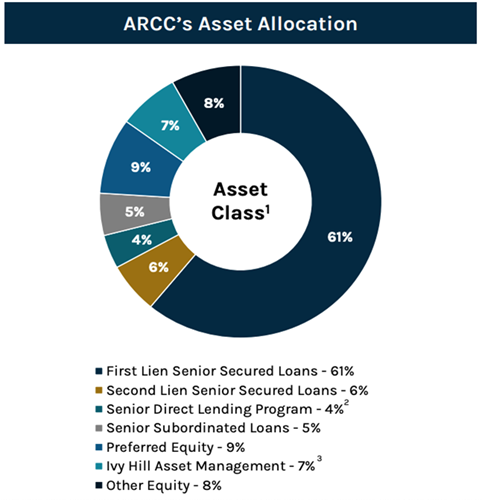
Source: ARCC Q3 investor presentation
ARCC continues to aggressively write new loans at attractive yields. Last quarter, the fund generated NII of $0.48 per share. As is the case with MSDL, that covered the BDC’s dividend: a matching $0.48 quarterly in ARCC’s case.
We also have a lot of dividend history to go on here, with ARCC going public more than two decades ago, in 2004. That history is very favorable indeed:
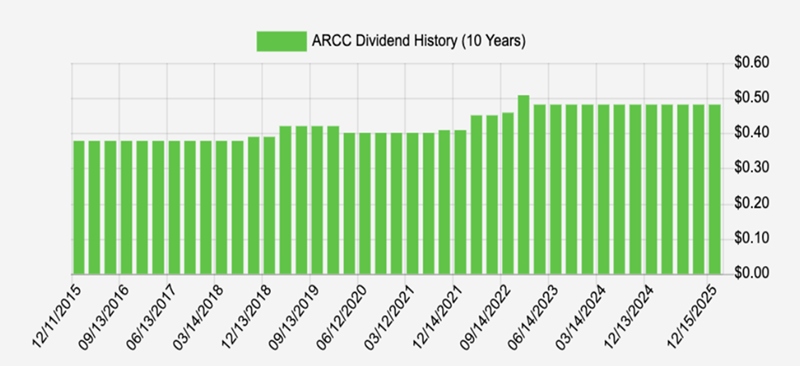
Source: Income Calendar
About 71% of ARCC’s portfolio was floating rate at the end of Q3, but management is steering more loans that way, as that total is up from 69% in the second quarter. This is a smart move as future rate cuts spur more small-biz borrowing.
Finally, ARCC trades around book value, which is fair in light of its dominant position and long history. Sure, we’d like to buy “cheap,” but investors rarely knock ARCC below book. So we’ll happily buy here and collect ARCC’s 9.4% payout while we wait for its next run up.
You Saved and Saved—and Think You Still Can’t Retire? You Probably Can.
I urge investors to buy steady high-yielders like MSDL and ARCC for one simple reason: They’re a proven way to grab a strong income stream in retirement.
Stack up a few payers like these in your portfolio, and pretty soon you’re well on your way to a retirement funded by dividends alone—and on far less than you think you need.
Heck, you may have enough to clock out right now!
This kind of investing is critical, with our portfolios being seemingly buffeted by a different fear every day: inflation, recession, an AI bubble—you name it. It’s gotten to the point where even those who’ve followed the “rules” and done everything right still think they can’t afford to hang ’em up.
I hate to see that—especially when “dividends-only” retirement is well within reach for many. They just haven’t been shown the right stocks to get them there!
That stops now. Click here and I’ll show you how you could retire on dividends alone, perhaps with as little as $500K invested. Then I’ll give you a free Special Report revealing the names and tickers of the stocks you need to get there.