
2026 is shaping up to be the best year for bond investors in many years. Washington wants rates down, housing up and borrowing cheap again.
This wish list is wildly bullish for bonds.
Fed Chair Jay Powell has delivered two rate cuts to end the year, with more to follow. Whether or not Powell personally delivers them doesn’t matter to us. Powell is on his way out. But the Fed show will go on, with a ringmaster ready to roll.
President Trump has confirmed his shortlist for the next Fed Chair is down to “The Two Kevins”: Kevin Hassett and Kevin Warsh.
The implication for bond investors is the same, regardless of which Kevin gets the nod:
- Kevin Hassett, the “cut early, cut often” candidate, has spent 20 years arguing the Fed moves too slowly. He knows the assignment: Cut!
- Kevin Warsh, a historic hawk, has aligned himself with Trump’s mandate. He told the President personally that borrowing costs must come down.
Whichever Kevin gets the job, the result is already in the cards. More cuts are coming.
This “Kevin accommodation” is the catalyst our bond funds have been waiting for. PIMCO and DoubleLine don’t just buy bonds for their closed-end funds (CEFs)—they borrow money to buy more bonds.
This is called leverage. For the last three years, high rates made leverage a dead weight on these funds. In 2026, falling rates will burn that weight like rocket fuel. Every quarter-point cut lowers the funds’ borrowing bill and widens the spread between what they pay and what their portfolios earn.
The “pure plays” on lower borrowing costs are PIMCO Dynamic Income (PDI) and PIMCO Dynamic Income Opportunities (PDO). With more leverage than your typical bond fund, PDI and PDO have felt high rates more acutely than their peers.
They will be happy to see either Kevin in action and experience the relief of falling rates. PDI and PDO have been paying 5-6% on their credit lines. Cutting back towards 3-4% restores the profitability these funds enjoyed in their late 2010s bull run.
PIMCO is the 800-pound gorilla when it comes to bond trading. They don’t just buy bonds; they bully the market. PDI yields a massive 14.9% and uses 32% leverage. Yes, it has been paying the price for high rates, but now it is ready to run, thanks to Fed cuts. Its younger sibling PDO, meanwhile, employs 35% leverage and yields 11%. Not shabby!

If PIMCO is the bond bully, then Jeffrey Gundlach is the fixed-income sniper. The “Bond God” isn’t afraid to buy “unloved” assets for DoubleLine Income Solutions (DSL). His edge is simple: when emerging-market debt gets dumped, he buys it at 60-70 cents on the dollar and clips big yields while he waits for appreciation.
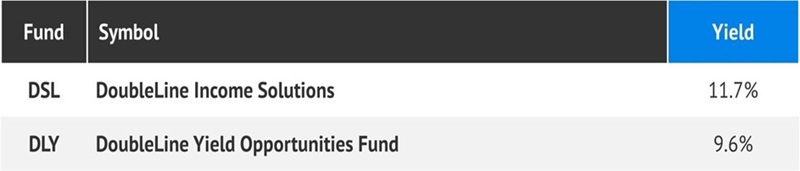
As the US dollar softens further from falling rates, these global bonds are positioned to bounce. They act as a high-yield hedge to greenback weakness. DSL yields 11.7% while its more conservative sister fund DoubleLine Yield Opportunities Fund (DLY) pays 9.6%. They use 22% and 15% leverage respectively—conservative numbers.
Speaking of a softer dollar, AllianceBernstein Global High Income (AWF) is a direct play on it. The fund owns high-income debt from around the world. In a falling-rate environment, the dollar typically weakens—making AWF’s foreign-bond income worth more when converted back into dollars. It’s a nice currency kicker on top of a 7.3% yield.
Finally, Muni Bondland is the place for leverage. Safe muni bonds take advantage of the security in their sector by borrowing to buy more. The leverage ratio for Nuveen Municipal Credit Income (NZF) is 41%, so this fund is about to save big time:
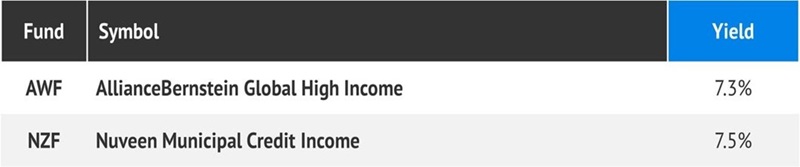
Plus, that 7.5% yield from NZF gets a tax “hall pass” from Uncle Sam. For a top-bracket taxpayer, that 7.5% tax-free income is worth 12.6% in taxable terms. It’s essentially an S&P-beating return from safe muni bonds.
With 12% to 14.9% yields in hand, we don’t need to chase AI moonshots or sweat over quarterly earnings reports. Retirement is no longer a spreadsheet problem. We just need to buy the right bonds before vanilla investors realize the leverage game has flipped.
When we can lock in 14.9% yields, our retirement math gets very simple.
Funds like these are the secret to retiring on as little as $500K. Let’s face it, the traditional “safe” income strategies touted by Wall Street are broken with the Fed cutting rates. Policy changes are gutting retirement plans. Which is why we are turning to the only reliable retirement solution—a “no withdrawal” portfolio that helps us retire on $500K.