
Stocks are about to do something almost totally unheard of: chalk up three winning years in a row.
And no one is celebrating.
Instead, worry is everywhere: about an AI bubble. Sticky inflation. Or the Fed—everything from the bank’s next chair to its independence and the direction of rates.
This combo—a strong market tempered with a big dose of anxiety—has set up a rare setup in our favorite high-income plays: 8%+ yielding closed-end funds (CEFs). It comes in the form of a pattern I don’t see often, but when I do, it’s almost always a buying opportunity.
That pattern is the following: A drop in a CEF’s market price (driven by investor sentiment), while its underlying portfolio (driven by management’s talents) keeps on growing.
This can only happen with CEFs: Since they have a roughly fixed number of shares, these funds can (and often do) trade at prices higher or lower than their portfolio value (the net asset value, or NAV, in CEF-speak). If the market price is higher than NAV, it’s a premium. Lower, a discount.
And right now, plenty of CEFs are showing just this kind of setup: Their market prices are dropping while their portfolios keep rolling higher. We’ll look at three examples yielding up to 17.9% (not a typo!) in a moment.
But before we do, I have to tell you something else working in our favor with these high payers: market history.
You see, in most cases when investors fear a downturn, that’s when a downturn is least likely. Few called, or even expected, the 2008 recession, for instance. That’s partly why it was so painful.
It was only when Wall Street “wisdom” was to sell that stocks began to recover in 2009. And, of course, they kept soaring for the next decade and a half.
Which leads us to today, where we have a kind of ambient worry that makes contrarian bullishness more likely to pay off in the coming years. We can also see this weird meeting of paranoia and profits in those three CEFs, which we’ll get into now. All of them are underpriced as a result.
Bargain CEF #1: Portfolio Up, Price Way (Way) Down
The first is the Guggenheim Strategic Opportunities Fund (GOF), which sports that crazy 17.9% yield.
Let me be clear: That yield is unsustainable, but that’s fine by us. Even if it were cut in half, it would still be around 9%, or more than the CEF average. So there’s room for that dividend to move around, and for the fund to still be a strong income provider. Plus there’s this:
Portfolio Gains, Share Price Tanks
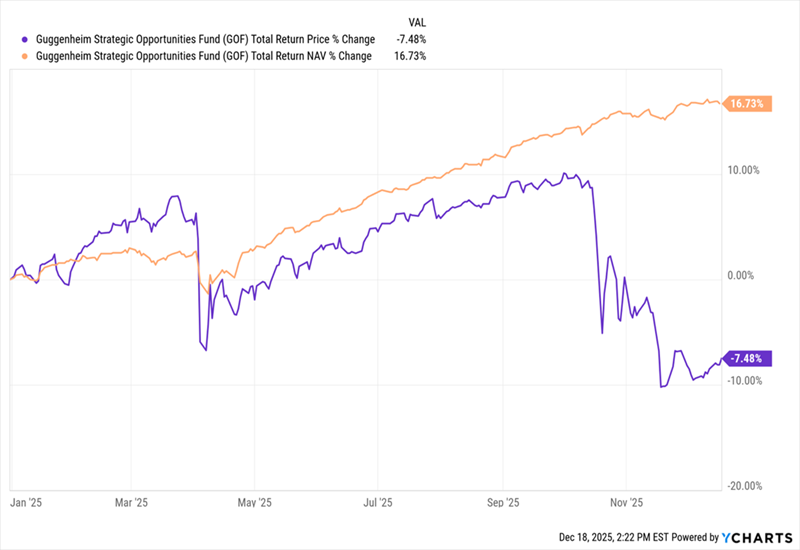
Even though its portfolio is performing well (the orange line above), GOF’s market price-based return (in purple) took two big dips in 2025 and is now way behind.
This fund’s portfolio gains stem from its focus on relatively low duration debts (a 2.7-year weighted average, which cuts its interest-rate sensitivity). GOF also holds a range of credit, including bank loans, corporate bonds and mortgage-backed assets.
But that hasn’t been enough to keep investors onside.
Before we move to our next CEF, one thing to note here is that the drop in the fund’s market price doesn’t make it a buy just yet, as it still sports a 6.7% premium. But it does make GOF worth watching, as that premium has been fading, due to the fund’s sinking share price, and could turn into a discount. If it does, that’ll be the time to pounce.
Bargain CEF #2: A Dip Even a Patriotic Ticker Couldn’t Stop
Next up is one of my personal favorites: the Liberty All-Star Equity Fund (USA). Not only does this all-stock CEF have the best ticker on the market, it’s also got one of the best portfolios, including NVIDIA (NVDA), Microsoft (MSFT), Visa (V) and many other American mega-caps.
Another Strong, but Unloved, Portfolio
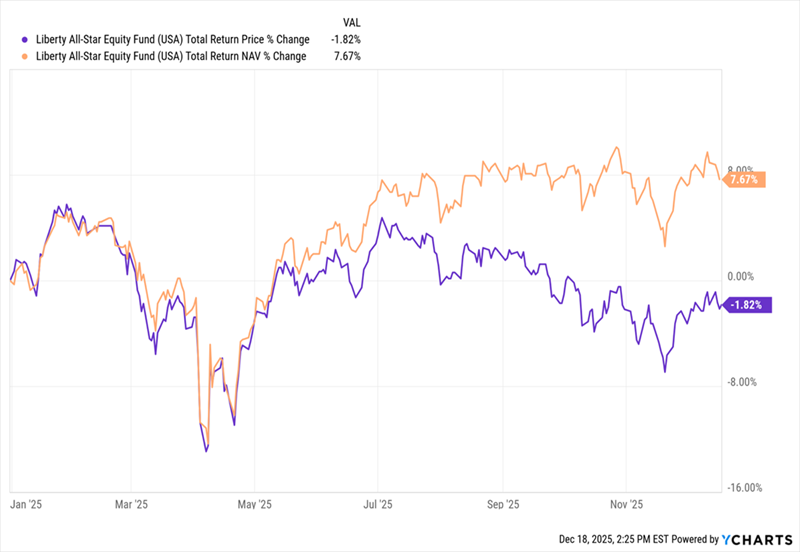
The profits from those holdings are why the fund’s NAV return (in orange) has risen in 2025. But look at its price return (in purple): It’s actually gone negative! That’s very odd, and it’s why USA’s pricing has tanked.
A Rare Buying Opportunity
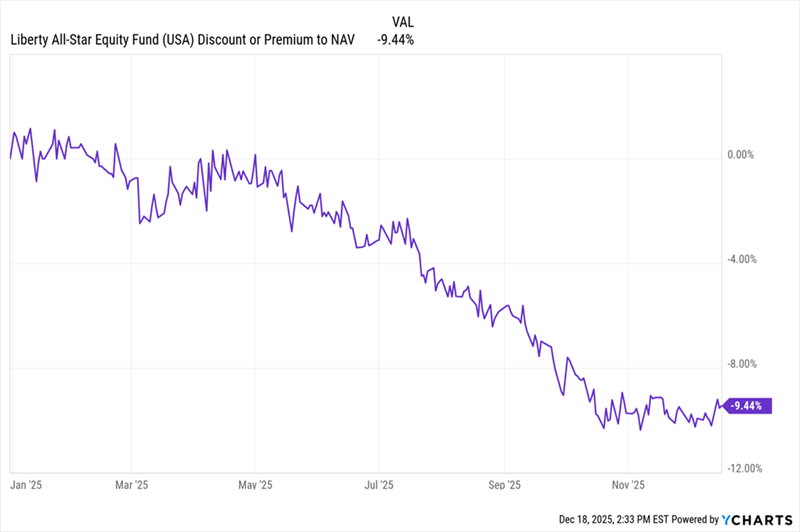
With a 9.4% discount, USA is cheaper than it’s been at any point in the last five years. That alone makes this fund a smart pickup if you’re looking to bolster your stock holdings. The dividend is another: an 11% yield that looks sustainable.
Bargain CEF # 3: An 11% Payer Built for an Uncertain Fed
Another high-yielding credit CEF that’s fallen into the bargain bin is the Calamos Dynamic Convertible & Income Fund (CCD). Its 11% yield is sustained by a mix of convertible bonds and high-yield corporate bonds. CCD’s weighted average duration of just two years also lowers its rate sensitivity.
That’s why CCD’s portfolio value has soared in 2025, as the Fed’s slower-than-expected rate cutting helped grow the fund’s portfolio (in orange below).
Big Profits, Falling Prices
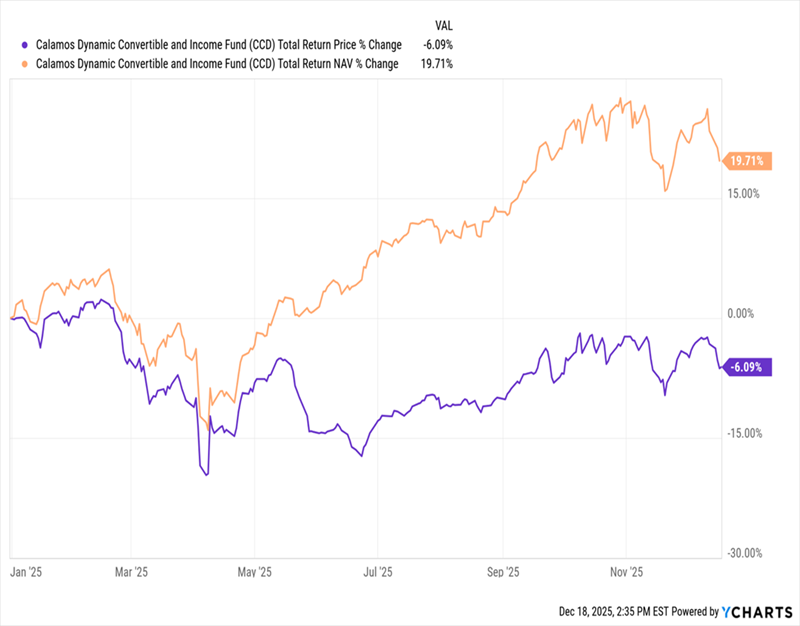
Investors didn’t see it that way, though, which is why CCD’s price return (in purple) is down for 2025. That sort of disconnect doesn’t tend to last, so expect CCD’s price to gain in the future.
Now there is a catch with CCD: It still trades at a 1.9% premium. That’s small, but we could see it flip to a discount before it reverses course. But that’s no guarantee, so one approach would be to add a bit now, wait for the discount to appear, then buy more. And all the while, hold on to USA and keep an eye on GOF.
Shocking Income Secret Pays You 60 TIMES in 2026
These three aren’t the only high-yielding CEFs displaying this unique price-down, portfolio-up pattern. My favorite monthly dividend CEFs are seeing their market prices lag, too.
That’s our cue, especially as these 5 funds pay a rich 9.3% dividend between them. And now, with worry running high, is the perfect time to buy.
I’ve put all 5 of these reliable monthly payers together into a “mini-portfolio” all their own. I’m urging all investors to buy it now. Not only do we get paid to wait as these 5 funds’ undeserved discounts vanish, but we get our payouts every single month, too.
Think about that for a moment: With 5 monthly dividend payers, you’re getting paid 60 TIMES a year!
Plus, with a 9.3% average dividend, you can make those 60 checks very healthy indeed—on a modest upfront investment!
Now is the time to buy them and start your 60 “paycheck” income stream! Click here and I’ll tell you more about these 5 stout monthly income plays. I’ll also give you a free report revealing their names, tickers and everything else you need to start collecting your 60 dividend payouts in 2026!