
The bombs continue to fall in the Middle East. But we contrarians know something the crowd always forgets at times like this:
The world is always burning somewhere.
At times like these, our Contrarian Income Report dividend strategy shines. Our portfolio yields 8.2% on average, and those dividends roll in no matter what the world throws at us.
The result? No need to sell into a downturn to get the cash we need. And we get the chance to go on offense, too, snagging dividends on the dips and boosting our income stream (and upside potential) as we do.
Rinse and repeat.
We especially love stocks and funds that pay us monthly, for two reasons:
- They line up perfectly with our bills.
- They let us reinvest our dividends faster—especially when markets dip.
The problem for most investors is that they limit themselves to the fan favs of the S&P 500, and there are virtually no monthly payers there. But we know there are plenty to be found if we hunt just a little off the beaten path.
Best of all, we can get those high monthly divvies without giving up the large caps we already hold. The key is to buy them through closed-end funds (CEFs), which yield around 8% on average. Plus, most of the 400 or so CEFs out there pay dividends monthly.
Here are two that stand out now.
Monthly Dividend Pick No. 1: A Diversified Pick With an 8.2% Dividend
The BlackRock Enhanced Equity Dividend Trust (BDJ) is purpose built for a market like this. For starters, its portfolio is balanced among stock sectors—finance is the biggest slice, at 19% of assets, followed by industrials (14.5%), healthcare (14.2%) and technology (12.5%).
Then it goes further, adding in a dash of global exposure, with about 12% of assets outside the US, in stable countries like the UK, South Korea, Germany and Canada.
Let’s get to what we really want to know about here: the (monthly!) dividend, which is not only hefty but has risen a stout 32% in the last decade (not including special dividends, which BDJ has paid five times in that span):
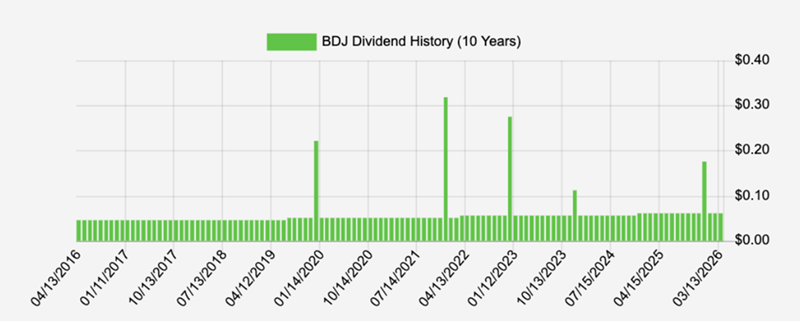
Source: Income Calendar
The fund aims to hold at least 80% of its portfolio in dividend-paying stocks. Right now, its holdings include the likes of Amazon.com (AMZN) and medical-device maker Baxter International (BAX), both of which stand to gain as AI boosts their efficiency; Dollar General (DG), which is nicely set up as consumers cut costs; and BP plc (BP), a clear winner from rising oil.
BDJ further bulks up the divvie by selling options on about half of its holdings. That increases income, particularly in volatile markets.
But despite these strengths, investors have unfairly tossed BDJ aside. As I write this, the fund’s discount to net asset value (NAV, or the value of its underlying portfolio) sits at 6%, having nearly doubled since hostilities broke out in Iran.
BDJ Goes On Sale—as Its Discount Looks for a Bottom
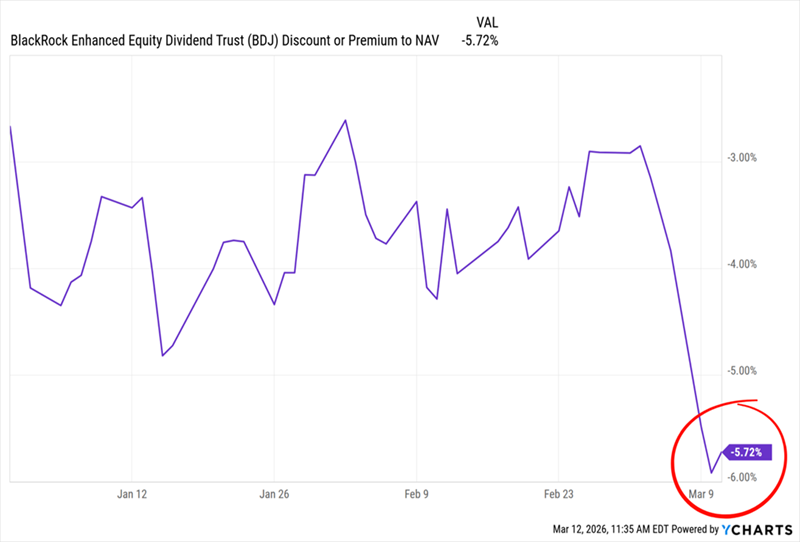
That’s a clear overreaction. And if you look at the right side of that chart, you can see that its discount is looking to form a bottom. That sets up a nice entry point for those on the hunt for a well-diversified monthly paying stock fund.
Monthly Dividend Pick No. 2: An 11.5% Payer With a “Discount in Disguise”
We’ve talked in recent days about how AI is deflationary because it caps wage growth as businesses automate more tasks. Add a cooling job market and a new Fed chair who’s likely to lean toward lower rates, and you get a strong outlook for bonds.
The PIMCO Corporate & Income Opportunity Fund (PTY) is perfectly set up for that. The fund stands out for a lot of reasons, but a key one is the long effective maturity on its credit assets: just over seven years as I write this.
That’s important because longer-duration bonds do better when rates decline, as they’re more attractive than new (and lower-yielding) debt.
Moreover, PTY’s effective leverage-adjusted duration is 3.8 years. That’s enough to position it for gains on lower rates without taking on too much risk if rates rise. With all that in mind, it’s surprising (to me) that PTY is trading at such a bargain now.
That might sound like an odd thing to say about a fund that trades at a 6.5% premium to NAV. But with CEF discounts and premiums, context is everything. And the truth is, PTY is on sale at that level. In fact, that premium is lower than it’s been since the bond (and stock) meltdown of 2022.
PTY’s “Discount in Disguise”
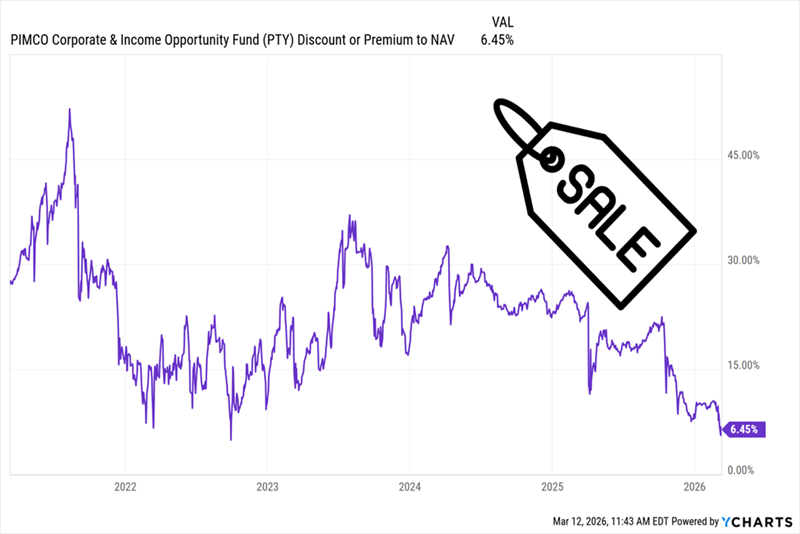
The fund’s drop in valuation is overdone. And if you look at the right side of that chart, it looks like that premium is carving out a bottom, similar to what’s happening with BDJ.
But why the premium in the first place?
It’s simply because PIMCO, founded by legendary investor Bill Gross in the ’70s, has long had an almost superhuman mystique. That’s why most of its funds trade at premiums—many with bigger ones than PTY.
Even without the “PIMCO aura,” it’s tough to argue that PTY hasn’t earned a premium. The fund has been around since 2002, longer than the benchmark US corporate-bond ETF, the SPDR Bloomberg High Yield Bond ETF (JNK). In the years since, PTY has clobbered that benchmark.
PTY Laps JNK—Again and Again
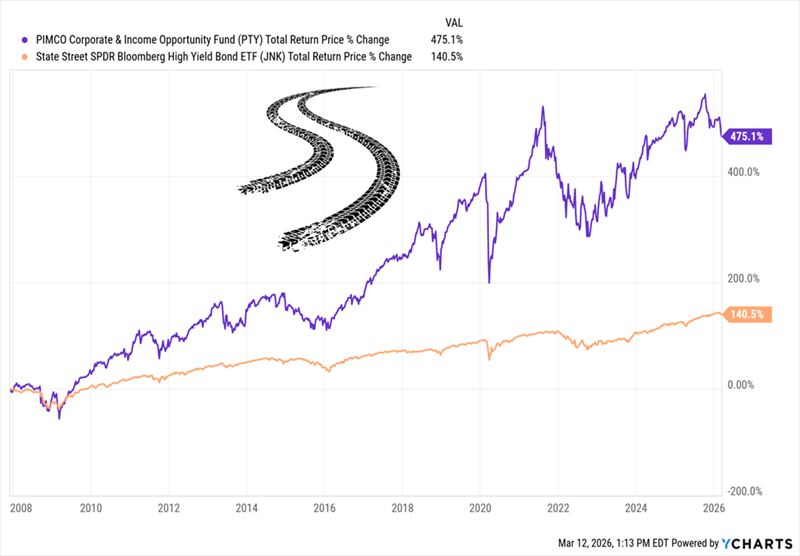
Reinvested dividends drove that return, thanks to PTY’s huge monthly payout.
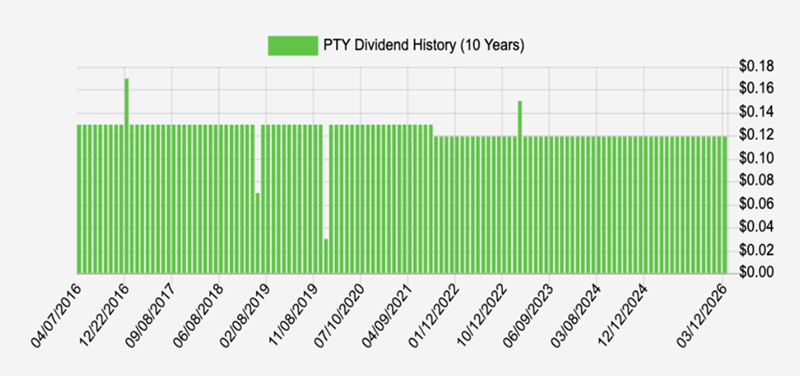
A Reliable 11.5% Dividend
Source: Income Calendar
Despite a slight cut during COVID, PTY’s payout has held steady for years. And besides, its regular special dividends (the spikes and dips above) have gone a long way toward making up for that cut.
I expect that to continue as the wind shifts toward lower rates and this proven income generator reclaims the premium its track record deserves.
Boost Your Income Even More With My #1 Monthly Payer (Yields 11% Now)
These 2 CEFs are strong plays for a jumpy market. But my favorite bond CEF is even better.
It’s ridiculously oversold, for one—and it kicks out an 11% dividend that (of course!) drops into our accounts every single month.
An 11% payout means we’re getting $11,000 a year for every $100K invested.
$22,000 on every $200K.
$500K? A sweet $55,000 in yearly dividends.
And with those payouts rolling in every month, the next one is always just a few days or weeks away.
Which is why I’m urging income investors to grab this 11% payer now. The longer you wait, the more payouts you’ll miss. Click here and I’ll tell you more about this bargain-priced 11% payer and give you a free Special Report that reveals its name and ticker.