
Wall Street and the press have it all wrong on the US economy. Here’s the truth:
It’s stable—and growing.
I know. Boring, right? Maybe to most people. But not to us!
The narrative put forth by the press and punditry—that inequality is rampant and getting worse—lends itself to much more compelling headlines (which is why we’re not hearing much about it).
Worries around this inequality—namely that it will cause more political instability and pile risk on to the economy as a whole—are part of what’s been weighing on stocks lately. That and concerns about the Iran War, the direction of interest rates, unpredictable trade policy and others (it’s a long list!).
What’s the old Wall Street saying? Stocks climb a wall of worry? That’s certainly the case now.
That expression is quite relevant in this case, in fact, because it preaches buying when worry runs high. That’s the situation now—and in the case of the inequality argument, the warnings we hear seemingly every day are simply off the mark.
So we contrarians are (naturally) going to push back on this fear. And we’re going to grab an 8.3% dividend while we wait for it to (inevitably) crash into reality.
Moody’s Stirs the Pot
This is on my mind now because Moody’s Analytics recently released a report showing a steep gain in spending among the top 10% of income earners. This, the rating agency said, was boosting wealthy Americans’ spending far beyond that of any other group.
That’s a compelling story for journalists, but does it hold up? The Federal Reserve says no. And they have good reason to say that.
For starters, the Moody’s study didn’t actually measure spending. Instead, it looked at how much each group is saving, then assumed whatever is not saved is spent. That does have a kind of logic to it. But the methodology looks off here.
For instance, the rich don’t spend just from income. They also spend from selling, or borrowing against, assets. This can skew their spending number higher, when compared with less-wealthy groups. As a result, we can get a picture of rich people spending more eagerly than the not-as-rich.
But in any event, a report from the Federal Reserve, which has more data than Moody’s, suggests this is simply not the case:
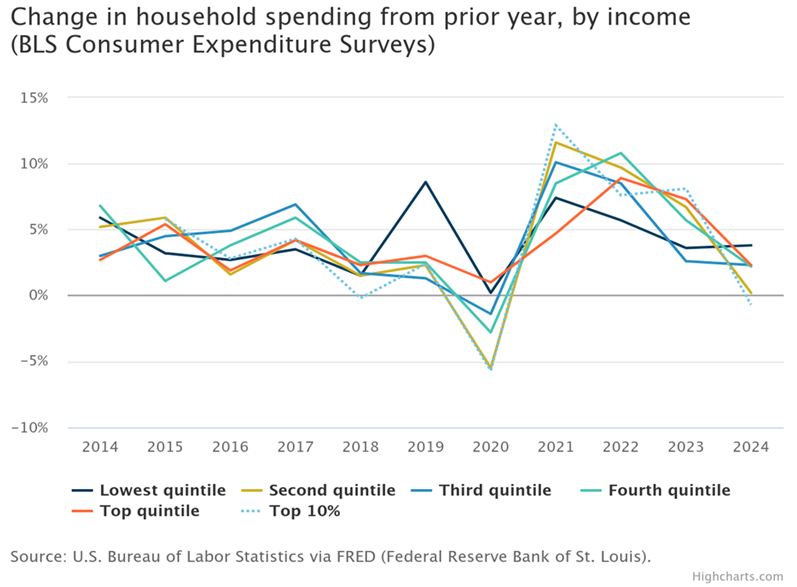
The Fed’s greater research resources let it look at actual income-spending trends more precisely than the rating agency can. When it does, it sees that all income groups have seen their spending grow and decline at more or less the same rate.
And as you can see above, after most people increased their spending after the pandemic, they’ve gone now back to a kind of boring “normal”: neither aggressive spending from the rich nor aggressive cost-cutting from the less-wealthy. Just everyone going back to a trend of moderate consumption.
Preparing for a “Dull” World
What this means for us is simple: As I said off the top, the economy is stable. Here’s another indication of that:
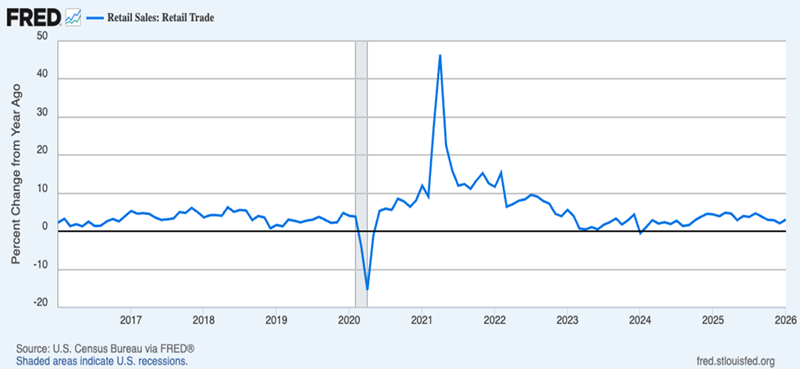
Here we see spending on retail goods by all Americans. It’s now up about 3.1% from a year ago, which is about the average we’ve seen over the last decade.
That, again, indicates a stable economy and maybe more spending in non-retail sales like going out to restaurants, taking more Uber (UBER) rides, et cetera. Spending on airfare, for example, jumped 7% in February. And that was before the Iran war caused the price of airline tickets to spike.
The Move to Make
In this kind of economy, it’s particularly important to be invested in stocks. Our favorite way to do so is through a high-yielding closed-end fund (CEF) like the Eaton Vance Tax-Managed Diversified Equity Income Fund (ETY).
At first blush, you could be forgiven for thinking you’re buying an S&P 500 index fund here: ETY’s top holdings are a who’s-who of blue chips, including NVIDIA (NVDA), Apple (AAPL), Amazon.com (AMZN), Visa (V) and the Coca-Cola Company (KO).
That’s where the similarities end.
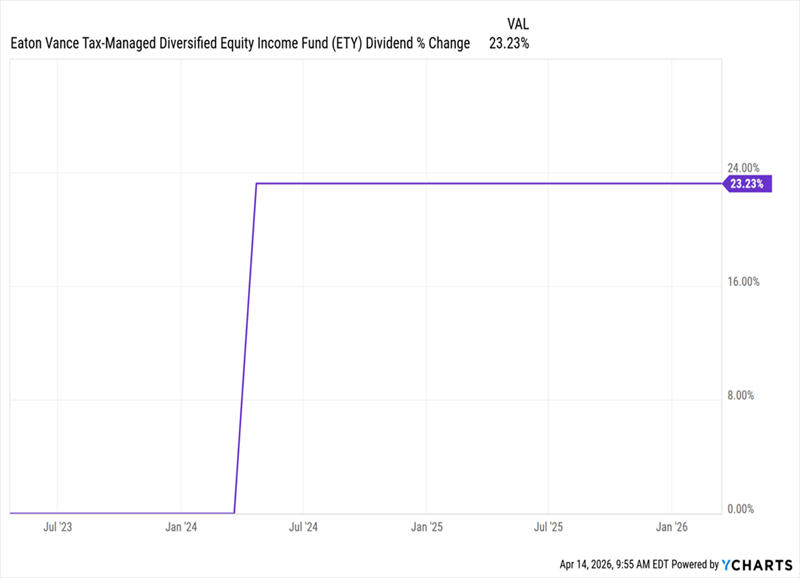
ETY pays nearly eight times what the typical S&P 500 stock does, yielding 8.2%. And the dividend (paid monthly, no less) has jumped 23% in just the last three years:
Big Dividend Gets Bigger
Then there’s the fund’s past performance, which sets it up for a strong run. Over the last decade, ETY has returned around 217%, with much of that coming as dividends, thanks to that high yield. That trails the S&P 500’s return of 291%. But the gap between ETY and its benchmark looks set to close.
Here’s why: In late 2025, ETY’s return based on its market price (in orange below) began to fall behind the performance of its underlying portfolio, or net asset value (NAV, shown in purple):
Investors Sour on ETY, as Its Portfolio Takes Off …
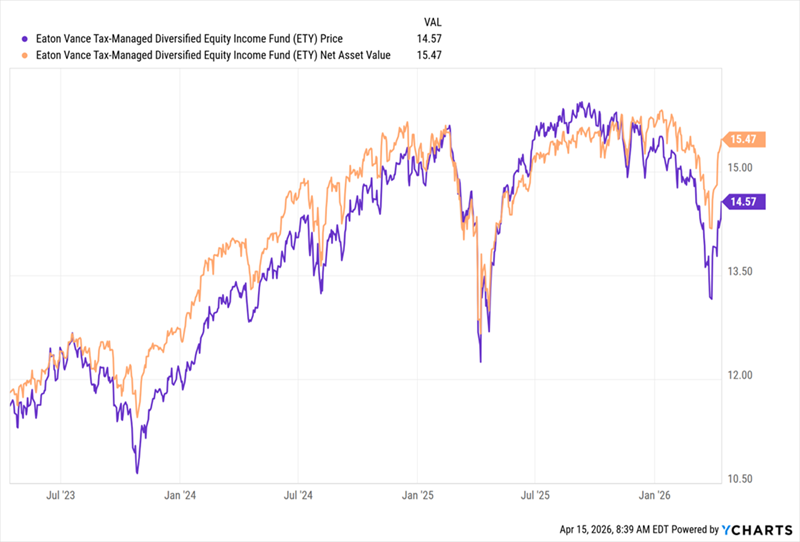
That reflects increasing fear in the market, and has little to do with ETY’s holdings. That’s a key point because it suggests greater gains ahead, especially when you look at the big discount to NAV at which the fund trades as a result:
… Handing Us a Deep Discount
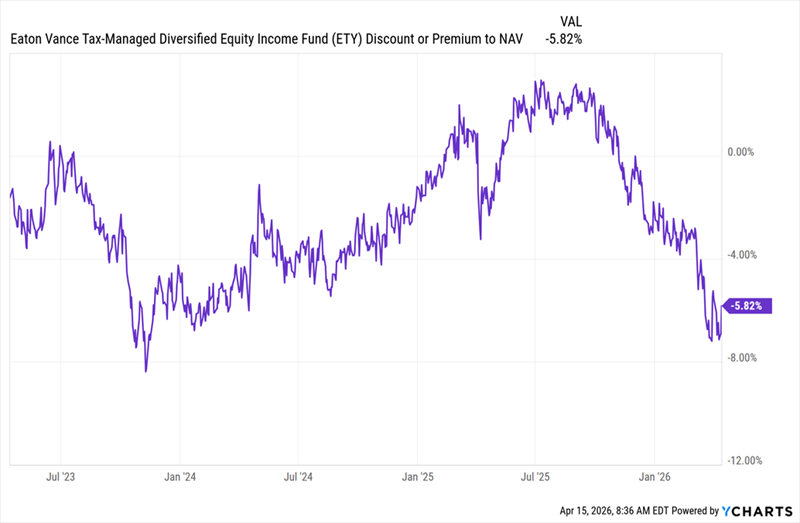
This means we have the opportunity to buy ETY’s portfolio of US blue chips for 6% less than they trade on the open market! That’s a nice “double discount” on these stocks, when you consider the pressure they’re already under, mainly from the Iran War.
I don’t expect this setup to last.
That’s because, over the last decade, ETY has traded at just a 1.9% average discount. A reversion to that level sets up a roughly 4% price gain. And that’s before we talk about further portfolio gains or the 8.2% dividend.
That’s a nice cash stream to pocket while we wait—both for the discount to revert to normal and for the public to come around to the fact that the economy is steadier than most people think.
Most People Have No Idea What’s Coming. We Do. These 10% Dividends Are the Play
AI is about to set off massive upheaval across the economy.
According to leading AI labs, in as little as 18 months, these 4 sectors will look like they’ve advanced by decades.
- In medicine, drug-development times are set to be slashed by years.
- In manufacturing, entire factory floors are being run by machines.
- In finance, a wave of AI-driven dealmaking ignites profits, and …
- In utilities, new power plants are built faster than ever to meet AI’s bottomless power demand.
These are the 4 areas where I see the biggest growth as AI remakes the economy. I call them “pivot points.”
To help us take full advantage of each one, I’ve hand-picked 4 funds (paying 10% dividends on average) that are each dialed straight into its own pivot point.
One pivot point, one fund. And a collective 10% dividend across all four.
Plus all 4 of these funds are cheap now, as most investors have no idea what’s about to arrive. We do.