
A Chinese startup is disrupting the AI world. Middle East worries are spiking oil.
These are the two biggest worries rocking markets now. And if you’re like me, you’re feeling a sense of déjà vu.
Let me take you back to February, when talk of a fight between Iran on one side and America and Israel on the other caused oil to soar and markets to sell off. Right now, that story is repeating (as it has many times as the conflict has ebbed and flowed).
On the AI side, variations of this story have been coming and going since early 2025, when a Chinese company created DeepSeek, a powerful, energy-efficient AI model. Today it’s a Chinese company called Moonshot AI, which released its Kimi K3 model in mid-July.
As for oil, at some point the Iran conflict will come to an equilibrium. No one—the US, Israel or Iran—can afford to have it continue indefinitely.
In previous times when these worries flared, markets recovered. But the word “recover” undersells what actually happened. Since the start of 2025, AI poster child NVIDIA (NVDA) has posted a 41.9% return, even with last week’s selloff. Another AI stock, Micron Technology (MU), has gone further, soaring 780%. The S&P 500, for its part, has returned 26.5%.
These are strong numbers, of course, and they reinforce an old market truth: Over time, stocks rise, provided that demand within the economy is strong.
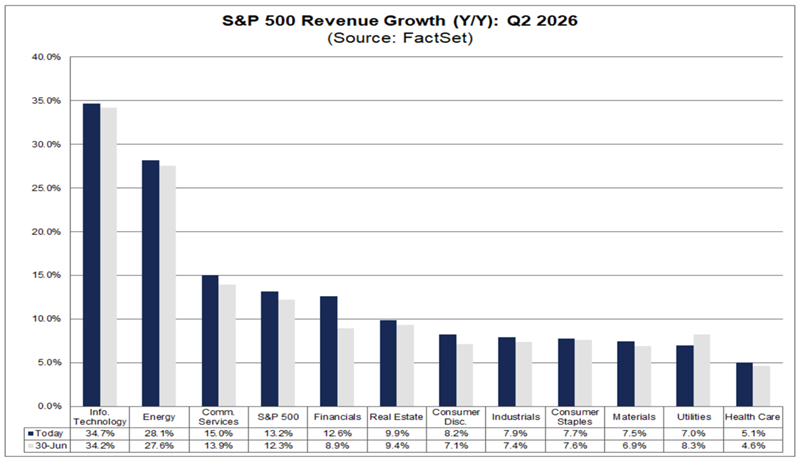
Right now, it certainly is. S&P 500 revenue soared a historically high 13.2% in Q2, and that growth was widely distributed. The slowest-growing sector, healthcare, is still growing faster than inflation.
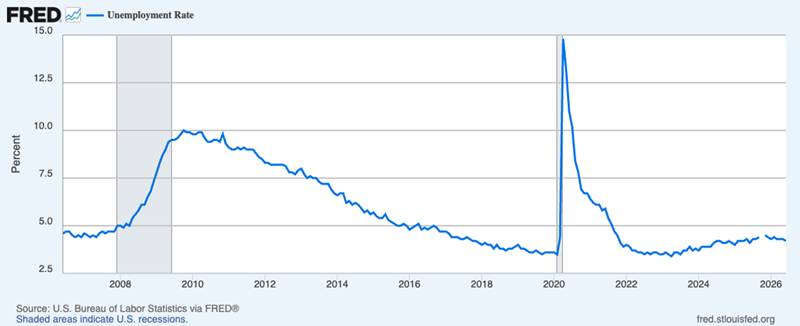
This chart of the US unemployment rate tells us why sales are so strong. From the 2008 financial crisis to COVID, joblessness fell as the US economy grew. But note that it took over five years for unemployment to fall from its post-2008 peak to below 5%. The fact that it has stuck below that level for so long since (with, of course, the temporary hit from COVID) shows the resilience of the US economy.
That fact, plus the overly bearish worries over oil and Chinese AI, makes this a buying opportunity.
Our best play here is a fund that still gives us exposure to the long-term growth prospects in tech but buffers that with other holdings from across the economy. That way if one of its holdings falls, the others are positioned to take up the slack, provided the economy is strong. And, as we’ve seen, it is.
And of course, we want a strong dividend, too.
This is why I recommend buying a high-yielding (and highly diversified) closed-end fund (CEF). To demonstrate the power of a diversified CEF, let’s look at one of my favorites, the Adams Diversified Equity Fund (ADX).
This fund is the oldest holding in the portfolio of my CEF Insider service, with our original buy call coming in July 2017. The fund (in purple below) has easily outrun the S&P 500 since then.
ADX Beats the Market
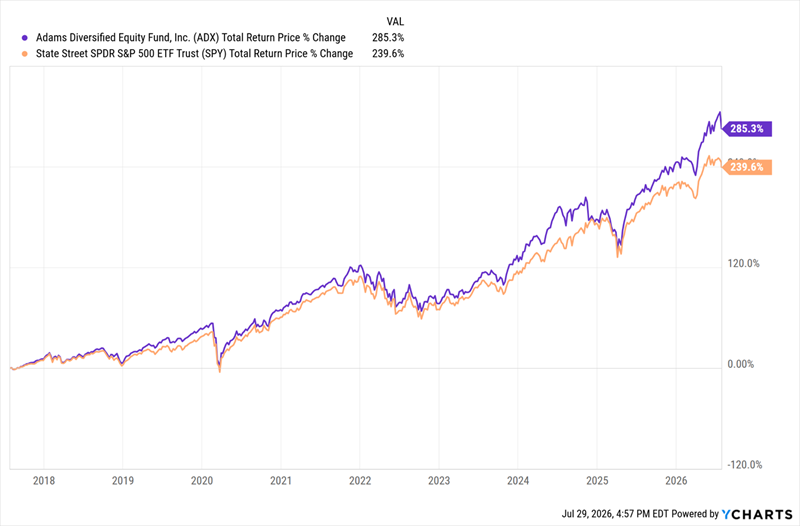
This outperformance—an actively managed fund beating the S&P 500—is something conventional wisdom says shouldn’t last. But this smartly run fund does just that. I attribute some of that strong performance to its long institutional memory: ADX is nearly 100 years old, having launched back in 1929, on the eve of the Great Depression.
We want that kind of experience now more than ever. With “human” managers at the helm, ADX can shift away from technology (currently 37% of the portfolio) and back in as conditions warrant. That’s not the case with an S&P 500 index fund, which must represent all sectors with the same weighting as the benchmark index does.
ADX’s real magic is in its dividend, which yields a stout 8% today. Look at this payout pattern:
ADX’s High—and Stabilizing—Dividend
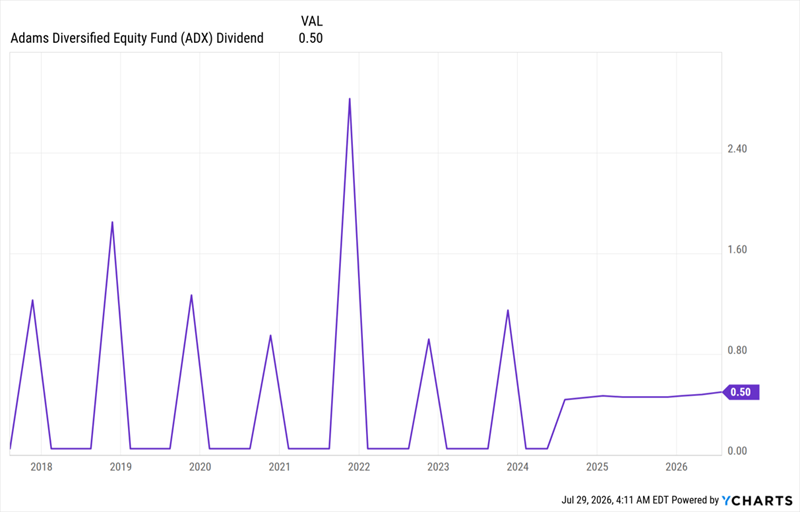
This chart is a bit unusual, and that’s due to a change in its dividend payout policy back in 2024. Prior to that, the fund aimed to return 6% of its net asset value (NAV, or the value of its underlying portfolio), mostly in the form of a big year-end special payout.
Under its updated strategy, it targets 8% of NAV and pays that out in regular quarterly installments. That makes the dividend more consistent, as you can see at the right side of the chart above.
Which brings me to the discount to NAV, our go-to CEF valuation metric. To be sure, the fund’s discount has been grinding toward par all year long, coming close to hitting that mark a couple weeks back. It now trades at a modest discount after pulling back last week.
That’s put the fund below my buy-up-to price as I write this, though I expect it to bounce around that target in the next few days. For my latest advice on the fund, consult our CEF Insider portfolio, whose prices are updated daily, telling members of the service when it’s time to buy.
5 Monthly Paying Funds (Yielding 9.7%) That Are Strong Buys Now
In the meantime, I’ve got 5 other CEFs for you that pay more than ADX: I’m talking a 9.7% yield on average. And their payouts are even more consistent, rolling your way monthly. This kind of 9.7% income stream is exactly what we want in uncertain times like these.
These 5 funds are diversified, too, holding utility stocks, infrastructure plays, tech stocks, real estate investment trusts (REITs) and corporate bonds.
They’re cheap now, thanks to the latest volatility, putting them well within our buy range.
But I don’t expect that to last, as more investors seek these funds out—drawn in by their high payouts (not to mention their eye-popping discounts).
I want to make sure you get in line for their next monthly payouts as soon as possible (and as cheaply as possible). To do so, click here and I’ll tell you more about these 9.7% monthly payers and give you a Special Report with the specifics you need to buy them.