
Every now and then, I’ll field a reader letter asking me what’s more important: dividends or growth?
My answer?

Stock pundits have dogged first-level investors with this false dilemma for decades. They love to sort the world into neat piles for their hot takes, and they’ve decided that companies can either pay us or their R&D teams, but not both.
I could drive a truck through the hole in that logic—and I will.
Then, I’m going to highlight seven dividend stocks that I expect to announce hikes to their cash distributions over the next few months. That includes five companies paying us high yields of up to 11%, as well as a pair of companies that doubled their dividends last year.
The lazy criticism behind dividends is that companies start to pay them—and aggressively grow them—because management has run out of more productive ways to spend that money. If the C-suite believes it’s better off sinking extra dollars directly into our pockets, rather than fund more research or step up marketing, the company’s growth stage must be firmly in the rear-view mirror.
But that’s silly—it’s not a zero-sum game. Many companies that pay and improve their dividends are both growing the top line (which flows into the bottom line) and getting better at turning those revenues into profits. So now they can afford to multitask; they can still crank out innovations and pay us a tidy sum.
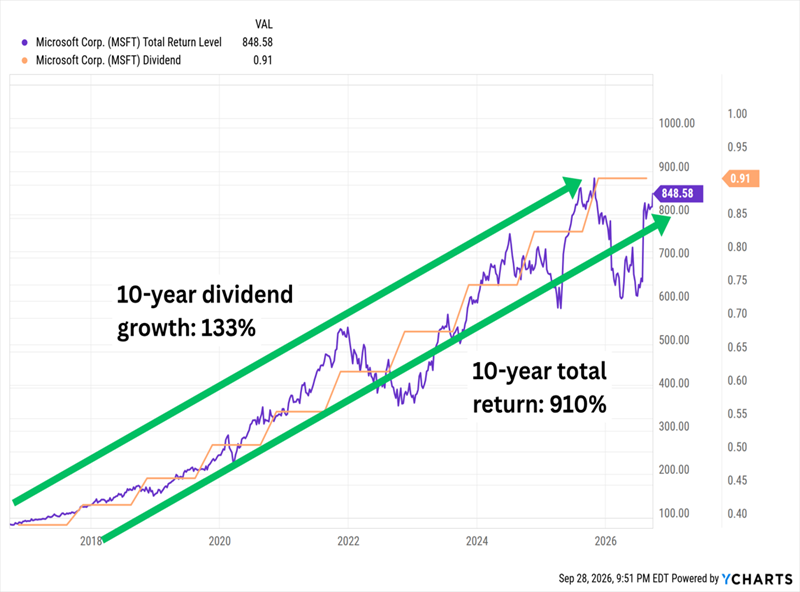
The tech sector is full of these stories, but here are two of the most recognizable:
No One Is Accusing Microsoft of Being Behind the Times
Or Broadcom Either
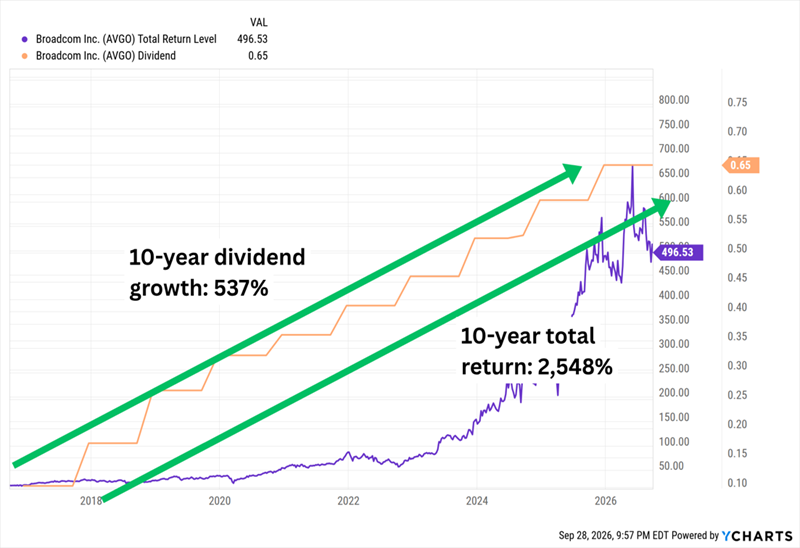
In both cases, breakneck income improvement wasn’t a sign of stagnation—it was a sign that each had taken new steps in their ability to churn out cash.
I call this phenomenon the “Dividend Magnet.” Rising dividends tend to pull prices upward, so we get paid in two ways: higher stock prices, and a continuously growing “yield on cost.”
That’s why I keep regular watch on the earnings and dividend-announcement calendar. Big splashes and continuing trends of generosity are a goldmine for double-threat stocks. On my radar right now?
- A pair of recent dividend doublers
- Five companies paying up to 11% that still appear to have more money to share with us.
2 Dividend Doublers
I’ll start with the red-hot dividend growers. They won’t bowl anyone over with their current yields, but they could evolve into portfolio cash cows if they keep up this pace.
GE Vernova (GEV, 0.2% dividend yield), the General Electric clean-energy division that was spun off in April 2024, wasted little time getting its dividend up to speed. Near the end of 2024, GEV announced it would pay its first dividend—25 cents quarterly—in January 2025. Fast-forward to December 2025, and it announced it would double that distribution.
More could be on the way. Vernova was unprofitable as recently as 2023, but its bottom line has exploded over the past three years: $5.64 per share in 2024, then $17.96 in 2025, then on pace for $35.42 in 2026. Wall Street thinks earnings will cool off next year, but GEV still stands to benefit longer-term from growing demand for power infrastructure. Also, its dividend is just 8% of 2027 estimates. That’s miles of room for the payout to run. Expected dividend announcement: Early December.
PG&E (PCG, 1.6% dividend yield), a California utility, also doubled its dividend last year, but its situation couldn’t be any more different than GE Vernova’s. The company suspended its distribution in 2017, then declared bankruptcy in 2019, because it faced tens of billions of dollars in liabilities connected to years’ worth of devastating wildfires. But it exited Chapter 11 protection in 2020, revived its dividend program at a penny per share in 2023, then juiced that payout by 150% in 2024 and 100% last year.
PCG has taken a beating over the past month or so after the California legislature blocked Gov. Gavin Newsom’s plan to insulate utilities from wildfire liability. Shortly after that, the utility announced it would undergo a “strategic review” and said it would defer approximately $2 billion of work in 2027 to put off higher-cost borrowing. This stock faces a lot of risk, and the environment looks downright hostile to the hopes of a dividend hike later this year. The silver lining? PG&E is projected to keep growing its profits this year and next, and the current distribution represents just 12% of 2026 earnings estimates. The utility average is closer to 60%. That makes PG&E’s investor-relations page a must-watch in a few months. Expected dividend announcement: Early December.
5 High-Yield Growers
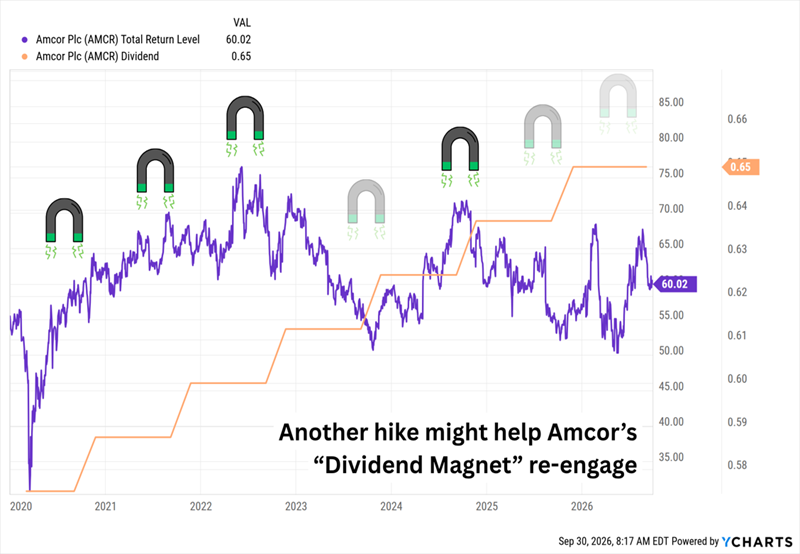
Amcor (AMCR, 6.1% yield), a global packaging giant, is an income unicorn. It’s a Dividend Aristocrat (by virtue of its 2019 tie-up with Bemis) that both pays a healthy yield and is reasonably priced. It made my recent write-up of inexpensive dividend stocks, and it’s still cheap, at around 6 times cash-flow estimates.
The war in Iran and weak consumer spending have hampered Amcor’s business this year, and AMCR shares have delivered a flat return in response. But the company has kept its results ahead of the Street thanks to strength in its foodservice and pet care lines, and it’s still on pace to grow this year’s bottom line by low double digits. Its 2025 acquisition of rival Berry Global could also be a cash-flow driver in coming years. Dividend coverage isn’t exactly loose at 65% of this year’s earnings estimates, but potential growth gives Amcor room to deliver more than the 2% hikes it has been shelling out over the past few years. Expected dividend announcement: Late October/Early November.
Amcor Could Use a Pick-Me-Up. Dividend Hike #43 Could Do It.
Getty Realty (GTY, 6.8% yield) is a real estate investment trust (REIT) that owns 1,245 “freestanding” (single-tenant) retail properties across 46 states and the District of Columbia. It’s also one of the most stable businesses we’ll find. While it’s technically a retail REIT, it’s no fickle mall operator—it’s a landlord for convenience stores, auto service centers, drive-through quick-service restaurants, gas stations, car washes, and more.
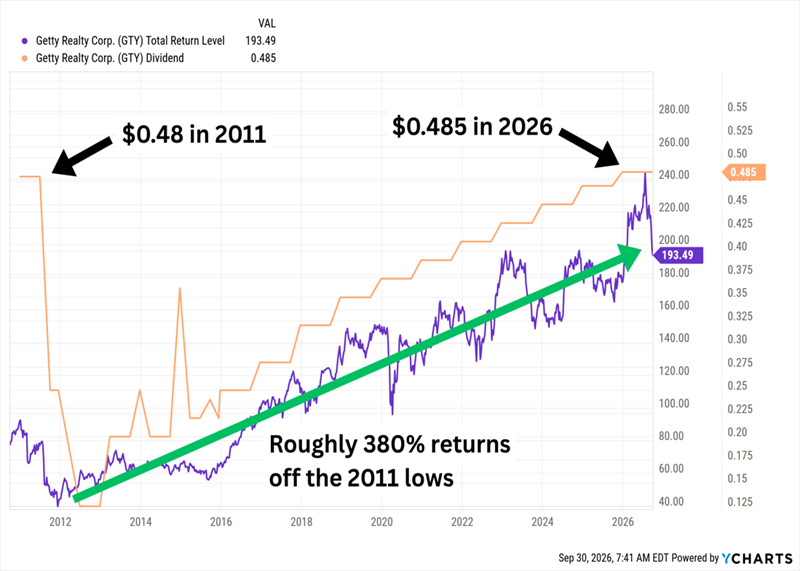
It wasn’t always so safe. Getty Realty once rented out roughly 70% of its properties to Getty Petroleum Marketing (GPMI), but it was forced to terminate leases for nonpayment for rent, and GPMI filed for bankruptcy. GTY had to hack down its dividend twice—by 48% in 2011, then another 50% in 2012. Since then, it has broadly diversified its portfolio and, as of 2025, brought the dividend back above what it was paying prior to the cuts. Getty’s current dividend accounts for 77% of 2026 estimates for funds from operations (FFO), which is a fairly safe level that should accommodate even more growth. The size of its next hike could be an indication of how worried it is (or isn’t) about spending power in its lower-income customers. Expected dividend announcement: Late October.
GTY Is Feeling the Pinch of Late, But Still Well Within Its Uptrend
MPLX LP (MPLX, 7.5% yield) is an oil-and-gas master limited partnership (MLP) that acts as the holding vehicle for Marathon Petroleum’s (MPC) midstream assets. Those include pipelines, refineries, natural gas liquids (NGL) gathering systems and processing complexes, NGL fractionation facilities, storage caverns, tank farms, motor vessels and barges, and other joint MPC/MPLX assets.
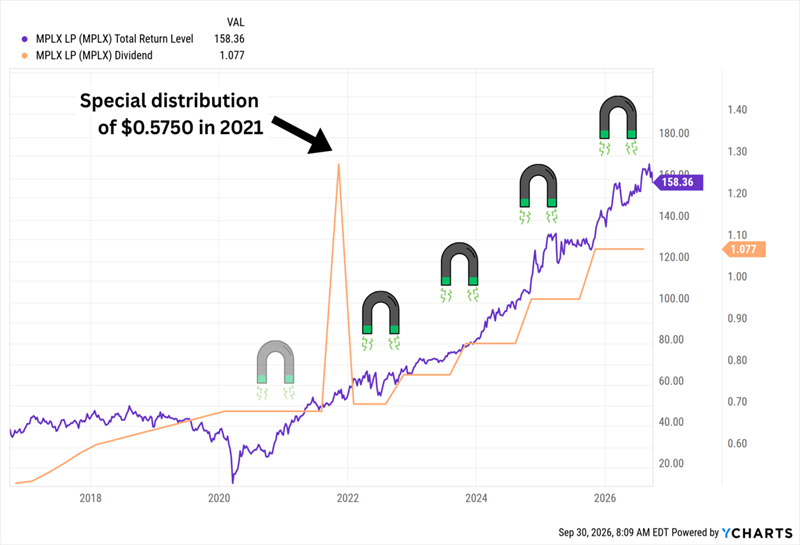
This high-yielding energy stock is the poster child for my argument that dividend growth is no sign of operational “slowth.” MPLX is expanding its Permian Basin gathering and processing capabilities, as well as its fracking capacity, and several growth projects have either come online already in 2026 or should be live by the end of the year. And it’s doing all this while maintaining an unbroken streak of distribution increases since the COVID dip that management believes will continue at least this year and next. Expected distribution announcement: Late October.
Ever Since the Pandemic, MPLX Has Been Powered Up
Delek Logistics Partners LP (DKL, 8.5% distribution yield), which is tethered to Delek US Holdings (DK), is another energy midstream MLP with operations in the Permian. It owns about 1,200 miles of crude and refined-product pipelines, as well as gas processing plants, water services, several joint-venture pipeline assets and more.
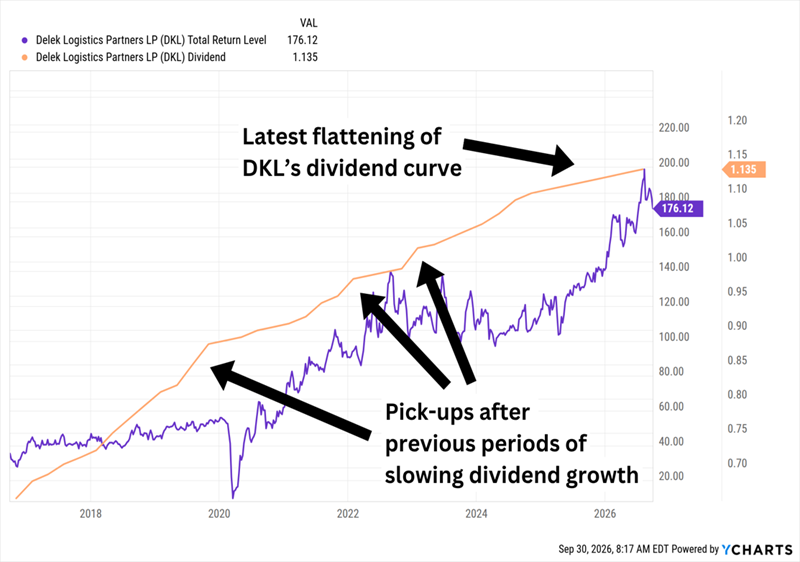
The expansion of new pipeline projects is improving pricing, which in turn is making drilling on its acreage more appealing. Its sour gas “sweetening” treatment is also attracting producers. That bodes well for DKL, but the proof will be in the payout. Delek Logistics Partners is already one of the highest-paying MLPs on the market. But it’s also a quarterly raiser, and has been for years. Its distribution growth has been slowing, though I’ve pointed out in the past that Delek’s pace has ebbed and flowed in the past without breaking the streak. Expected distribution announcement: Late October.
We Don’t Want to See This Line Go Fully Horizontal
NexPoint Residential Trust (NXRT, 11.0% yield) is a residential REIT that owns 36 properties with 13,305 units in 10 markets across the Sun Belt. Most of its properties are Class B multifamily leased out to “workforce” and middle-income residents. It focuses on providing “value adds,” which is simply upgrading its properties to warrant higher rents. Improvements such as interior rehabs, new appliances and the addition of smart-home tech produce meaningful rent premiums.
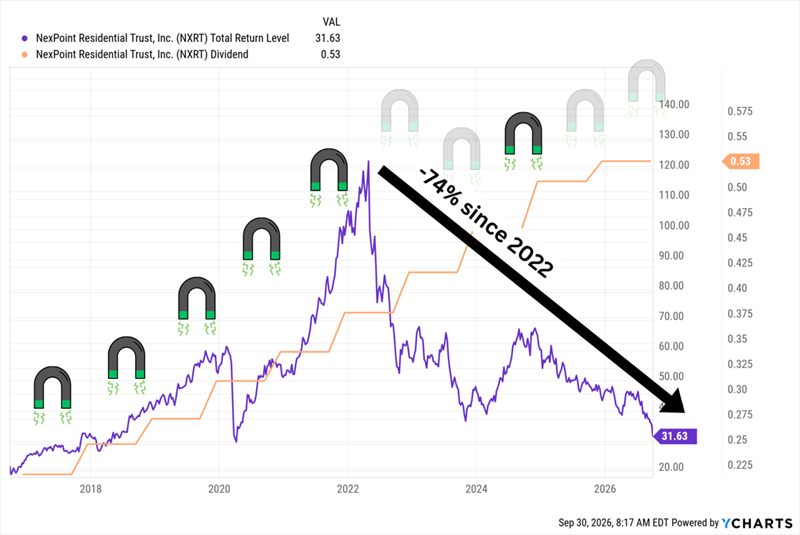
This could be one of the biggest dividend announcements of the upcoming quarter. NXRT has been in a massive downtrend since 2022, and it has fallen off a cliff in recent months. The yield has exploded from just under 8% to 11% since my write-up on NexPoint and other REITs in June, in large part because of interest-rate fears. The company is heavily levered, and most of that debt is set to become more costly after the Fed’s recent hike. The Street isn’t just whispering about a dividend cut here—at least one analyst has flagged NexPoint’s ability to cover the distribution with its cash flow. A little reassurance from management would go a long way. We’ll likely get at least a sign (one way or another) in a few weeks. Expected dividend announcement: Late October.
NexPoint’s Price Has Completely Detached From Its Dividend
Live Off $500K For Life … And Save Yourself From 12 Ticking Dividend Time Bombs!
The last dividend-growth I want to tell you about is a monthly dividend stock serving the small-business community. It’s just a few weeks away from announcing what I expect to be yet another hike to its already fat paychecks. And it’s one of the “No Withdrawal” stocks I’m relying on to keep me well-financed when I retire.
See, sky-high yielders that still pony up a little more coin each year aren’t just nice-to-haves … they’re must-owns if we want to make it to (and through) retirement.
Think about it: The talking heads on CNBC and Fox Business tell us we need to have $1 million, $1.5 million, $2 million saved up for a comfortable retirement.
But the average 55- to 64-year-old has just more than $500,000 socked away!
What will that half-million get you?
- If you invest that $500,000 in a traditional 60/40 portfolio, you’ll earn $26,900 a year. That’s just above the poverty line.
- If you invest that $500,000 in my 8% “No Withdrawal” Retirement Portfolio, you’ll earn an annual income of 8%, 9% or even 10%+. That means you could bank $40,000 to $50,000 (and potentially more) each year!
How could you earn even more? Because the income powerhouses I hold aren’t done growing their distributions.
Let me introduce you to this dividend grower and all of my other high-yield retirement names, and teach you how to live off $500,000 for the rest of your life. Click here, and I’ll share the details on these secure and generous dividends—and reveal my “Dirty Dozen” list of 12 dividend stocks every investor needs to sell now!