
We need to talk about four of the cheapest dividend payers on the planet. I’m talking about blue-light bargain valuations and, our favorite, serious high yields!
These four pay from 4.7% to a terrific 12.6%. Yet the Wall Street suits have left them for dead, on the side of the road (or Street, if you will!). Which is fine with us careful contrarians. We’ll sort through the sale rack.
Let’s start with a telecom that stays cheap yet keeps paying us nearly 5% because this divvie perennially finds its way into the suits’ doghouse.
AT&T (T)
Dividend Yield: 4.7%
AT&T (T) is one of telecom’s “Big Three” alongside competitors Verizon (VZ) and T-Mobile US (TMUS).
On the upside, it enjoys an effective triopoly of the U.S. wireless market, where barriers to entry are sky-high. It also has some business diversification, servicing some 15 million domestic broadband customers, as well as 25 million wireless customers in Mexico.
These are heavily saturated markets, however, and they have been for quite some time. That’s why, from a pure price perspective, AT&T’s stock has never eclipsed its pre-dot-com peak. Most of its returns over the past few years have come from the dividend, making T feel more like a bond than a stock.
That Dividend Isn’t What It Used to Be, Either
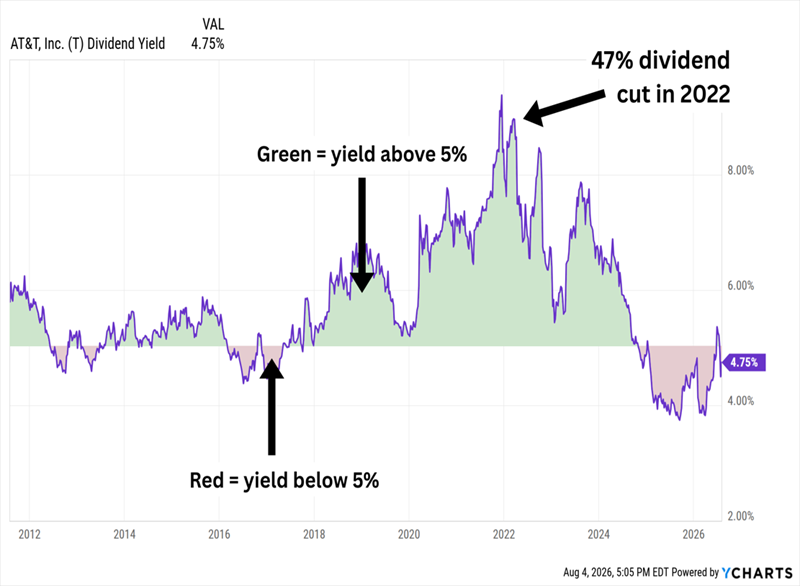
AT&T slashed its dividend by almost half in 2022 in an effort to both reduce its debt and pay for the continued buildout of its 5G and fiber infrastructure. A sharp rally between 2023 and 2025 was a further drag on the yield, which eventually sank below 4%.
Shares are now paying closer to 5% again, and AT&T (which historically trades at cheap multiples anyways) looks more attractive than it has in about a year. The stock trades at less than 4 times cash-flow estimates; a 0.9 price/earnings-to-growth (PEG) ratio also suggests shares are on sale. (Remember: Any PEG below 1 implies a stock is undervalued.) We would be getting a stable stock, too, with a beta south of 0.5 signaling AT&T is less than half as volatile as the broader market.
But we would also be buying into an uncertain and unfriendly business environment. Cost pressures and price competition are weighing on the business again, IT spending has largely been concentrated in artificial intelligence and data centers instead of 5G and fiber, and economic sluggishness has weighed on consumer demand.
Amcor (AMCR)
Dividend Yield: 5.6%
It’s rare for Dividend Aristocrats to go on sale, and it’s even rarer for them to pay much at all, let alone the 5%-plus that Amcor (AMCR) is currently throwing off.
Amcor makes food-related packaging products, including high-barrier paperboard trays for beef and meats, glass dressing bottles, overwrap for home and personal care. Its products are also used in garden and outdoor products, agriculture, pet care, healthcare, even building and construction.
The company went from a major player to an outright juggernaut last year when it bought rival Berry Global, and so far the deal has been a winner, with Amcor ahead of schedule on synergies. On the flip side, AMCR has struggled with weak consumer spending, which has put a lid on volumes.
In other words: Amcor is delivering M&A growth, but what we need to see more of is organic growth.
Shares have been up and down since I looked at Amcor in November—not much different from how AMCR has traded since recovering from its COVID lows. Dividend growth has been modest, too.
42 Consecutive Years of Raises, But Recent Hikes Have Been Chintzy
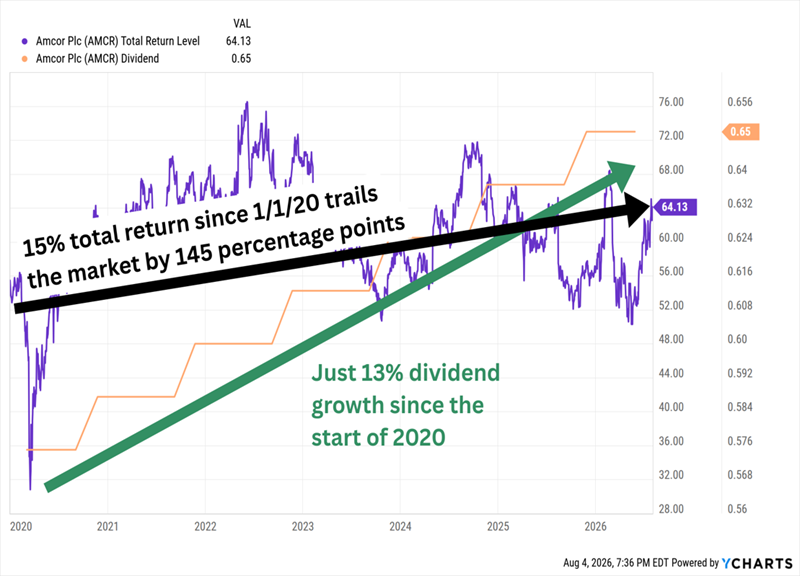
If we did want to hold AMCR and wait for the economy to unleash this packaging giant, we wouldn’t have to pay much. Shares trade at less than 6 times cash-flow estimates and a thin PEG of 0.2. And we’d be collecting more than 5% for our patience.
Concentrix (CNXC)
Dividend Yield: 5.6%
Subscribers to my Hidden Yields service are probably smiling at the mention of Concentrix (CNXC), a global provider of customer service, tech support, sales and digital operations.
That’s because a little more than a year after we bought TD Synnex (SNX), it spun off Concentrix, unlocking a boatload of value in both companies. In fact, we booked 80%-plus gains in SNX, and we more than doubled our money in CNXC.
And Our Timing Couldn’t Have Been Better
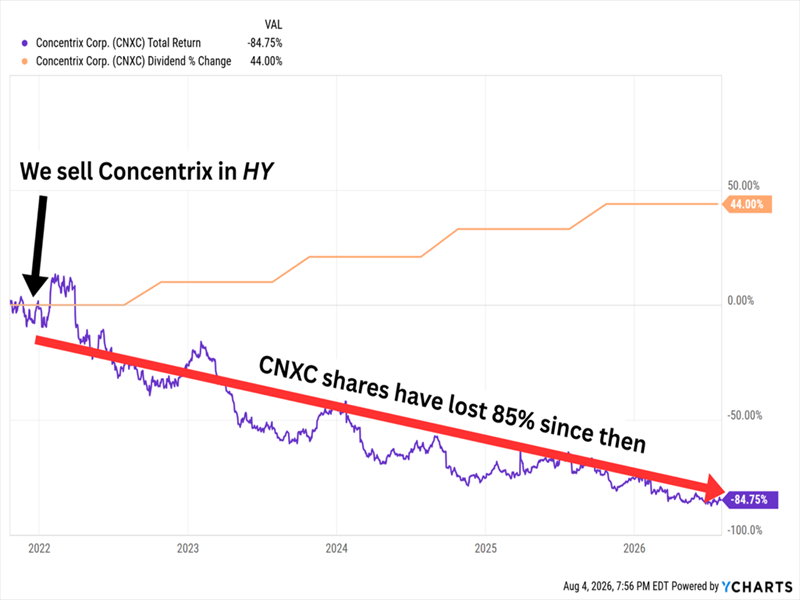
Concentrix has been hampered by numerous issues, but No. 1 with a bullet is artificial intelligence. Wall Street is increasingly convinced that automated AI agents will replace human customer service workers, disrupting CNXC’s business process outsourcing (BPO) operations. And clients have been redirecting funds away from outsourced headcount to fund their own internal AI development.
What comes next largely rests on its response: the Concentrix Intelligent Experience (iX) Product Suite, which is an enterprise-grade AI and generative AI technology toolkit. During the company’s most recent earnings conference call, CEO Chris Caldwell said his company saw “a record level of contract signings for our iX Suite of technology, up 400% year-over-year for the number of deals.”
Investors clearly doubt that Concentrix can reinvent itself as an AI customer-experience company, and we’re being dared to take the other side of that trade. CNXC stock trades at just 2 times cash-flow estimates and a PEG of 0.4.
Concentrix is also paying us dearly to believe in it, at almost 6% at current levels. And as the chart above shows, that dividend has been growing despite its troubles. The current payout represents 55% of earnings estimates for each of the next two years, which is plenty sustainable—as long as CNXC doesn’t decide to redirect that cash toward solving its business-model crisis.
Innovative Industrial Properties (IIPR)
Dividend Yield: 12.6%
Innovative Industrial Properties (IIPR) is a capital lifeline for the cannabis industry, serving as both a landlord and a primary lender in the space. As I’ve described the business before:
IIPR buys dispensary facilities from the operators who are often short on cash and can’t finance their buildings because of the many roadblocks set up between cannabis businesses and banks. In the transaction, IIPR hands them a chunk of cash they badly need. Then it leases the facility back to the operator for 15 to 20 years.
Because traditional banks won’t touch the space, Innovative Industrial Properties negotiates incredibly favorable leases. They have long durations, built-in rent escalators and guarantees from the large corporate multi-state operator-lessees.
IIPR was one of many cannabis stocks that bubbled up and eventually popped post-COVID. Excitement over momentum in state-level legalizations drove years’ worth of speculation. However, investors eventually faced reality: The industry’s growth remains limited by America’s federal prohibition of marijuana, as well as other legal and financial red tape.
But while Innovative Industrial Properties’ shares cratered alongside growers and retailers, its plumped-up dividend remained.
Dividend Growth Has Screeched to a Halt, But IIPR Is Still Paying a Substantial Sum
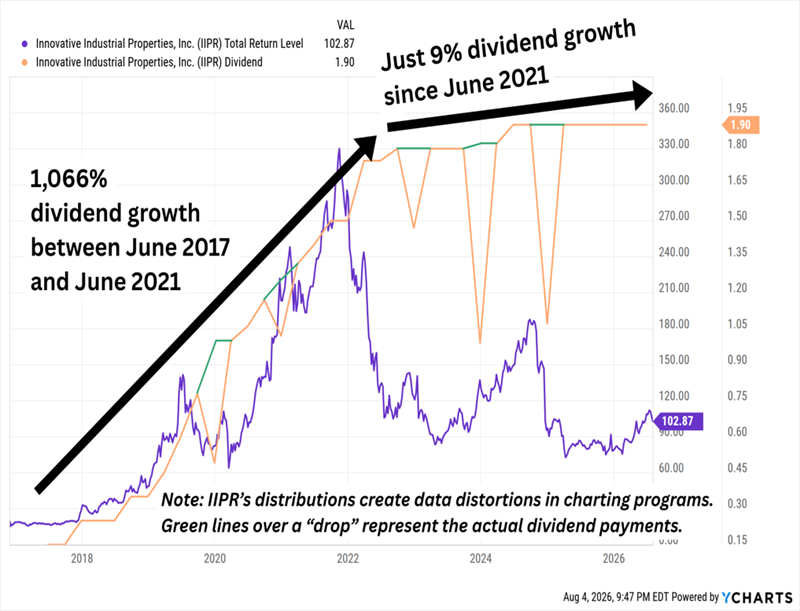
Thanks to IIPR’s stock losses, the company now trades at about 8.5 times adjusted FFO (AFFO) estimates, and the yield is a wild 12.6%. But the math is uncomfortable: The REIT shells out $7.60 annually but expected to earn just $7.14 in AFFO per share this year.
An important headline to watch out for in the coming months is whether the Drug Enforcement Administration rules in favor of the Trump administration’s cannabis rescheduling proposal. Earlier this year, Acting Attorney General Todd Blanche issued an order reclassifying state-licensed medical cannabis and FDA-approved marijuana products from the extremely restricted Schedule I (high abuse risk, no accepted medical use) to Schedule III (relatively low abuse risk, accepted medical uses). The proposal the agency is considering would more broadly move marijuana to Schedule III.
Put differently: Cannabis would go from being treated like heroin to being treated like Tylenol With Codeine.
Avoid the Retirement ‘Death Spiral’: Collect 8% or More for Life
“Stealth” plays like these underloved stocks are exactly how I’m going to retire on dividends and interest income alone.
Millions of investors cross their fingers and hope that the S&P 500 and the “4% rule” will get them through retirement. Fat chance.
The 4% rule works until it doesn’t. Every few years, the market will dip and force you to sell more shares when prices are low—which means when shares rebound, you need an even bigger gain just to get back to your original value.
It’s a retirement death spiral.
But I don’t sweat market downturns. That’s because I’ll just sit on my 8% “No Withdrawal” Retirement Portfolio, which produces a high enough level of income that I can fund my retirement without even touching my nest egg.
The “No Withdrawal” portfolio can turn just $500,000 in savings into a $40,000 retirement “salary.” If you’ve socked away even more, all the better!
Let me show you the stealth payout plays that Wall Street overlooks—names that yield 8%, 9% or even more that can help us coast forever on dividends alone. Please click here and I’ll share the details on these secure funds with very generous dividends!