
The recent blowup at Situational Awareness, a hedge fund run by a so-called AI “whiz kid,” tells us a lot about the mindset of the mainstream crowd these days—and what we need to do to avoid falling victim to it.
In fact, the same selloff that broke Situational Awareness put one of our favorite tech CEFs on sale. More than that: This steady payer is trading near discount levels not seen in more than a decade.
An AI Fund Built on Hype and Debt
After working at OpenAI (and being fired in April 2024), Leopold Aschenbrenner wrote an essay called “Situational Awareness” that got a lot of attention and later became the name of his hedge fund.
His celebrity then soared so high that he was able to raise $225 million that, by June 2025, had grown to $45 billion, driven in large part by inflows and leverage up to 400%, according to CNBC.
That was all well and good until this latest semiconductor selloff, which sent the benchmark ETF for the sector, the VanEck Semiconductor ETF (SMH) down around 25% from its year-to-date peak to the trough of its plunge. (It’s since taken some of that drop back, down around 15% from its 2026 peak).
At that point, Aschenbrenner wrote six words to his investors that may have been the understatement of the year: “We let you down this month.”
No kidding! Situational Awareness was facing a margin call and was at risk of going to zero. And worse losses are possible as a result of tax obligations the fund’s outside partners may have because of the forced selling SA had to do to meet those calls.
In other words, Situational Awareness had borrowed too much money on margin and didn’t have the cash to pay it back.
The fund’s massive returns, then, weren’t really about AI, or even picking the right stocks. Instead, Situational Awareness had aligned itself with a hot trend and then borrowed to the max to ride it. The whole time, of course, it lacked any kind of risk management.
In Wall Street jargon, Aschenbrenner’s fund wasn’t delivering alpha at all: it was just levered beta.
Prudent Investors Still On Top
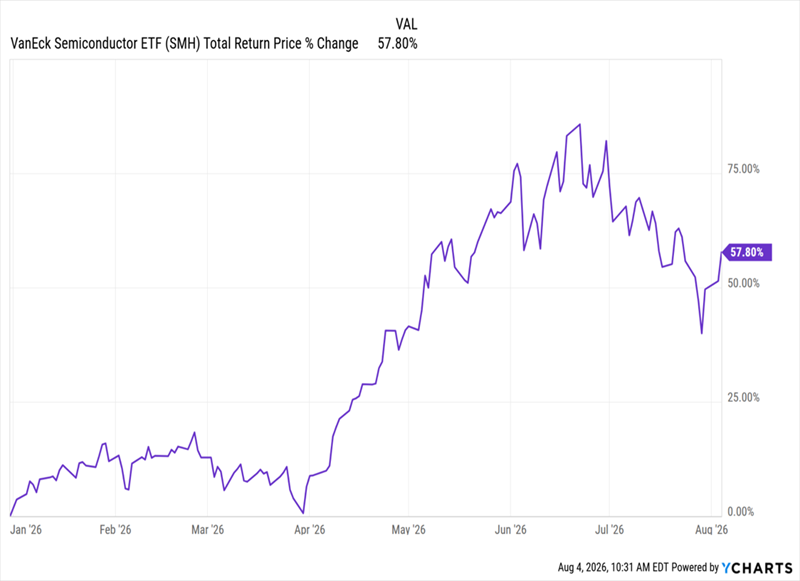
Beyond the Greek letters, that difference matters: an investor who didn’t overuse leverage and simply bought SMH, the go-to semiconductor ETF, has done fine, has faced no margin calls, and has seen their investment slowly recover after Situational Awareness’s margin call.
To add insult to injury, Situational Awareness had to sell its public stocks to one of the oldest and most respected hedge funds on Wall Street: Citadel, which is already profiting from this trade.
There is one particularly odd twist about this story, though: Situational Awareness actually remains up for the year, to the tune of 80%. But that is a result of the fund’s investment in private shares of Anthropic (which is another story we won’t get too far into here).
A Sensible Tech Alternative Trading at a Sudden Discount
All of the blunders that sent Situational Awareness plunging—way (way!) overdone leverage, inexperienced (to be polite) management and far too little attention paid to risk-management—melt away when you go with a well-run closed-end fund (CEF), especially those we hand-pick and safety-check through my CEF Insider service.
These funds are well-diversified, managed by financial experts and, most importantly, when they do use leverage, they use a reasonable amount, positioning themselves to enhance returns in a rising market while still managing the risk in a market drop (unlike Aschenbrenner’s Situational Awareness).
Better still, we can still take advantage of the semiconductor selloff to grab one of our favorite tech CEFs at a sudden discount: the Columbia Seligman Premium Technology Growth Fund (STK), which trades at an 8.9% markdown to its net asset value (NAV, or the value of its underlying portfolio) as I write this:
STK’s Back-to-2014 Discount
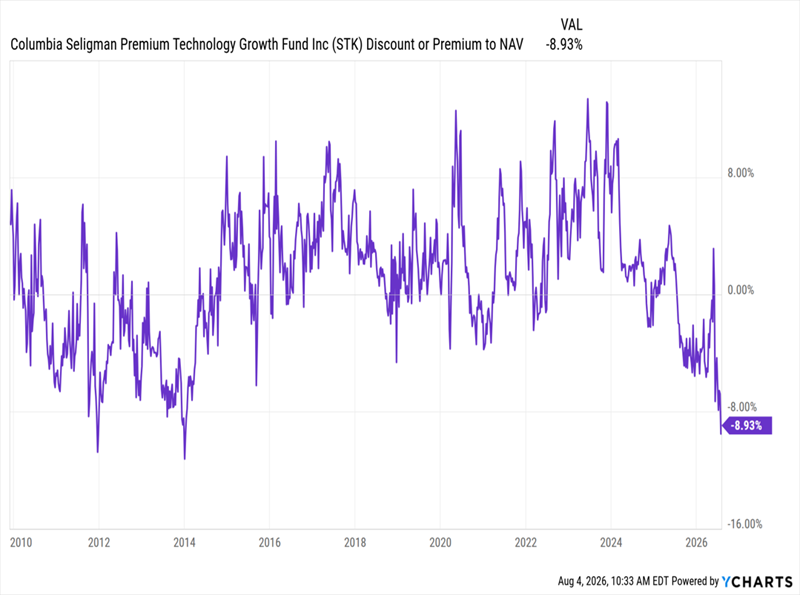
That’s a vastly overdone markdown on this terrific fund, which holds NVIDIA (NVDA), Bloom Energy (BE), Lam Research (LRCX) and other cutting-edge companies benefitting from the tech run-up.
And despite that discount, the fund’s performance has been strong this year, even though STK’s return was crimped by the semiconductor selloff (as you’d expect):
A Market-Crushing 2026 Return
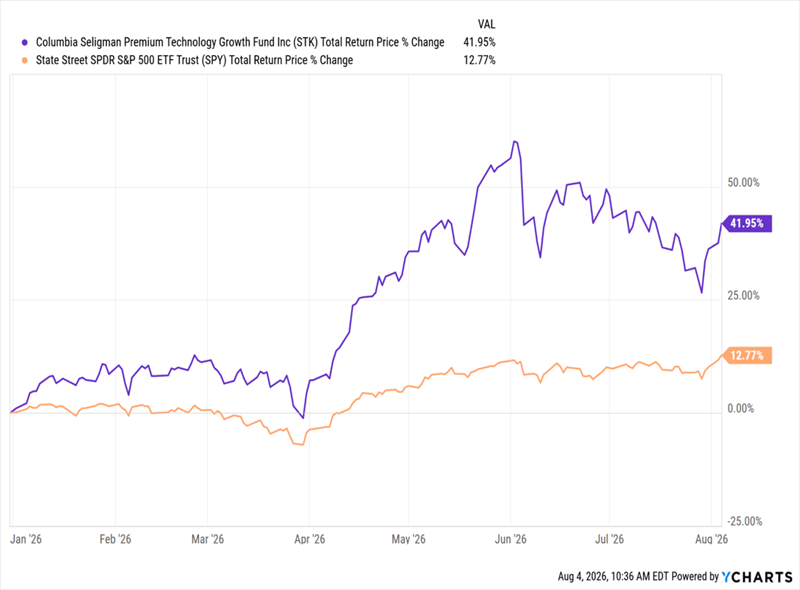
Note that the recent selloff did crimp STK’s total returns this year (in purple), but it’s still well ahead of the S&P 500. That doesn’t surprise me, given the fund’s long-term track record.
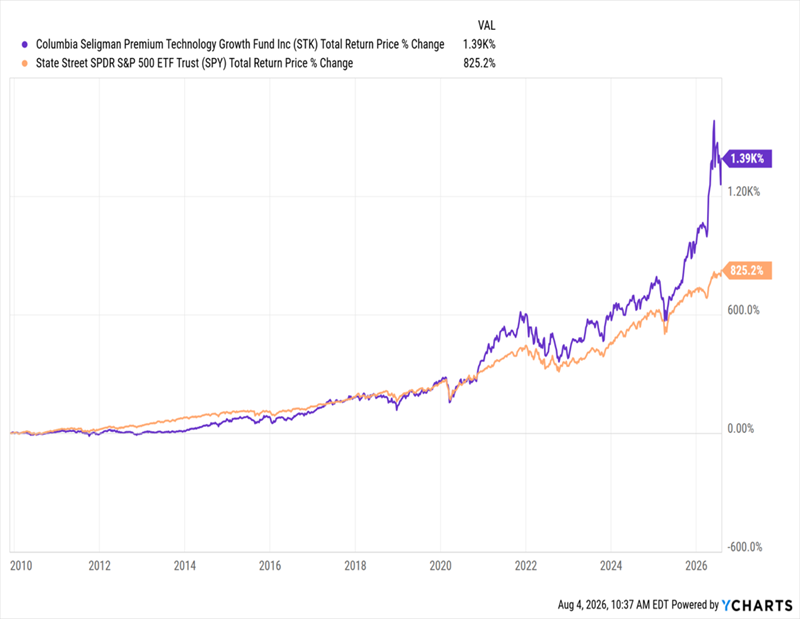
STK is up more than 1,300% since its inception in 2009, and as you can see above, its performance continues to improve in relation to the S&P 500.
The fund’s yield looks thin for a CEF, at 3.8%. But that’s a feature, not a bug: It’s entirely the result of the soaring share price. Further, it has a history of being consistent, with regular year-end special dividends, too.
And I think you’ll agree that with a long-term total return like this fund has, we’ll happily forgo some dividend income! Especially since it keeps us off the rocks that pretenders like Situational Awareness have run up on.
4 CEFs Cashing In on AI’s Next Wave (While Paying Us 10% a Year in Cash)
STK is just the start of our AI play at CEF Insider. The fund nicely gets us started with a sturdy (and dividend-driven) growth angle.
Now we’re going to go further and grab 10%+ current yields as AI spreads throughout the economy.
Our tool? Four “stealth” funds that let us hold low-key AI winners, like insurance companies, banks and pharmaceutical firms. These firms are all subtly adopting AI and using it to make better decisions. Or, in the case of pharma stocks, to bring new treatments to market faster than ever before.
The 4 CEFs I recommend hold the most innovative companies in all of these sectors. All 4 are cheap now, but I don’t expect that to last as more investors pick up on their discounts and the 10% average dividend on offer here.