
Our favorite 9.5% dividends are on sale, and very few investors realize it.
It’s a striking situation because a payout that size handily beats a 10-year Treasury. Sure, the 10-year pays about 5% now. And it’ll pay you that for a decade, until you get your principal back.
But that’s still only a bit more than half of what these 9.5% payers—called closed-end funds (CEFs)—pay on average. Plus, unlike a Treasury, we can buy these funds’ portfolios for less than they’re actually worth, putting the potential for big upside on the table, too.
In fact, because so many investors are currently dazzled by those Treasury yields, we have a unique chance to buy our favorite CEFs at an unusually deep 7.8% average discount (more on that in a moment).
Before we get into how we’re going to play this field of nearly 400 funds, I want to put one particular CEF in front of you. It’s jumped back on my radar for plenty of reasons, including:
- A high yield (9.2%).
- Sustainable payouts. (This payout has grown over the last 16 years, with special dividends, too.)
- A deep discount (11.3%).
- Strong performance. (We’re talking 13%+ annualized returns here.)
It’s called the Virtus Equity & Convertible Income Fund (NIE), and we know it well at my CEF Insider service. We’ve held it three different times, and it’s delivered positive returns every time.
The latest? A 58% total return in a little over four years, from March 2022 to May 2026. And we collected the fund’s handsome payout over that entire span.
NIE Pays Nearly Twice What Treasuries Do, Trades for 89 Cents on the Dollar
NIE is a tidy “one-stop shop” for stock and fixed-income exposure. It holds blue-chip stocks like Alphabet (GOOGL), Apple (AAPL), Amazon.com (AMZN), and Caterpillar (CAT). It then adds highly liquid, high-yielding convertible bonds and convertible preferred stocks to boost its income. It caps all that with an option-selling strategy to provide a bit of extra cash.
The result is what you see below: a dividend paying that 9.2% yield and that hasn’t been cut since the 2008/2009 financial crisis.
A Time-Tested 9.2% Payout
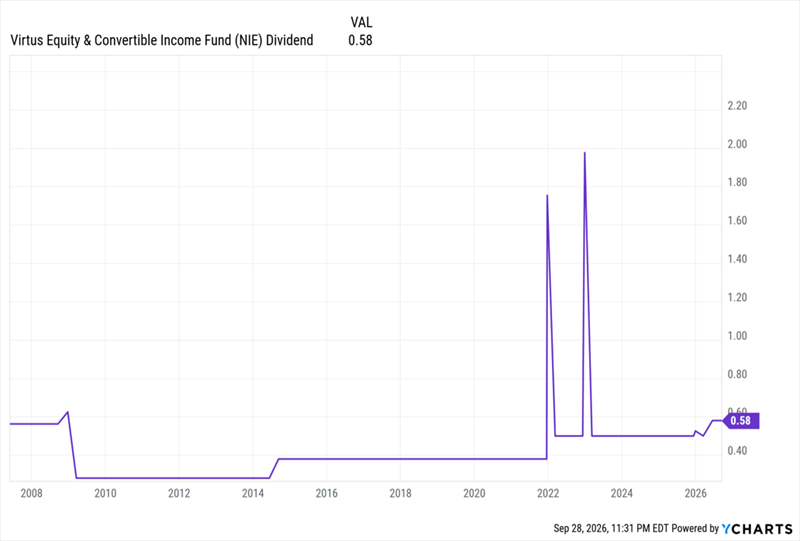
In fact, the regular payout has grown since then, with regular special dividends (the spikes you see above). And how’s this for performance?
NIE Triples Investors’ Money (and Then Some)
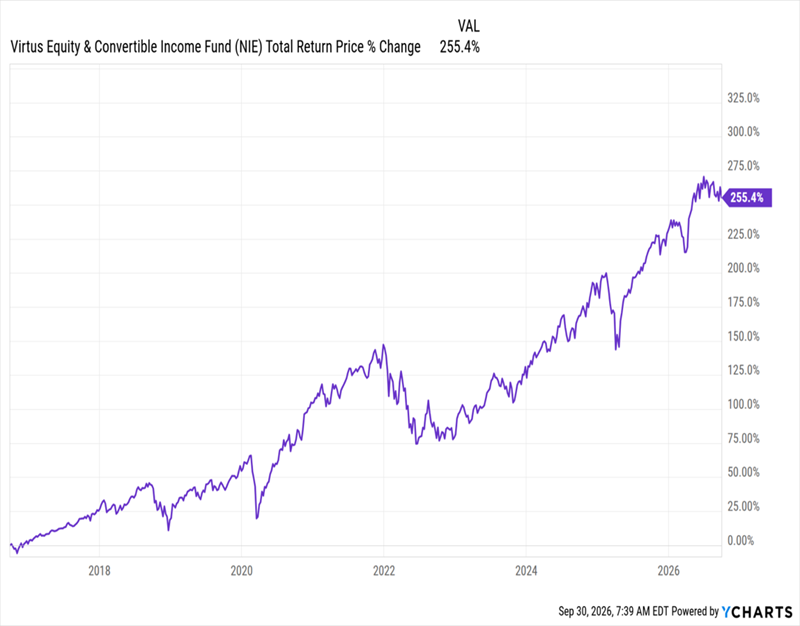
Over the last 10 years, the fund’s total return, based on its market price, has clocked in at a hefty 13.4% annualized.
That leaves it with an income-and-growth record that’s about as spotless as they come: a 13.4% annualized total return, a 9.2% current yield and a dividend that’s grown over the last 16 years.
With all that in mind, how in the heck is NIE trading at an 11.3% discount? Not only is that markdown deep on its own, it’s below the 9.8% the fund has averaged over the last five years.
I’m going to break that down next, because deals like this exist across CEFs.
Before we get to that, though, I know I’ve been throwing the word “discount” around liberally here, so let’s step back and talk about what it means when applied to CEFs.
A CEF “Quirk” That Delivers 9.5% Dividends, “Stock-Like” Price Gains
When I say “discount” I mean a discount to net asset value, or NAV. It’s the difference between a CEF’s price on the stock market and the per-share net asset value (NAV) of its portfolio.
Unlike stocks and ETFs, CEFs generally have a fixed number of shares for their entire lives. As a result, CEFs can (and often do) trade at different levels in relation to per-share NAV: premiums when above and discounts when below.
That’s our opportunity: We can buy CEFs when they’re heavily discounted, wait until they aren’t, then sell and roll our money into another discounted fund. And we collect CEFs’ large dividends the entire time.
This is the heart of our strategy at CEF Insider. And as I mentioned, CEFs’ discounts have been getting wider.
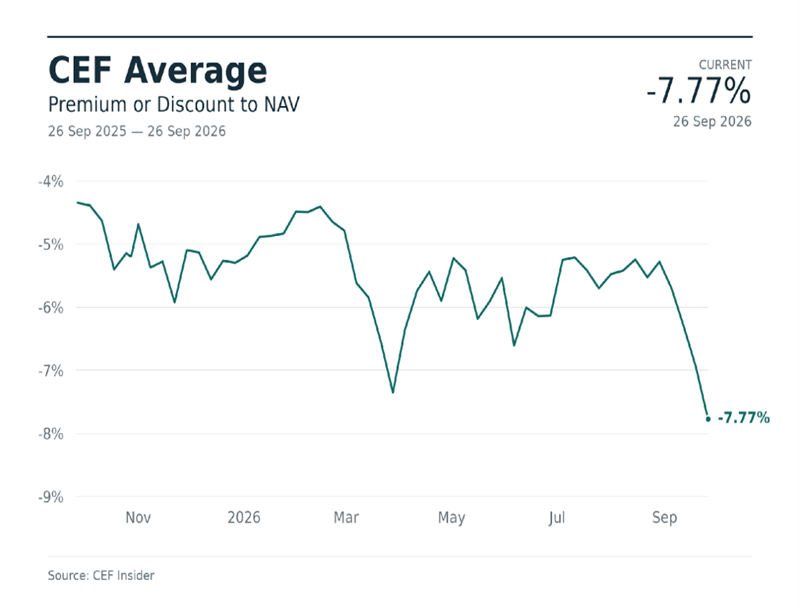
You can see this in the chart above, with the average discount recently hitting 7.8%, the widest in over a year. That sudden dip is part of a broader historical story that makes this recent markdown even more compelling.
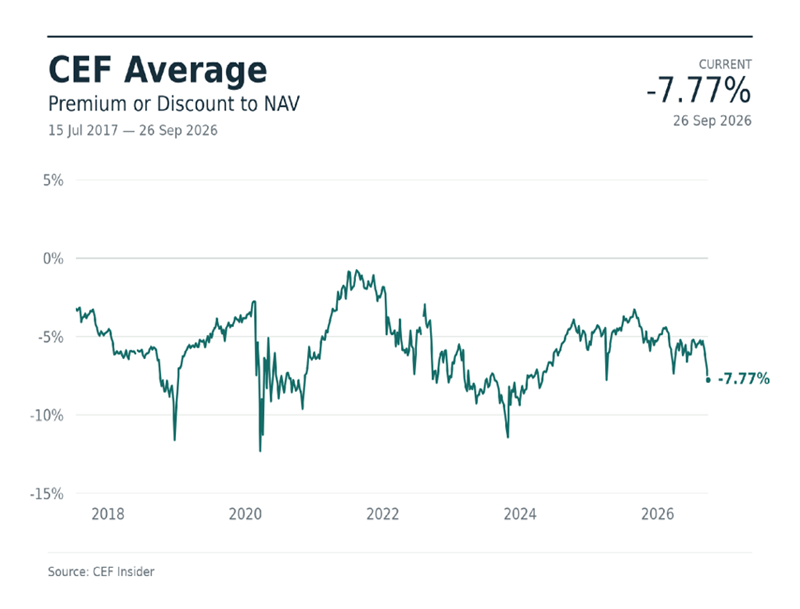
It also follows a steady recovery that’s been brewing since 2024—a good two years now. During that time, CEF discounts have been recovering from their widest point in late 2023 following the 2022 mess (showing that CEF investors tend to move more slowly than stock buyers).
These discounts were steadily recovering until panic caused them to widen sharply in April 2025 (the “tariff tantrum”), then recover and dip again in March 2026, with the Iran war, only to recover yet again.
Now discounts are widening once more and, like the two dips in the last two years, this is a buying opportunity for us.
NIE Is Just the Start
Which brings me back to NIE, with its 9.2% dividend and 11.3% discount.
It’s natural to wonder if a payout that big is sustainable. The answer is yes, and we can tell that by looking at the fund’s NAV. Over the last decade, the fund has delivered a total NAV return of 13.2%. That’s far ahead of its 9.2% yield, and gives the payout strong support.
This makes NIE particularly attractive at an 11.3% discount. Throw in the overly large discounts on CEFs as a whole, and we get a whole hunting ground of 9%+ payers, too.
Why haven’t other investors caught on to this? They’re entranced by the 10-year Treasury’s 5% yield. We’re going to take advantage of that to grab CEF yields nearly double that—at deep discounts, too.
NIE Is a Great Fund. Here Are 20 More (Yielding 10.5% on Average)
As I said, we love NIE at CEF Insider. Every time we’ve bought, it’s paid off.
The fund’s big discount has moved it back up my watch list. It’s not in our CEF Insider portfolio yet—but it’s only a nose behind the 20 CEFs that are. I’d like to see the fund’s 11.3% discount hold here for a while longer, or even widen a bit more, before we add it again.
While we wait, we’ve got plenty of other targets to go after. Those include the 20 funds in our portfolio, nearly all of which are buys right now, thanks to this pullback.
On average, these 20 income plays yield an outsized 10.5%.That’s more than $1,000 headed your way in yearly dividends on every $10K invested!
I’m inviting you to take a close look at these funds through a special invitation to “try” CEF Insider on a no-obligation basis for 60 days.
Your trial also comes with a free Special Report revealing my top 5 monthly paying CEFs, too. They yield 9.2% on average and, like NIE, are cheap today, due to this latest plunge in CEF discounts.
It’s all laid out in an investment strategy paper I’ve set up for you. Click here to read it, get your free report on our top 5 monthly dividend payers and set up your no-obligation trial to CEF Insider.
All of the funds you’ll read about handily beat Treasuries on yield and give you a shot at discount-driven upside, too. I urge you to take a look at them now, while they’re still bargains.