
This year, Christmas (for dividend investors!) is set to arrive two months early.
Our gift?
A chance to grab our favorite high yielders—closed-end funds (CEFs) paying 10% and more—on an early “year-end” sale.
How cheap are we talking here? How about 90 cents on the dollar? In some cases less.
We’ve got an early start to the year-end tax-loss selling season to thank for this opportunity.
Forget Year-End: The Best Dividend Deals Are Right Now
Our play starts with the fact that CEFs are a small market, with only around 365 out there. That means they’re mainly held by individual investors, since most CEFs aren’t big enough to move the needle for the big guys.
And when I say these funds are mainly held by everyday folks, I mean it. Individuals make up around 90% of CEF owners, according to one source.
You and I both know the mainstream crowd is highly likely to overreact to the headlines. That’s our “in,” because I expect these folks to get a little uncomfortable in the weeks ahead. As they do, they’ll sell—and we’ll be there to scoop up the bargains!
Here’s what I see driving that selling pressure:
- Midterms are coming, cranking up the anxiety level with each passing day.
- October is historically the most volatile month for stocks.
- Soaring bond yields are scaring investors into selling anything that looks like a bond (hint!).
This is already happening: According to the Q3 CEF review from First Trust, the average CEF discount to net asset value (NAV, or the value of its underlying portfolio) widened to 8.4% at the end of Q3 from 6% at the end of June.
Taxable-bond CEFs (hint! hint!) saw their discounts widen further, from 6.6% to 9.98%.
That’s where those early tax-loss sales come in, because despite all the worry these days, the go-to stock ETF, the SPDR S&P 500 ETF Trust (SPY), has gained 15% this year.
That’s going to prompt some nervous folks to take money off the table. As they do, they’ll offset those gains by booking losses. Bond CEFs, which have taken a beating, are prime candidates to be tossed over the side.
The result? Those already wide 9.98% average discounts could get even bigger, pushing these funds’ yields higher still.
Here’s the twist: When these folks clear the IRS’s “wash-sale rule” (which disallows the loss if you buy the same fund within 30 days before or after you sell it), they’ll likely re-buy those same high-yielding bond CEFs.
It’ll pay to be in before that happens. Then you could either sell later this year or early next, when a nice gain may be on the table—or simply hang on for the income.
Here are two CEFs to target, each kicking out dividends near 11%.
(Early) Tax-Loss Bargain #1: A 10.8%-Payer With a 10% “Red Tag Deal”
The BlackRock Credit Allocation Income Trust (BTZ) delivers a nice blend of stability and value, with 45% of the portfolio in investment-grade bonds. The rest is split among high-yield corporates, foreign debt, agency mortgages and bank loans.
The fund’s “goldilocks” effective duration (4.87 years) is another plus. It positions BTZ to gain if rates fall, while limiting losses if rates go higher than expected.
Which brings us to leverage—a tool many CEFs use. Here, management has taken a pragmatic approach, borrowing against 27% of the portfolio. That, like BTZ’s duration, is modest enough to boost income without layering on too much risk if rates keep rising.
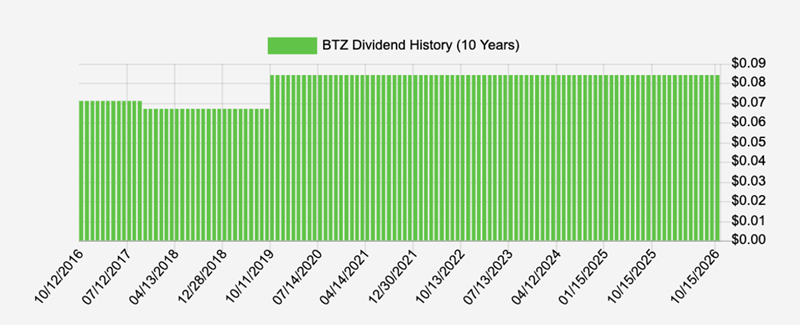
The yield? 10.8%, and that payout has held up well over the last decade, with a small cut in 2017 more than offset by a hike in 2019. It’s been “no drama” since.
Source: Income Calendar
The discount plays a role in the payout: If you divide the yearly dividend by the fund’s NAV, not its 10%-discounted market price, you get 9.7%. That’s what management needs to earn to cover the dividend, and while NAV is down slightly this year as rates have climbed, its total NAV return was 10.1% in 2025.
But this year’s NAV weakness looks more than priced in: Right now, BTZ’s 10% markdown is much wider than its five-year average of 6.6% and double the 5% at which the fund traded at the start of the year.
That makes this one a smart play on “early” tax-loss selling. If the discount narrows later this year or early next, we’ll have a nice return to take off the table. And if rates fall, NAV returns would likely rise. That would bolster dividend coverage—and could shift BTZ from a short-term discount play to something more.
(Early) Tax-Loss Bargain #2: A 10.9% Payer With a “Blown Out” Discount
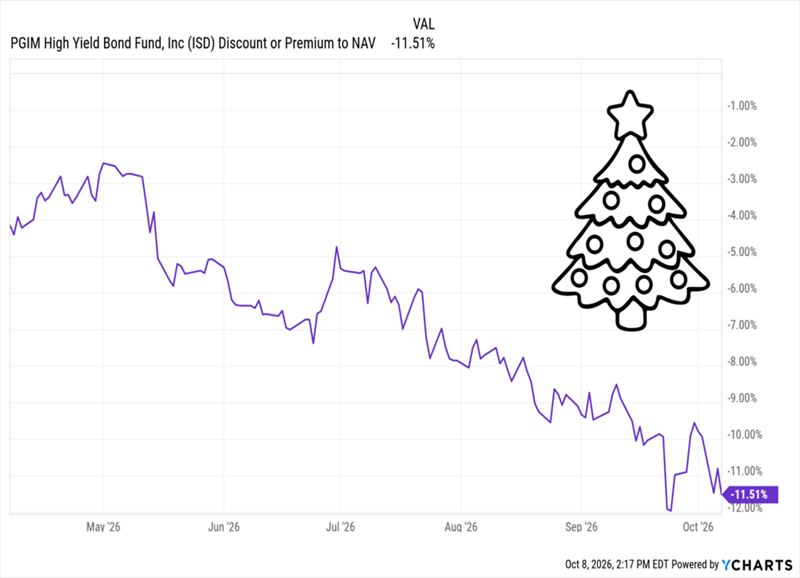
The PGIM High Yield Bond Fund (ISD) provides the clearest evidence yet that our tax-loss selling party is kicking off early. This 10.9%-payer (complete with a monthly dividend) trades at an 11.5% discount.
Compare that to the average over the last year (just 2.2%!).
One chart clearly shows us that this deal is all about investors panic-selling ISD in their rush away from bonds:
ISD’s Portfolio Is Fine. Its Market Price Has Tanked
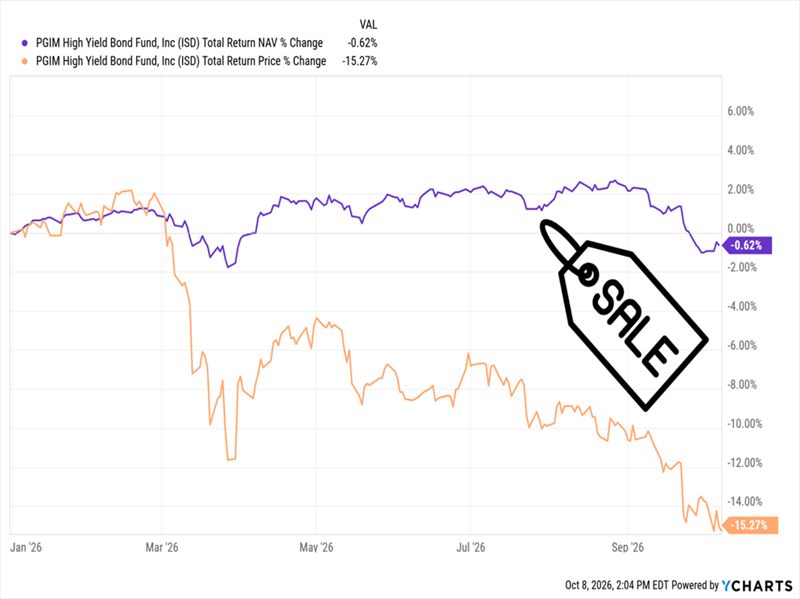
Above we see that the fund’s total return NAV (or its portfolio performance) has been flat, while its return on the public markets (in orange) has plunged. Investors are dumping a portfolio that’s doing just fine!
The result is an 11.5% discount that’s done nothing but grow wider over the last few months, again suggesting the crowd is looking to book its losses here.
ISD’s Discount Widens Heading Into Late 2026
The fund’s portfolio also complements BTZ, with 90% rated BB or below. That focus on non-investment-grade paper is great for us, because it’s where the biggest yields are.
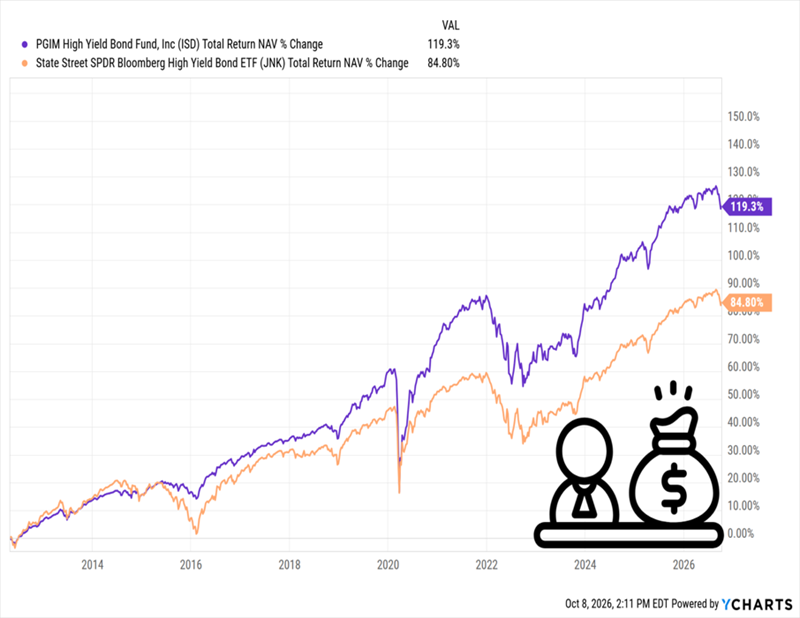
We’ve got history on our side, too. Since its launch in 2012, ISD has posted a 102% return on its market price, even with this pullback. Compare that to around 84% for the State Street SPDR Bloomberg High-Yield Bond ETF (JNK), a proxy for US high-yield bonds.
And on a NAV basis (a better measure of management’s skill), it’s done better. See the purple line below:
ISD’s Portfolio Crushes Its Benchmark
ISD also uses zero leverage. Plus, its effective duration is 3.85 years, again positioning it to benefit from falling rates but not suffer too much if rates head higher.
My take? Tax losses or no, investors are moving off this well-run fund at exactly the wrong time. Taking the other side of that argument—and that sweet 10.9% dividend—is the better play.
My #1 “Christmas in October” Buy: 12% Dividends. 94 Cents on the Dollar
And there are even bigger dividends than these two on sale now.
Like my favorite bond CEF. Check out its resume:
- It yields 12%, paid monthly.
- It usually trades at a premium to NAV. Today you can buy it for 94 cents on the dollar.
- It’s run by a legendary CEF firm—a company I call “the Amazon of CEFs.”
- Its manager is a former Morningstar Fixed Income Manager of the Year.
Yet investors are blindly tossing this smartly run income play in their rush away from bonds. That’s our cue to buy, before the tax-loss selling crowd finishes selling and starts buying back in.
I’ve got the details for you in a free strategy paper you can access right here. That page tees up this 12% monthly income play and gives you access to a Special Report, simply titled “The One 12% Dividend to Own Now,” that reveals this fund’s name and ticker.
That’s not all. You’ll also get an opportunity to try my Contrarian Income Report service—and gain access to its full portfolio of high-payers (average yield: 9.2%).
Grab this 12% payer while you can still do so at a bargain.