
Yeah, we’re here for the dividends. But isn’t it nice when we buy a stock and it goes up, like, right away?
And it happens for us. We are contrarians! We buy payers when they are out of favor because that maximizes our yield (more dividends per dollar!) and minimizes our downside (everyone has already sold!).
Sometimes this works and we buy, say, a 6% dividend stock that quickly gains 10%. The hated setup gave us a quick paper buck. Cool—but now what do we do?
Well, we need to understand that a dividend acts like an anchor in both directions. This stock attracted income investors because it used to pay, say, 5%, but its price dropped, that yield became 6%, and people started buying because, “hey, Great Stock pays us more!”
But then, a 10% rise can move its yield closer to that previous 5% mark. So, our “next move” depends upon our timeframe and return goals. If we are here truly just for the divvie, then we hold. We locked in a 6% yield when we bought, which means this price movement is just noise. (True, potentially loud noise, but clamor to be ignored nonetheless.)
That said, we have to be OK with our gains retracing. And maybe we’re not. Perhaps we don’t mind having a shorter timeframe to lock in that 10%. Or even 17%, in an example I’ll show you now. This was a stock I recommended back in March. Since then, in aggregate, it’s gone absolutely nowhere. But we made 20% off of it anyway!
The landlord I’m talking about was Broadstone Net Lease (BNL), which I recommended to my Dividend Swing Trader readers earlier this year.
Most investors, even income-focused ones, don’t know the name because BNL rarely makes financial headlines. It quietly operates in the background with hundreds of single-tenant properties. These are mostly industrial buildings and a little bit of retail. BNL leases them out on long-term contracts and in net lease format, which means the tenants cover the property taxes, insurance and upkeep.
What does BNL do? It collects the rent and pays out most of it to shareholders in the form of dividends. Not a bad business.
We bought it low because BNL had been undervalued for some time. The company went public in late 2020, just in time for the Federal Reserve’s 2022 rate hikes. Not great for landlords like BNL who borrow money to grow, and therefore compete with the bond market for income investors. When rates jumped in 2022, investors dumped the whole REIT group, good landlords and bad. BNL slid from $26 to $14. By March of this year, it had clawed back to around $19, which I still considered cheap.
We bought, because BNL’s operating numbers told a steadier story. Occupancy was above 99%, about as good as it gets (duh!). AFFO, an earnings measure that accounts for non-cash items, grew 4% in 2025. Management had just raised its quarterly dividend again to 29.25 cents. Plus, the current leases had plenty of room to run, an average of 9.6 years, and they included built-in rent increases of about 2.1% per year.
BNL is growing cash flow by building new properties for current and future tenants, such as Amazon, Sprouts Farmers Market and Academy Sports. These companies have all signed long-term leases with BNL before construction.
We bought a little above $19 for a yield of 6%, and then the shares began to reward us. Over the next four months, BNL climbed to $22.79 per share, and along the way it paid two quarterly dividends totaling 58.5 cents per share, rewarding us with about 3% on our purchase price.
I told DST readers that Wall Street had caught on, and we sold for a 20.7% total return in about four months. Here’s what that looked like:
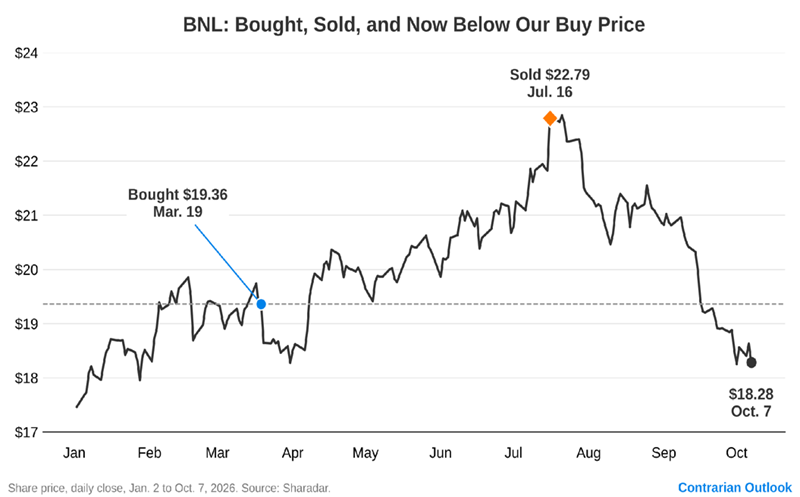
(Note: The chart above is price only. Our trade generated a $3.43 price gain plus $0.585 in dividends, a 20.7% total return.)
You see that most of our return came from price growth and not the dividend. And that is my point!
Last week, BNL traded at $18.28, below where we bought it in March. If you bought it then and held on, you’re down about 1%, even after collecting three dividends. At DST we banked 20.7%.
Why? Because the stock rallied to the upper end of its likely trading range. My DST system flashed a “take profits!” signal, so that’s what we did. There was no need to grit our teeth and endure a pullback. We took the money and ran!
In Dividend Swing Trader, we look for shorter term total-return opportunities in the same types of dividend-paying stocks and funds that you and I know and love. In these situations, we’re looking to collect our payouts and pursue price gains in the months ahead. That’s why I begged my editors to launch DST.
BNL shows what we’re looking for: a dividend worth collecting and enough price upside to make a shorter holding period worthwhile. In tomorrow’s issue of DST, I’ll introduce our next dividend opportunity and explain why I think it’s worth buying now.
Start your risk-free trial of DST today to receive the new recommendation, my buy-up-to price and updates and sell alerts along the way.