
This tech-stock wobble is rattling the mainstream crowd.
Good. We welcome it.
It goes without saying that tech stocks have been sucking up all the oxygen in the markets for years now. That, of course, has pulled attention away from other corners of the market, particularly those that offer lower volatility and higher dividends.
We’re buying those unloved payers now. That not only sets us up for high, stable dividends—it gets us in right as tech-stock volatility picks up, and potentially drives investors toward these off-the-radar assets.
Our main target? Real estate investment trusts (REITs), which I see as prime candidates to shine in 2027. Today we’re going to talk about a specific REIT fund to pick up. This one offers a healthy 9.3% dividend and trades for 12.7% less than its “true” value.
This closed-end fund (CEF) is a holding of my CEF Insider service and one of the top buys in our REIT bucket now. Before we break it down, let’s start at the beginning.
Anthropic’s IPO: The “Starting Gun” for a REIT Revival?
Anthropic’s forthcoming IPO is a big part of today’s tech worries. As part of the IPO process, Anthropic recently reported that its third-quarter revenue grew about 45% from the prior quarter. That sounds impressive, but it was a sharp slowdown from the second quarter, when sales more than doubled.
And then there are Anthropic’s spending commitments, which add up to about $800 billion. That sum makes the company’s $16.8 billion in third-quarter revenue look small by comparison.
It’s yet one more headline adding to today’s tech worries, which, as they continue to add up, are making alternatives to tech stocks look more attractive. This is where REITs come in.
Tech’s ascendance has been part of the reason why REITs, as measured by the benchmark SPDR Dow Jones REIT ETF (RWR), have generally been sluggish in the last five years, returning around 2.4% annualized.
This weak REIT performance is part of our opportunity, since it’s way below the 9.1% annualized return RWR turned in during the preceding five-year period (from 2016 to 2021). And if we stretch our timeline out over the very long term—from 2001 to the present—the fund turned in a very respectable 8.5% annualized.
Figures like these—8.5% annualized over the last 25 years and 9.1% annualized from 2016 to 2021—represent the more “normal” state of things. And they suggest REITs could return to their longer-term form as a wobbling tech sector finally convinces investors they need to hold more than just AI stocks.
One potential catalyst for such an upward move in REITs goes back to Anthropic.
If the IPO does go ahead later this year, the company’s first post-IPO earnings report would drop early next year. I’m sure I don’t have to tell you that it’ll be very closely watched, and a disappointment could usher in even more tech-stock volatility—and an even more favorable setup for REITs.
To set up for it, I recommend skipping RWR and its 3.6% dividend and picking up a closed-end fund (CEF) called the Cohen & Steers Real Estate Opportunities and Income (RLTY), payer of a 9.3% yield today.
This one holds some of the best-known REITs, including those that let us profit from the AI boom without having to try to pick which tech stocks will be the ultimate winners. I’m talking about data-center REITs like Digital Realty Trust (DLR) and Equinix (EQIX), as well as cell-tower REITs such as Crown Castle (CCI) and American Tower (AMT).
It also ticks the (mandatory!) box of adding non-tech exposure, with holdings like senior-care REIT Welltower (WELL), warehouse landlord Prologis (PLD) and self-storage names like Extra Space Storage (EXR) and Public Storage (PSA)—“boring” cash-flow generators that have been overshadowed in the tech boom.
RLTY holds many of the same names as the REIT-sector benchmark, RWR, so its results have been similar in the last few years. However, since it’s still relatively new, having been launched in 2022, we need to look elsewhere to get a sense of its longer-term performance.
The best place to look? RLTY’s older sister, the Cohen & Steers Quality Income Realty Fund (RQI), which has been around since way back in 2002.
In that span, RLTY’s sibling has handily outrun the REIT index, even with the global financial crisis, the pandemic and the high-inflation (and interest-rate) environment of the last few years.
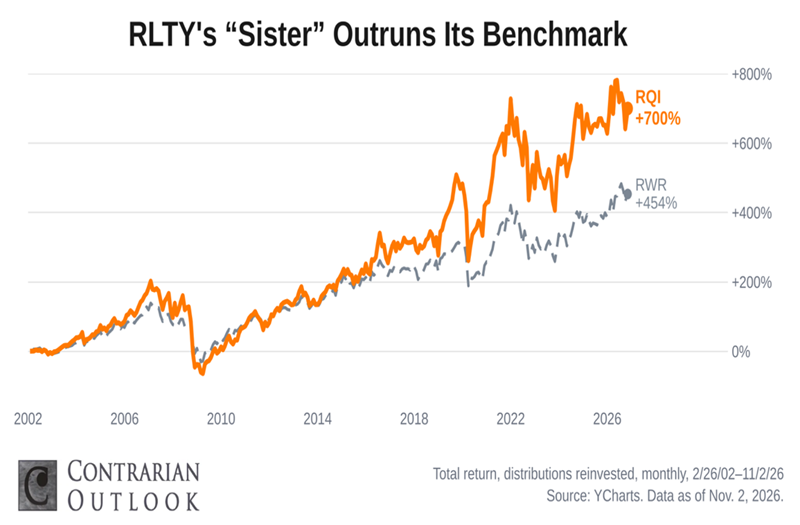
That’s an encouraging sign for RLTY. And with that in mind, you might wonder why we don’t just pick up RQI now and call it a day.
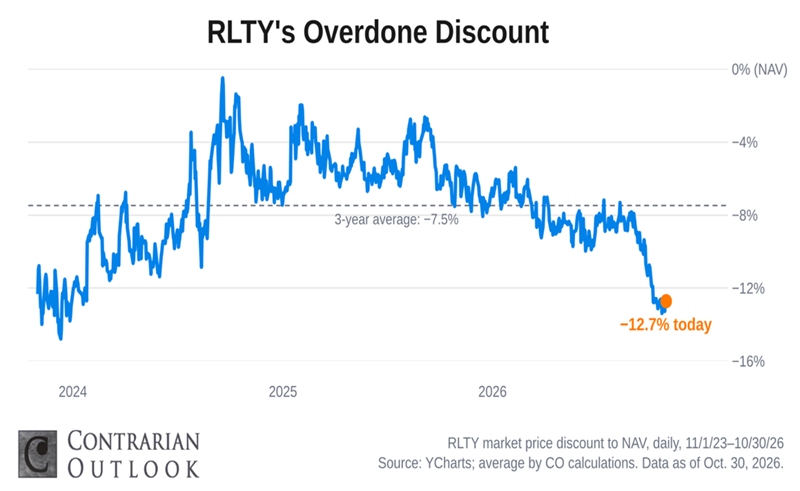
The main reason? RLTY’s discount to net asset value (NAV, or the value of its underlying portfolio). As I write this, it’s 12.7%, wider than RQI’s 9.8%. Moreover, RLTY is the cheapest it’s been since early 2024, nearly three years ago now:
Let me close with a look at that 9.3% dividend: as you can see below, it’s not only held up through this higher-rate period but has seen a hike.
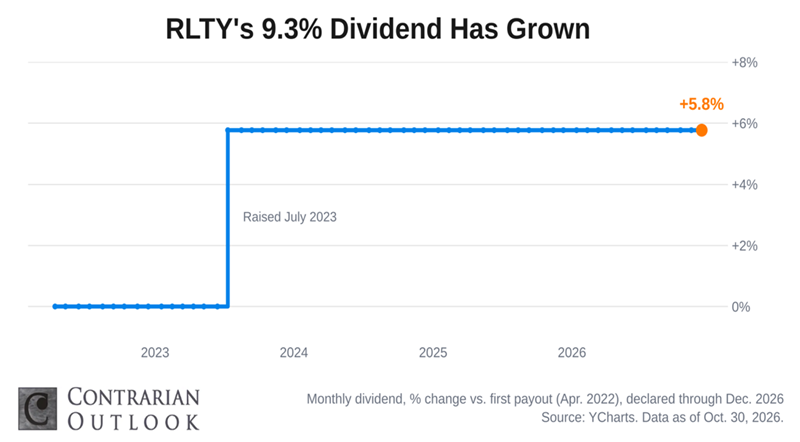
And when you calculate the current annualized payout based on NAV, not the discounted market price, you get a yield on NAV of 8%. That’s what management needs to clear to keep that 9.3% dividend coming our way, and it’s well within the 15.2% annualized NAV return RLTY has posted over the last three years. That’s another sign of stability.
All of this leaves us with a very nice window on RLTY: We buy at that double-digit discount, then wait (and collect RLTY’s monthly dividend) as tech volatility shakes more investors out of that sector—and into steadier corners of the market like REITs.
4 AI “Pivot Point” Funds Yielding 10% on Average
RLTY lets us collect “rent checks” from AI’s landlords without the tough (nay, nearly impossible!) task of trying to pick which tech stocks will ultimately win the AI race.
But it’s just one way to profit from the shifts AI is driving through the US economy.
I’ve identified 4 others. These are well-rooted (and totally underappreciated) shifts, from drug firms using AI to create the next breakthrough treatment to manufacturers using robots to revolutionize the factory floor.
I’ve also zeroed in on a CEF to tap each of these revolutionary “pivot points.” Together, these 4 funds yield 10% on average, and all 4 trade at overdone discounts now.
On a hypothetical $500,000 portfolio, a 10% yield works out to about $4,167 a month in dividend income.
That would be a big jump in monthly income for many investors, whether they’re in retirement or working their way there.