
This market is not out of the woods yet.
Sure, there was a “relief bounce” following Jensen Huang’s reinstatement as CEO of NVIDIA (NVDA). But there’s still a lot of fear out there.
We contrarian income investors are here for it, because it’s thrown our favorite assets, high-yielding closed-end funds (CEFs), into the bargain bin. And I do mean bargain bin. Check this out:
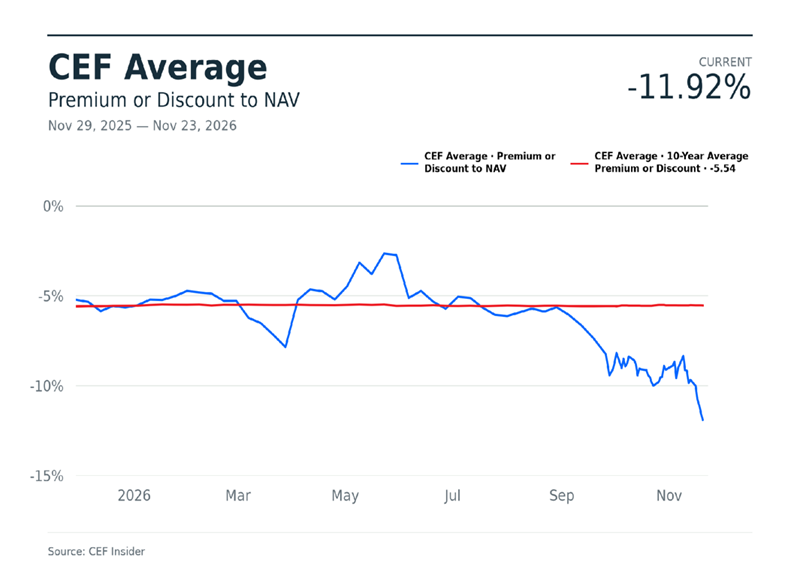
As I write this, the average CEF trades at an 11.9% discount to net asset value (NAV, or the value of its underlying portfolio). That’s far wider than the 10-year average discount of around 5.5%.
Even though the discount started widening earlier this fall, the NVIDIA-induced market panic has widened it further in the last few days. We still have this discount in front of us today.
Of course, no one knows where the stock market will go from here. So now is a good time to diversify—particularly into an asset class that generates a lot of income.
That asset class? Bonds, which are offering higher yields now, due in part to the likelihood that the Fed will raise rates into 2027. Moreover, thanks to strong corporate earnings, bond defaults remain low. So those higher interest rates are being paid.
Apollo Global Management Chief Economist Torsten Slok recently wrote that today’s “higher for longer” rates make high-quality credit more attractive. He laid out his case in this chart:
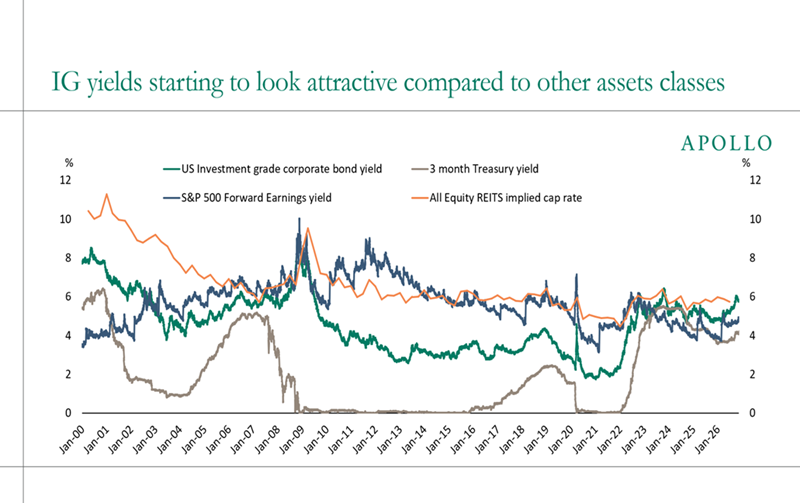
This is a bit hard to read, so let me cut to the chase: Investment-grade corporate bonds now yield more than real estate, which is unusual, while also yielding more than US stocks. Bonds paying more than stocks is pretty normal, but it is, in fact, much more bullish for credit.
That’s because bonds’ higher, sturdier yields mean long-term investors might consider switching to them from stocks in a volatile time like this. This should mean higher bond prices down the road.
But back to CEFs. Their discounts, plus higher yields for credit, mean we can use these funds to tap into some nice, high bond income.
A 12.1% Payer Trading at a “Panic Price”
There are many such options out there now among CEFs, including the seven in the bond bucket of our CEF Insider portfolio. One that stands out is the Ares Dynamic Credit Allocation Fund (ARDC). This fund yields 12.1% and was a recommendation in our October issue.
Thanks to the selloff, our “discount window” on this fund is still open:
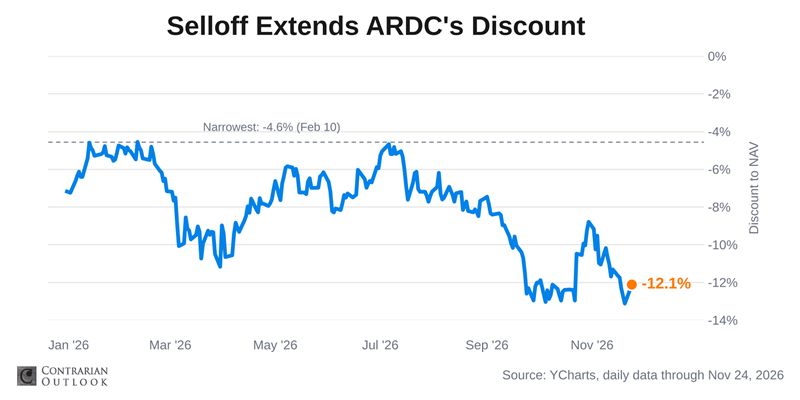
Over the last decade, ARDC has had an average discount of 8.4%. Its current 12.1% markdown is well below that. The selloff that started earlier this fall is the main reason for this, as ARDC was trading at a discount narrower than its 10-year average for much of the year.
The discount isn’t justified, as a quick look at ARDC’s portfolio indicates. There are over 250 different credit issuers here, so it is immensely diversified.
The portfolio is also diversified across credit types, holding loans, bonds and collateralized loan obligations (CLOs) that help keep it from being too sensitive to changes in interest rates. Most encouraging, the fund’s average yield to maturity across its assets is sufficient to maintain its payouts, since the fund pays out that yield as distributions to shareholders. Even more valuable is the fund’s relatively short effective duration, of 1.62 years, which allows ARDC to buy new bonds at higher interest rates over the next year as the Fed hikes rates and new bonds pay higher yields.
With the fund’s current wide discount, this looks like a good time to buy while investors are fearful, then wait for that discount to shrink. This approach has paid off for ARDC before, as one recent example shows.
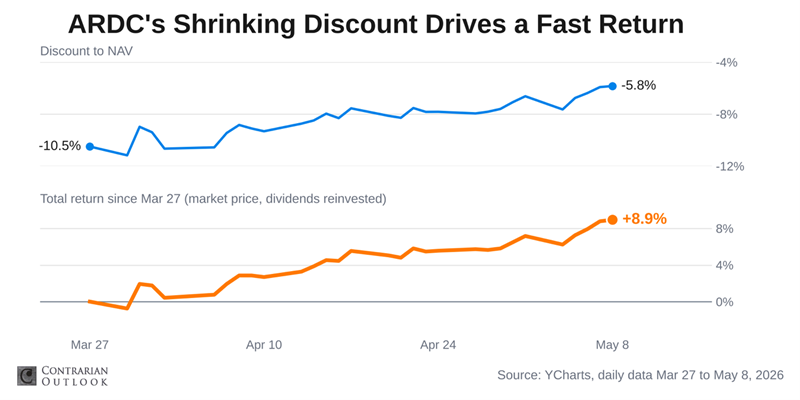
Earlier this year, in March, ARDC’s discount blew out like this, and the fund gave investors a quick 8.9% total return in a month and a half.
A similar recovery could well be in the cards now, because the reason for this latest leg of the selloff has had more to do with one person than anything else. But Jensen Huang is back now, so a big reason for that particular selloff is gone.
However, investors are good at finding new things to panic sell over, and they have been at it again these past few days (and let’s not forget that NVIDIA still faces other investigations), so we further selling could be in the cards. Funds like ARDC, though, have an income stream that gives them intrinsic value that should help them shake off these short-term panics.
ARDC Isn’t the Only Bargain. These 4 CEFs Yield 9.8% on Average (With 20% Upside Potential)
ARDC isn’t the only fund investors have dumped in this panic. As we saw above, the average CEF now trades at an 11.9% discount, more than double its 10-year average of 5.5%.
In other words, we dividend investors are facing a field stacked with top-quality high payers going for cheap!
I’ve zeroed in on 4 of the best—my top CEFs for new buying now. Together, they yield 9.8% on average, and I see 20% upside potential over the next 12 months as their discounts close.
On a hypothetical $500,000 portfolio, that works out to $49,000 in yearly dividends, or about $4,083 a month.