
As contrarians, we search for income stocks that vanilla investors hate. Today there are plenty of dividend deals. No surprise, with the market selling off this month.
And when we expand our search to CEFland, we find closed-end funds (CEFs) at the bottom of the bargain bin. Today we’ll discuss five that pay between 7.7% and 15.9% and trade at discounts between 11% and 15%.
In other words, these five CEFs trade for 85 to 89 cents on the dollar. Let’s explore whether each dividend is “cheap for a reason.”
John Hancock Premium Dividend Fund (PDT)
Distribution Rate: 9.0%
We’ll start with a fund that invests in preferred stocks—a stock-bond “hybrid” that has some characteristics of common stock, but pays a fixed income that’s closer to a bond’s coupon and tends to trade more similarly to debt.
That typically means less downside, but rising rates and fear of an AI-bubble pop have driven higher volatility and relatively steep declines in preferreds. That drop has turned into fat discounts in preferred-stock CEFs.
But the John Hancock Premium Dividend Fund (PDT) isn’t a typical preferred fund. It’s a hybrid too.
Managers Joseph Bozoyan and James Gearhart are tasked with investing at least 80% of assets in “dividend-paying securities.” Well, common and preferred stocks both technically pay dividends, and they’ve invested 45% of assets in each. The remaining 10% is bonds.
While preferreds and bonds pay much more than common stocks, it’s rare for them to pay 9%. We get there via management’s liberal use of debt leverage, which currently is a high 36%. So even though the fund has about $650 million in assets, it’s able to generate about $1 billion in investment exposure.
The result is largely what we’d expect—performance that splits the difference between a regular preferred fund and a dividend-stock fund.
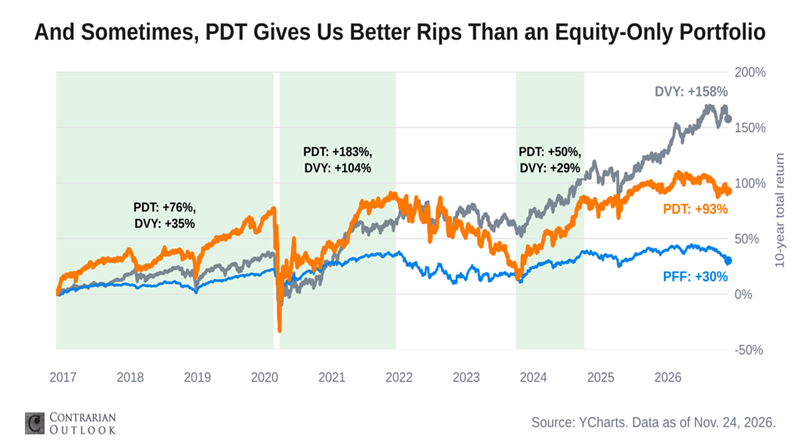
JHancock Premium Dividend Fund is a monthly payer, and it raised its distribution by about 7% this summer. And a nearly 12% discount to its net asset value (NAV) is much deeper than its five-year average discount of 3%.
But the Fed could make life miserable in the short term for PDT, which is sensitive to interest-rate hikes. Preferreds, like bonds, decline in value when prevailing interest rates rise, and dividend-paying common stocks can struggle as their yields look less competitive compared to lower-risk fixed income. On top of that, rising rates increase the fund’s cost of using leverage.
Royce Micro-Cap Trust (RMT)
Distribution Rate: 7.7%
Most coverage of the stock-market’s crash-out has been focused on the big-company S&P 500, Nasdaq and Dow indexes. But small caps have been even worse over the past three months.
CNBC and Fox Business refuse to notice, leaving us with plenty of deals if we’re willing to shop for smalls. And there are few better places to do that than in Jim Stoeffel and Andrew Palen’s Royce Micro-Cap Trust (RMT).
At roughly $1 billion in average market cap, RMT’s portfolio is truly closer to small-cap in nature. Still, these 167 companies aren’t exactly a who’s who of recognizable faces. Top holdings include semiconductor test automation specialist Cohu (COHU), cruising and adventure travel firm Lindblad Expeditions Holdings (LIND), and drug development solutions provider Certara (CERT).
Small-cap funds typically deliver less than a percentage point of yield, and if RMT paid out exclusively dividend income, that’s where its yield would fall, too. But rather than using debt leverage or trading options, RMT makes large, quarterly distributions of mostly long-term capital gains.
And those gains are significant—Royce’s fund has thrashed the Russell 2000 over the very long term.
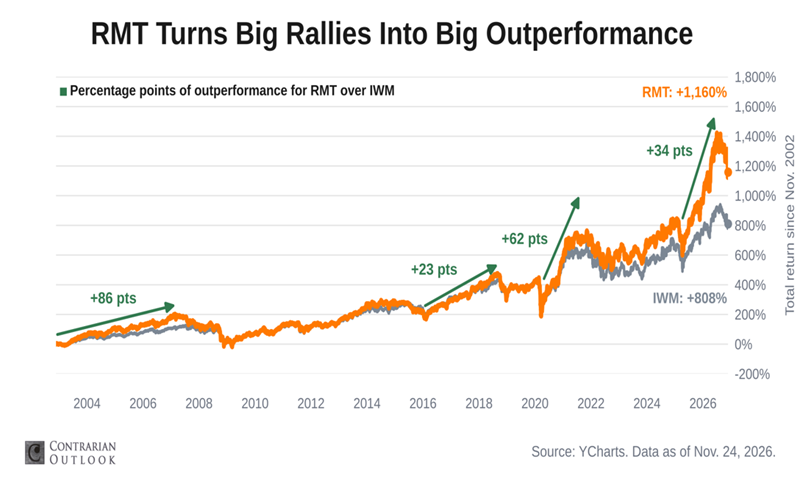
RMT perpetually trades at a wide discount—to the point where management should try to find a way to close it. But as it stands, the CEF’s discount of 12.6% is about a percentage point deeper than its five-year average.
Eaton Vance Tax-Managed Buy-Write Opportunities Fund (ETV)
Distribution Rate: 10.1%
Another equity-focused CEF that’s sharply underpriced is the Eaton Vance Tax-Managed Buy-Write Opportunities Fund (ETV).
This is a straightforward mega-cap equity portfolio chock full of stocks that have tumbled during the recent selloff: Nvidia (NVDA). Alphabet (GOOGL). Microsoft (MSFT). Again, on its own, this would churn out a meager yield.
But ETV doesn’t just sit on these positions. It trades options against them. Specifically, management sells covered calls on major market indexes like the S&P 500 and Nasdaq Composite, which generates the income that fuels its thick monthly distribution.
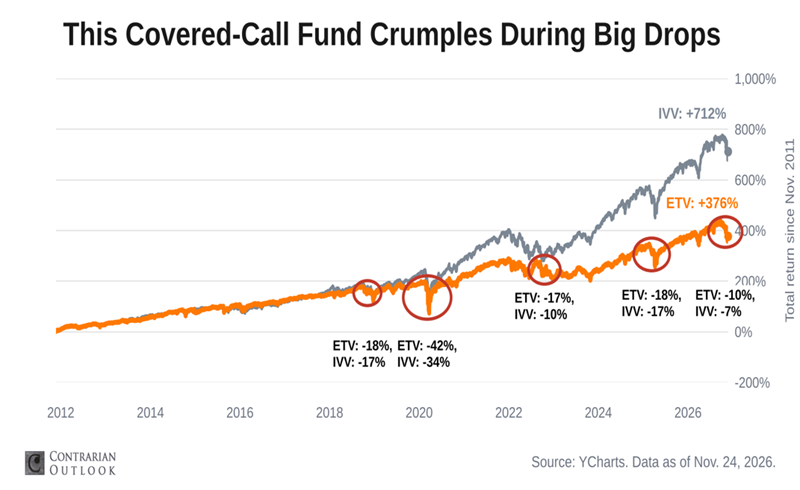
The point of a covered-call strategy is downside protection, which we get at the cost of lower upside potential. It’s a well-known tradeoff, which is why funds like ETV aren’t typically bought and held forever, but added tactically when we need to go on defense. And if we can buy that defense at a discount—ETV’s steep 11% discount is far better than its 3% five-year average—all the better!
But while Eaton Vance’s fund has provided a few percentage points of buffer during flat to slightly down periods for the market, it has been dreadful when we’ve needed protection the most.
Kayne Anderson Energy Infrastructure Fund (KYN)
Distribution Rate: 8.8%
I couldn’t tell the difference between a chart of oil prices in 2026 and Billy’s path home in The Family Circus. It has been a nauseating year for energy investors, and the current slump in commodity prices has opened up fresh discounts.
Kayne Anderson Energy Infrastructure Fund (KYN) helps us squeeze income out of the midstream component of the energy sector. It predominantly invests in companies responsible for pipelines, storage, terminals and other assets that deal in oil, natural gas, natural gas liquids (NGLs) and more.
Holdings such as Energy Transfer LP (ET) and Williams Companies (WMB) are effectively toll takers that generate cash and pay out sizable distributions. KYN applies a good deal of debt leverage (27% currently) to deliver even more income. The result, over the long term, is pretty similar performance to the MLP benchmark.
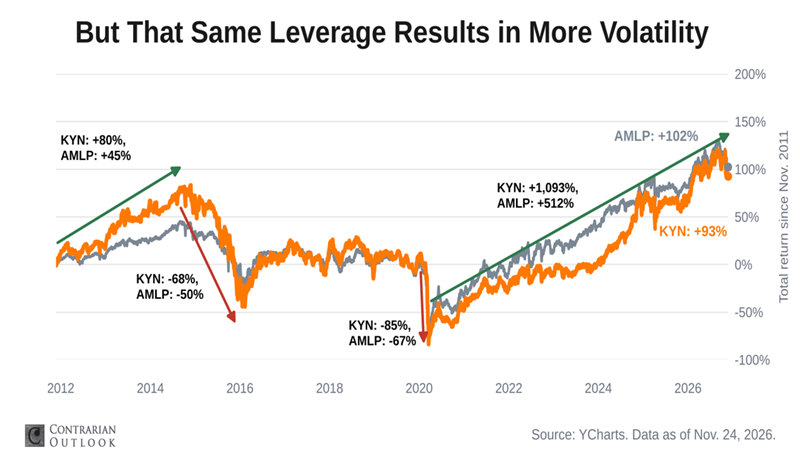
This dynamic means we have to be especially mindful of timing and valuations.
Right now, for instance, KYN trades at a nearly 15% discount to NAV, or just 85 cents on the dollar. That’s a little more distance from its 13% five-year average than when I looked at Kayne’s fund in July.
Lastly, a perk to owning Kayne Anderson Energy Infrastructure is that despite holding ET and other master limited partnerships (MLPs), it allows us to sidestep the dreaded K-1 form. We just get a simple Form 1099, like what we’d use for any other normal stock.
Western Asset Diversified Income Fund (WDI)
Distribution Rate: 15.9%
The Federal Reserve has made it pretty clear that rising rates are the path of least resistance.
That doesn’t mean we need to avoid bonds. But if we want to collect fixed income from bonds without getting paddled by the central bank, we should keep an eye out for shorter-duration funds. (Duration is interest-rate risk. In very simple terms, if market interest rates rose by a percentage point, a bond with a duration of five years would be expected to decline by about 5%.)
The Western Asset Diversified Income Fund (WDI) doesn’t explicitly attempt to fit that bill, but right now, it does the job.
WDI focuses on “what we believe are undervalued securities with attractive fundamentals.” We can get behind that. Management goes well beyond traditional bond categories to wherever the best opportunities are, and it’s happy to rotate in and out of those areas as market conditions change.
Right now, Western Asset Diversified’s portfolio is loaded up on junk (42%), followed by low-double-digit exposure to collateralized loan obligations (CLOs), commercial mortgage-backed securities (CMBSs) and bank loans. It also owns emerging-market sovereign and corporate debt, asset-backed securities, investment-grade debt and other issues.
Credit quality is pretty low: 70% of assets are junk-rated, another 20% aren’t rated, leaving just 10% above the investment-grade line. And yet an effective duration of 4.7 years is about a year less than the buttoned-up Agg index.
The problem? WDI’s low duration is offset by a massive 40% of debt leverage that can lead to wild swings.
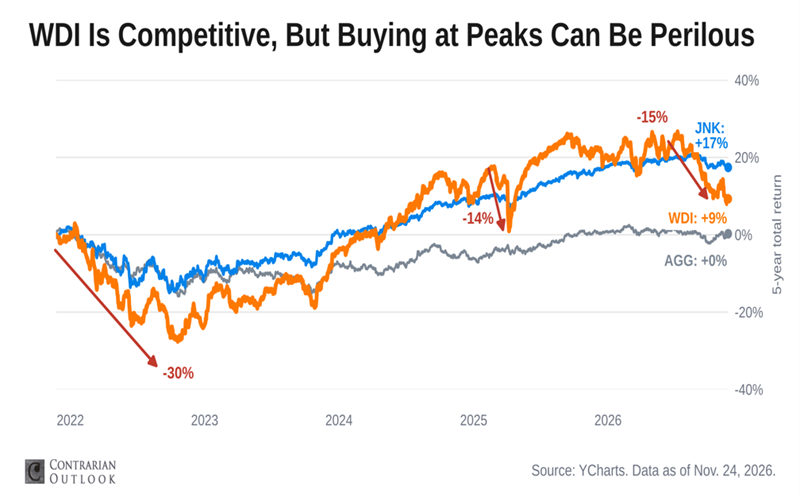
The good news here? This latest leg down has driven WDI’s monthly distribution up to almost 16%. Meanwhile, its 12%-plus discount to NAV is about 5 percentage points sweeter than its five-year average.
My Favorite 12% Dividend for 2027 Is a Cure for Market Chaos
I love WDI’s yield and the monthly payday. But if our goal is to keep calm and carry on when the market is pitching a fit, we should avoid funds with a history of violent swings and so-so returns.
If I’m going to take a swing at a double-digit yield, I make sure it’s backed by highly skilled managers with a consistent track record of running up the score on their competition.
Right now, my favorite home-run dividend for 2027 is a heavily diversified, brilliantly built bond portfolio that not only yields 12%, but is also set up for stock-like gains.
This fund delivers four traits that, when all wrapped up in a single package, no income investor should ignore:
- It pays a whopping 12% in annual income
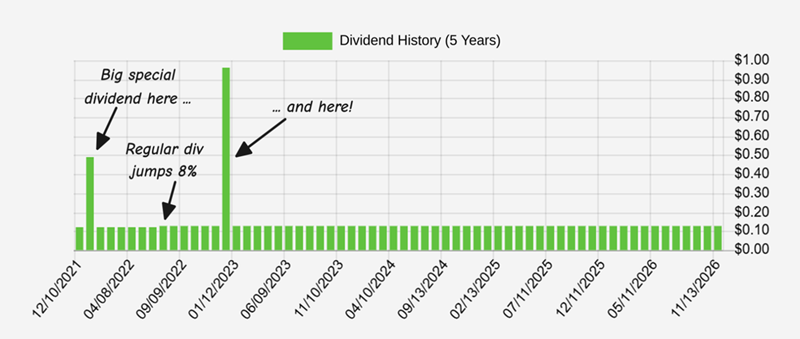
- It has increased its dividend over time
- It has paid out multiple special dividends
- It pays its dividends each and every month!
If that weren’t enough, the man at the helm has previously been honored by Morningstar as a Fixed Income Manager of the Year, and he’s even been inducted into the Fixed Income Analysts Society Hall of Fame.
Those are serious bona fides, and that experience is put to work earning us $1,200 for every $10K we plunk down.
But the window is closing as we get closer to 2027. Premiums on funds like these tend to rise as volatility ticks higher and as investors rotate out of growth stocks and into reliable sources of income like this. I don’t want you to miss your chance. Click here and I’ll introduce you to this incredible 12% payer and give you a free Special Report revealing its name and ticker.