
The ball swung to me, and without hesitation I went up for a 15-foot jump shot. Then I heard a yell. It was from “Old Carlos,” who was 10 feet from the play, who, by the way, is usually 10 feet out of the play. “He’s open for a reason,” OC yelled.
Well, I thought as I went into my shooting motion, “Little does OC know, but I’m a good jump shooter, and the elbow is a good shot for me. This is well within my range. Just because he hasn’t seen me play before doesn’t mean I can’t hit the shot.” The ball left my hand, and sure enough: clang, off the back rim.
Too much thinking on my part. OC got in my head with one of the great heckles. I learned it was a running joke. He never got there on defense, but he would scream at people that they were open for a reason. As a result, many beginners and even experienced players shot a lower percentage than they should have.
OC has since retired, but his lessons still loom strong. Whenever I see a stock, a dividend payer, that looks attractive but is a dog, OC’s voice jumps in my head: “Hey, it’s cheap for a reason!”
Let’s look at five overlooked payers yielding 5.6%-11% at prices any penny-pincher would love.
Take Comcast (CMCSA, 5.6% dividend yield), for example.
It owns NBC, Telemundo, Peacock, Sky Sports and theme parks around the world, plus a connectivity business (largely Xfinity) that sells broadband, wireless and cable TV.
It’s an extremely well-known consumer name, but it hasn’t warranted our attention until recently. A multiyear funk has sent CMCSA shares to a thin forward price-to-earnings (P/E) ratio of just under 7.
It also sent Comcast’s yield above 5% for the first time earlier this year, and it remains there today.
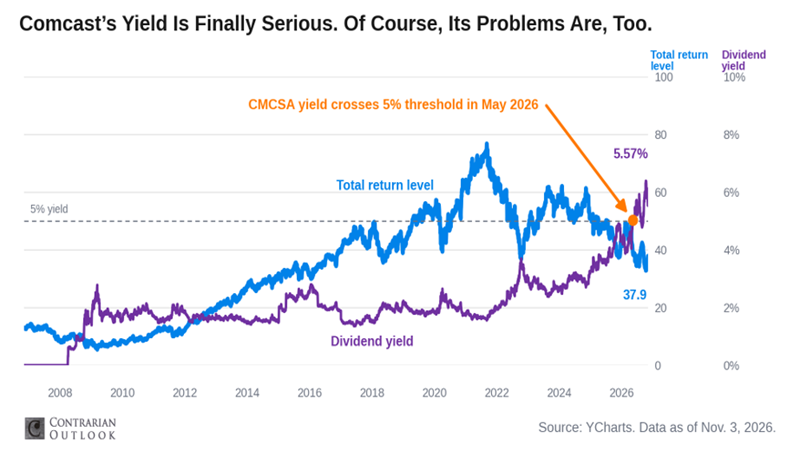
Comcast has been taking shots from all sides. It has struggled to retain broadband subscribers amid competitors peddling cheap high-speed fiber and 5G home internet; accelerating cord-cutting, which has hit both its pay-TV and advertising businesses; and decelerating Universal theme-park growth.
The company is answering with a massive unloading spree. It already spun off its cable channels into Versant Media Group (VSNT) and sold its Sky Deutschland operations earlier this year. It plans to spin off the NBCUniversal and broader Sky business in 2027. And Comcast is laying off workers as part of a broader restructuring that CMCSA warned would result in a roughly $1 billion charge in Q4.
CMCSA has raised its quarterly payout at least once a year since 2008 … until this year. All four dividends have been announced, and they’re all the same amount as last year’s final distribution.
But the dividend isn’t necessarily in trouble. For one, it only accounts for a little less than 40% of this year’s projected earnings. And also, while the company has suspended stock buybacks for the time being, management has said it’s still committed to the dividend.
The real question is whether there will be enough growth potential left once Comcast is done shedding assets.
High oil prices have translated into few discounts across the energy sector, but Northern Oil & Gas (NOG, 7.9% dividend yield) is trading below 6 times earnings estimates, all while paying us a high-single-digit yield.
Northern Oil deals in oil and natural gas across the Williston, Uinta, Permian, Appalachian and Duvernay formations. But while it’s technically an exploration-and-production (E&P) firm, it’s not an operator. Instead, it holds interests in thousands of wells, then partners with other E&P operators to work them.
That makes NOG less of a growth play on oil, and more a cash-flow play.
Northern Oil & Gas started paying us 3 cents per share quarterly in 2021, then dramatically ramped up the distribution, hiking every quarter for a few years before slowing to semiannually, then eventually stopping its raises altogether.
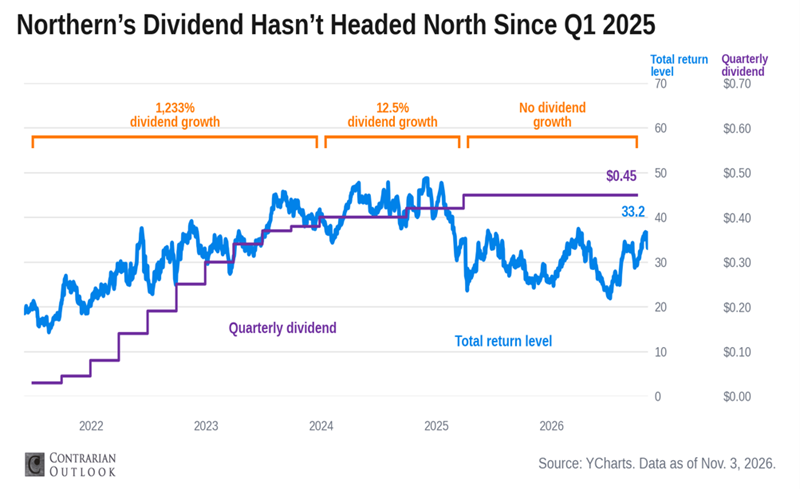
But NOG still pays one of the highest yields we can find among non-infrastructure energy stocks, and cash is no issue. Not only is coverage still plenty safe at a little more than 40% of this year’s earnings estimates, but NOG also authorized a $150 million increase to its buyback program in July.
This is ultimately a play on oil prices and little else, but it can still deliver some pop from depressed prices. NOG shares have put up a total return of almost 25% since my July article, and improving estimates have it trading at roughly the same valuation as before.
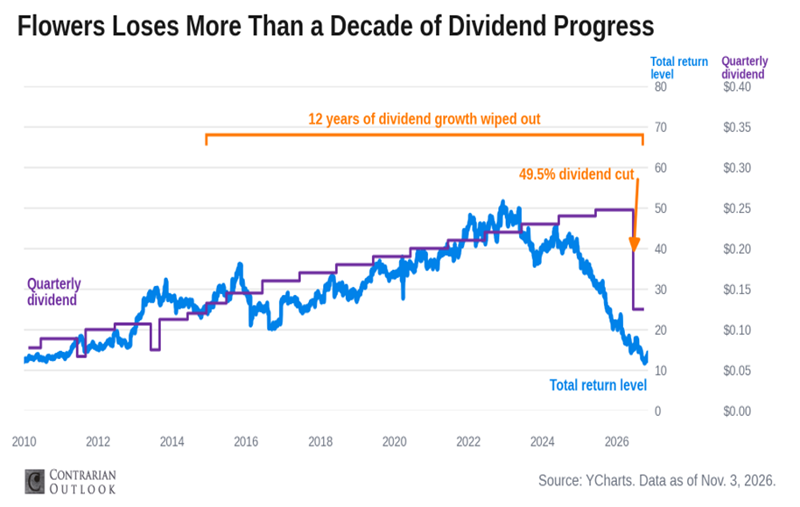
I’ve been warning about Flowers Foods (FLO, 7.1% dividend yield) for a long time. In May, the bread baker finally hacked its dividend nearly in half, to 12.5 cents per quarter.
It’s a critical reset—and given that Flowers still yields more than 7% even after the hack, it’s worth revisiting this consumer staples play to see whether the worst is over.
Flowers is a carbohydrate king, selling bread (Wonder, Sunbeam, Nature’s Own, Dave’s Killer Bread, among others) and snacks (Tastykake, Mrs. Freshley’s and more).
FLO has struggled mightily with high input costs and a generational shift away from sugary and otherwise unhealthy snacks. While revenues have actually climbed every year since 2022, profits have plunged by about 60% in that time—and the bottom-line hemorrhaging is expected to continue through the rest of this year and next. Flowers has lost three-quarters of its value since late 2022, and the stock now trades at a dirt-cheap 9.2 times earnings estimates.
Flowers’ answer to its issues is a pivot toward “better-for-you” brands. It bought Simple Mills (trail bars, baking mixes, crackers and healthier snacks) for $795 million last year. In August, the company reportedly was seeking a buyer for Tastykake. Unloading that brand, combined with the shearing of its dividend, would give FLO more deal ammunition and give it some room to cut into its debt.
But while Flowers is on better financial ground, the core business continues to teeter. Higher prices have softened demand for its premium Dave’s Killer Bread, and the relaunch of the Nature’s Own brand hasn’t done anything to shore up sales. FLO might look toward M&A for a spark, but any real recovery will almost certainly require improvement in the bread basket.
The Federal Reserve’s interest-rate turnabout sent real estate investment trusts (REITs) into freefall for a few weeks. The sector is finally getting up off the mat, but several are still trading on the cheap.
Douglas Emmett (DEI, 7.1% dividend yield) is a niche office-and-apartment operator whose geographical footprint is limited to Los Angeles and Honolulu. That’s it. All 18.2 million square feet of office space, as well as 4,410 apartments (plus another thousand or so in development), are contained within a pair of cities. That’s a critical lack of diversification.
Those two property types are imbalanced, too. Office tenants account for almost 80% of rent, which is largely why Douglas Emmett was among the worst REITs both during the COVID bear market and following it—and why DEI had to slice its dividend by nearly a third in 2022.
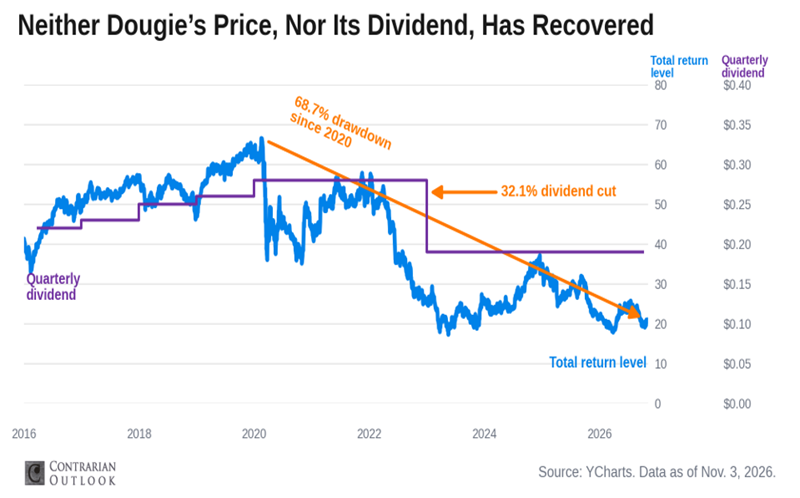
But DEI still has a few noteworthy qualities. It’s pretty well-rounded by industry—legal, financial services, real estate, health, entertainment and more—with no segment making up more than 20% of the tenant mix. Its tenants are also small and mostly local; 96% of its office leases are under 20,000 square feet. Local laws obstruct the building of new office towers near most of their locations. And the company’s leases bake in 3%-5% annual rent increase.
And it’s cheap, too. Right now, DEI trades at less than 7 times expectations for next year’s funds from operations (FFO). Throw in a yield just over 7% that’s extremely well covered at only around half of FFO estimates, and there’s a lot to like about Douglas Emmett in a favorable environment.
We’re just not in that environment yet. California has suffered from a corporate drain to other states, and one of Los Angeles’ bread-and-butter industries—entertainment—has suffered significant headwinds of late, too. That’s reflected in a poor occupancy of around 77%, which is 11 points less than the office-REIT industry average.
Commercial REIT Global Net Lease (GNL, 11.0% dividend yield) has crashed this fall. Earlier this summer, it traded at an 8% yield. Now it’s at 11%.
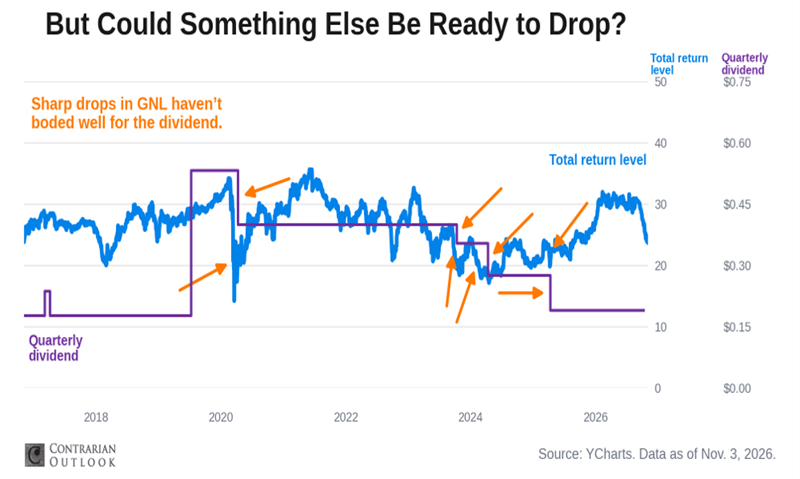
Global Net Lease’s name refers to its net-lease contracts, which are “net” of taxes, insurance and maintenance costs. GNL collects the rent; nothing more. And the lion’s share of those contracts (87%) have rent increases built in.
Its portfolio of nearly 800 properties covers 40 million square feet. Industrial and distribution real estate makes up almost half of straight-line rents, with the rest split almost evenly between office and retail. GNL is also more geographically diversified than most REITs, with three-quarters of straight-line rents coming from the U.S. and Canada, and the remainder from Europe.
Global Net Lease is moving that mix further away from offices, most notably with the $535 million, all-stock acquisition of Modiv Industrial announced in May.
This is a REIT that has been improving just about every aspect of its business over the past couple years, including shedding some debt, upping occupancy and percentage of investment-grade tenants, reducing expenses and getting rid of suboptimal properties. But it’s still dogged by extremely high leverage and some looming refinancings that look even worse in the wake of the Fed’s recent rate hike.
That puts the dividend in serious question. Even after raising full-year AFFO guidance to 82-85 cents, GNL pays out roughly 90% of it—not great considering a still-heavy debt load and higher debt expenses on the horizon.
My Retirement Income Plan for 2027
Our dividend targets for 2027 should be capable of generating so much annual income that, by the time we retire, we’ll never have to sell a single share.
But that won’t happen by owning stocks with a history of cutting bait on their dividends every time they face a financial hurdle.
Fortunately, that’s not a concern for the investments in my “No Withdrawal” portfolio.
The “No Withdrawal” portfolio solves the retirement-savings shortfall that literally millions of Americans face today.
Before COVID, I remember the talking heads on CNBC and Fox Business telling us we needed to have at least $1 million saved if we wanted to retire comfortably. When inflation kicked into high gear, that number did, too—it became $1.25 million, then $1.5 million. This year, I’ve seen numerous headlines asking whether $2 million is enough to retire!
But here on planet Earth, the average 55- to 64-year-old has just more than $500,000 socked away!
What will that half-million get you?
- If you invest that $500,000 in a traditional 60/40 portfolio, you’ll earn $26,900 a year. That’s just above the poverty line.
- If you invest that $500,000 in my 8% “No Withdrawal” Retirement Portfolio, you’ll earn an annual income of 8%, 9% or even 10%+. That means you could bank $40,000 to $50,000 (and potentially more) each year!
Let me show you the high-yield names I have lined up for 2027 and beyond, and I’ll reveal how you could live off $500,000 for the rest of your life. Details on these generous dividends—up to 16.2%—are waiting for you here.