
Let’s talk about this latest pop in Treasury yields and what it really means for those of us looking to save for (and generate reliable income in!) retirement.
Because the truth is, it means something completely different than what the mainstream media is trying to sell us. In fact, this situation sets up an opportunity for us to lock in high yields—I’m talking north of 6%—the longer it keeps up.
To be sure, the yield on long-term government debt is on the rise. At around 5.2% as of this writing, yields on 30-year Treasuries are now just below a high not seen in 19 years.
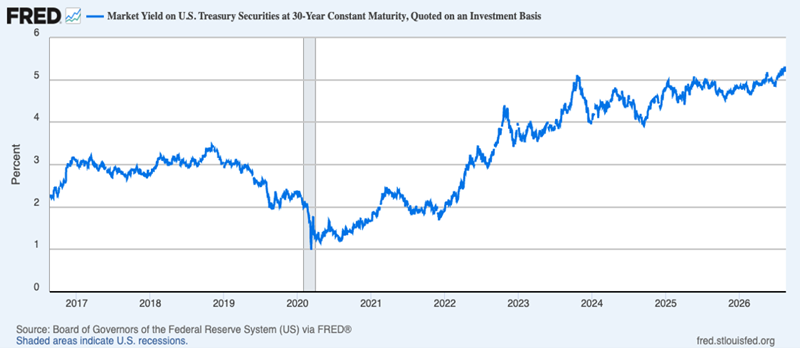
There are a lot of reasons for that: AI has sped up economic growth; the Strait of Hormuz closures have sent oil soaring; and the US government is overspending. These are all inflationary, and inflation causes long-term Treasury yields to rise.
I know this sounds worrying (and it is, for the US government and for consumers with high debt loads). But beyond that, it’s more of a mixed bag: The AI-driven economic-growth picture is good, especially if you’re invested in tech.
And the American economy remains resilient overall, with persistently high GDP growth. This suggests the Fed is less likely to lower rates, and could indeed raise them. That, again, puts upward pressure on long-term Treasury yields.
It’s easy to print scary headlines around this development, like The New York Times saying, “The Bond Market Is Signaling Rising Risks. Investors Should Listen,” and MarketWatch warning “The Treasury’s bond-market intervention isn’t working.”
But the reality is that there are winners and losers: If you want to invest in long-term Treasuries, for example, doing so today locks in a high yield.
And more broadly, if you want to invest in bonds of any sort, you’ll get a higher yield, as other bond yields tend to go up alongside those of long-term US Treasuries. That’s because all types of bonds compete for the same investors.
You can see that in action when you look at the benchmark index funds for long-term Treasuries—the iShares 20+ Year Treasury Bond ETF (TLT), in purple below—and for US high-yield corporate bonds: the State Street SPDR Bloomberg High-Yield Bond ETF (JNK), in orange.
Media Panics, Bonds Chill
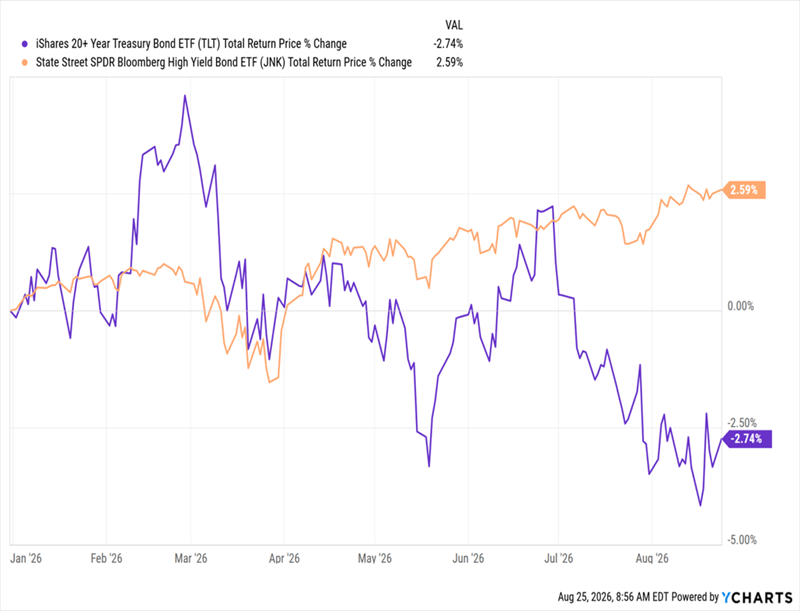
These are small moves, and they’re actually good news for bond markets, which tend to move slowly in calm economic times (and I’d argue that we’re actually in calmer economic times than the headlines indicate).
What’s important is the difference: Corporate bonds and long-term Treasuries were marching in lockstep until recently, when long-term Treasuries suddenly fell (remember, prices down, yields up and vice-versa). This tells us that investors are still interested in corporate bonds, and that there may be an opportunity to invest in them and get more income as interest rates rise.
Some funds that have lagged the market by a wide range are suddenly getting a boost as a result, such as a 6.5%-yielding closed-end fund (CEF) called the Highland Opportunities and Income Fund (HFRO).
Investors Pile Into This 6.5%-Paying Bond Fund
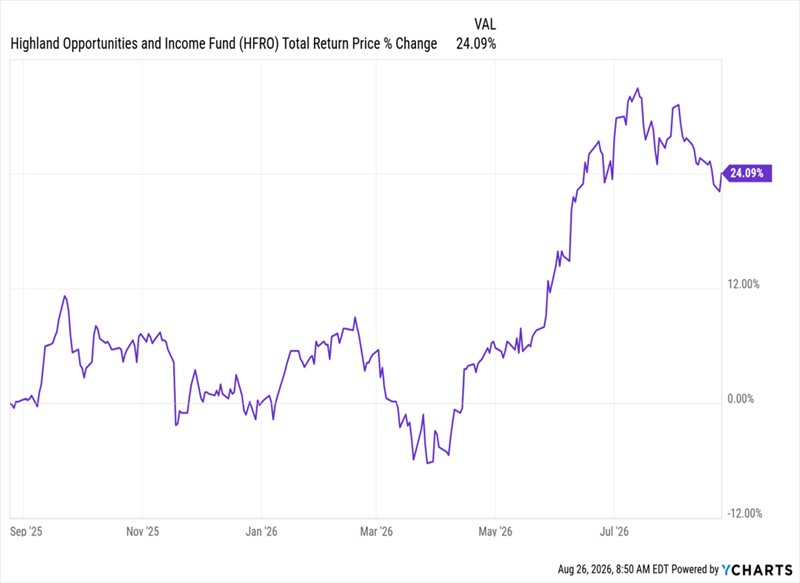
HFRO holds interests in a number of private real estate projects across America, as well as loans to other real-estate and corporate projects. All of these assets are strongly tied to movements in bond yields.
While the fund’s total return was pretty flat over the last year, with some dips earlier in 2026, it has soared in recent weeks as investors have developed an appetite for rate-sensitive assets. That’s boosting HFRO’s total return, while investors enjoy its 6.5% dividend. There’s something interesting happening on the valuation side of things, too:
A Wide Discount
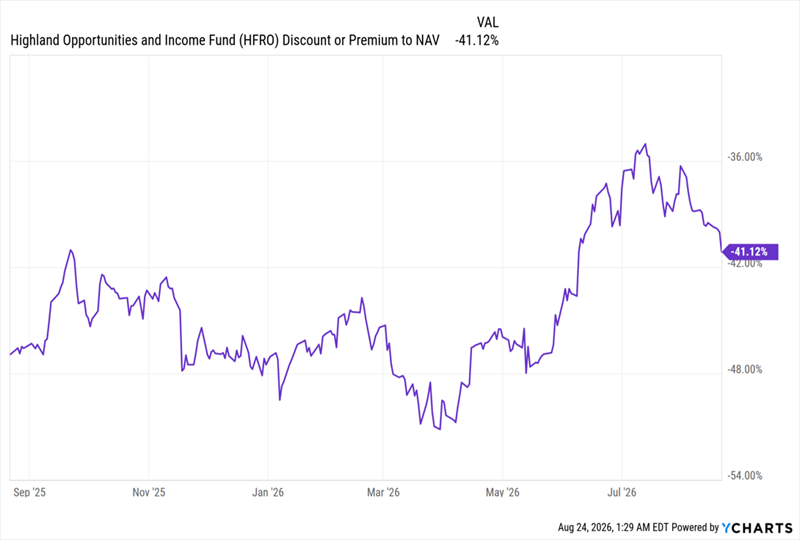
The fund is still very underpriced, with a 41% discount to net asset value (NAV, or the value of its underlying portfolio). The average CEF discount is currently 5.5%, so this is a huge difference, and that’s the opportunity a lot of investors are piling into.
With more interest in corporate bonds and other rate-sensitive assets, you could see more investors looking at funds like HFRO, but there’s a catch here. The more they buy, the lower the yield becomes, since higher prices, again, mean lower yields.
And 6.5% is already pretty low, with the average CEF yielding 8.9%, so there may be a limit to just how much this discount evaporates.
4 Funds. 4 Shots at Huge 9.9% Dividends Cheap (Thanks to Rising Bond Yields)
As I just told you, we’re not waiting around to take advantage of surging bond yields.
We’re not seized up with panic, like most investors, either.
No way. We’re using this worry to shop for bargains—like we always do when investors get edgy.
At the top of our list? Four CEFs kicking out a rich 9.9% dividend between them. They include the best plays on the overdone rate fear, featuring portfolios stuffed with the best corporate bonds, real estate investment trusts (REITs) and blue chip stocks, too.
The time to move, and lock in this outsized 9.9% payout, is now. Click here and I’ll break down the buy case behind each of these resilient (and cheap!) funds and give you a Special Report revealing their names and tickers.