
Today we’re going to look at a closed-end fund (CEF) that seemingly offers everything:
- A 6.7%-yielding dividend that pays monthly.
- A solid payout track record: This dividend has been delivered reliably for more than six years.
- Terrific performance, to the tune of an 8.5% annualized return over the last decade.
And yet, this fund is a sell. If you own it, I recommend dumping it immediately.
I know that sounds a bit strange, so let me explain why it’s a risky investment, and how other funds like it are, as well.
Before I do, though, let me emphasize one thing: The managers of the GAMCO Global Gold, Natural Resources & Income Trust (GGN) are professional, qualified and good at what they do. GAMCO is one of a handful of legendary asset-management firms on Wall Street, and they have a stable of high-quality funds.
And GGN itself has performed very well over the last year.
GGN Delivers in the Short Term …
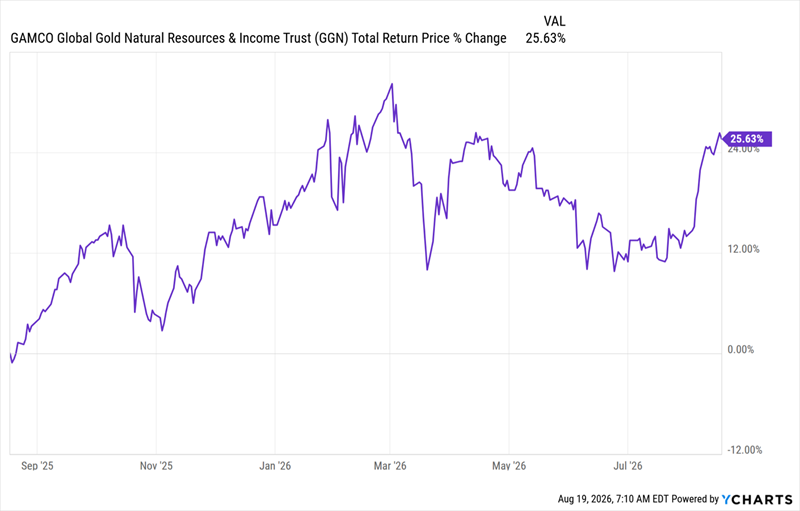
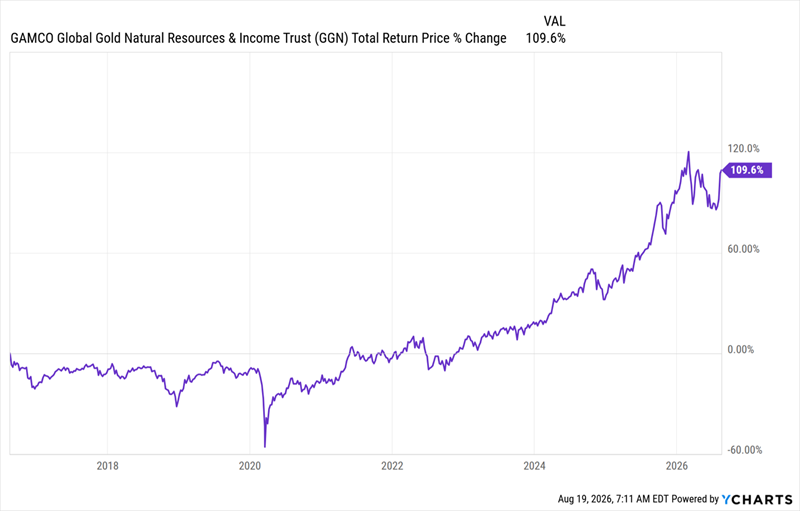
A 25.6% return in one year is nothing to sneeze at, and if we go back a decade, we see that the fund has also posted a solid return of around 8.5% per year on average.
… And the Long
Then there’s that 6.7% dividend. It’s impressive both because it’s roughly seven times the payout on the typical S&P 500 stock and because of the nature of this fund: With big investments in oil, natural gas and gold, GGN pulls a healthy income stream out of low- (or no-) yielding commodity investments.
Moreover, that income stream has held steady for six years, its last cut coming only in the early days of the pandemic, when interest rates (and inflation fears, a major driver of gold prices—more on that in a moment) crashed.
So far so good. So why is this fund a sell?
To get a hint, take another look at that 10-year chart above: Note how GGN was pretty much delivering flat returns until 2022?
If we zoom in on that period, we immediately see the problem: While gold—shown in blue below by the performance of the SPDR Gold Shares ETF (GLD), was starting to pick up with a pretty decent post-pandemic run, oil—shown by the United States Oil Fund LP (USO), in orange—was down sharply. (Note that USO and GLD are used here to compare other investable options for tracking these prices with GGN.)
GGN Lags Gold, Leads Oil Into the New Decade …
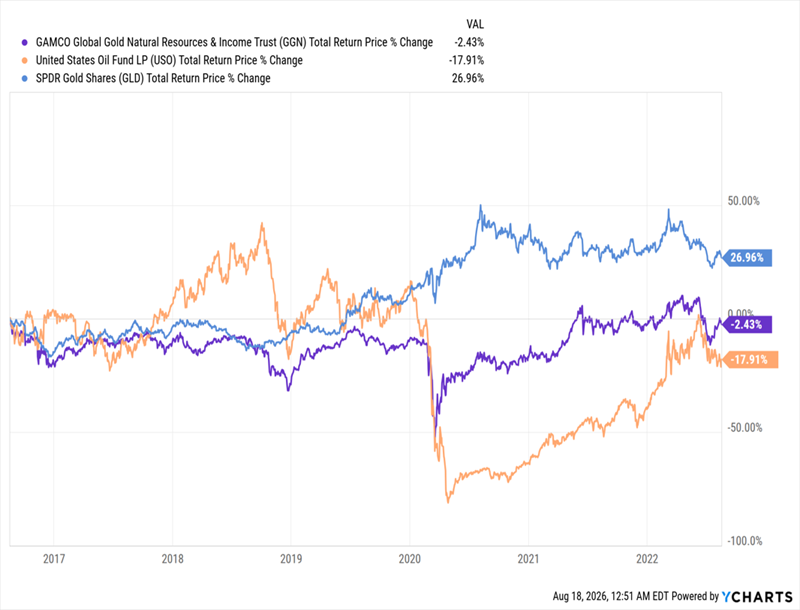
GGN (in purple) was slightly down as a result, in between the gains in GLD and the steeper losses in USO. That’s pretty much what you’d expect.
… But Drops to Third Spot in the Last 5 Years
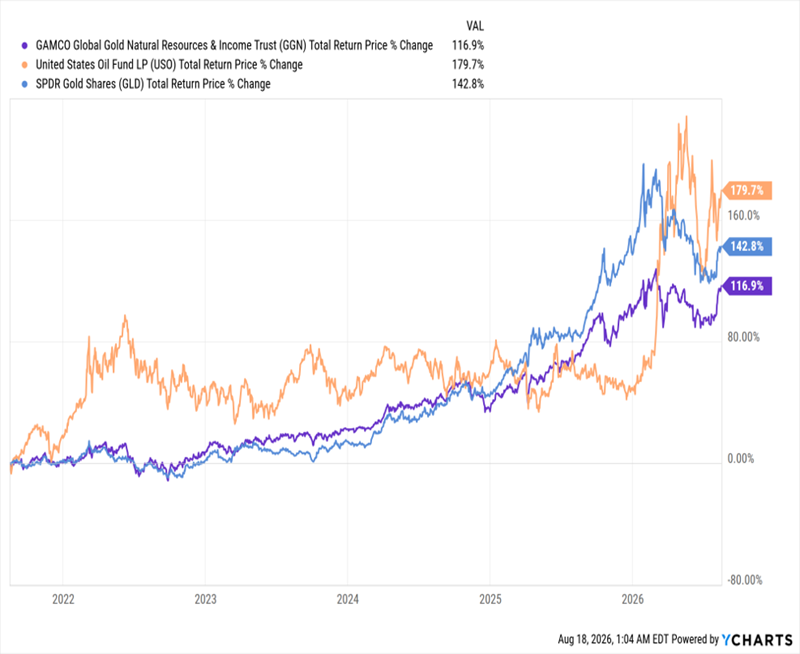
Then over the last five years, things have actually gotten worse for GGN, with its return trailing both GLD and USO.
Which brings us to the real problem with long-term commodity investing: If we take a look at how spot gold and oil prices do against the market in the long run (I’m talking 33 years here), we see that they’re nowhere near stocks in terms of total returns.
Commodities Lag the Market in the Long Term
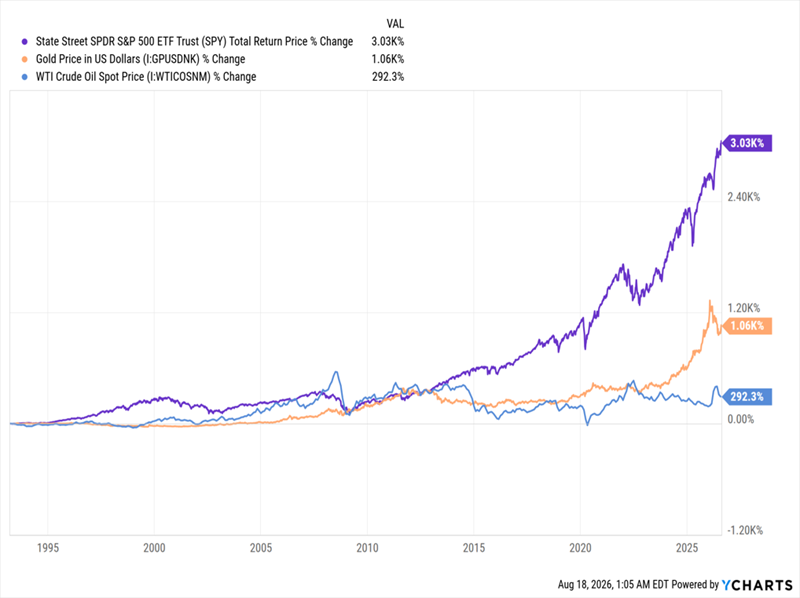
Over the long haul, gold and oil on their own have not done well compared to the S&P 500. This is how it tends to be: In the long term, stocks tend to outperform both gold and oil simply because stocks represent holdings in companies that produce goods and services. That’s inherently more profitable than commodities like oil and gold.
Oil, of course, is valuable on its own as an input to the economy. That’s why oil companies and oil-rich countries find ways to produce oil to fill that demand. It’s also why companies outside the oil sector, as well as countries that don’t have large oil reserves, find ways to cut their need for crude. Those pressures more or less even out, with oil growing just 4.2% per year over the last 33 years, versus 10.9% for stocks.
Gold is different: Its value has more to do with history and attitudes about inflation and future growth. This is why gold can soar in the short term (especially in periods of volatility), although its long-term gains are lower than those of stocks: At 7.4% annualized over the last 33 years, it’s done better than oil, but worse than equities.
In light of that, we should expect GGN to underperform stocks over the long term. And that’s exactly what’s happened.
GGN’s Gold, Oil “Anchors” Hold It Back
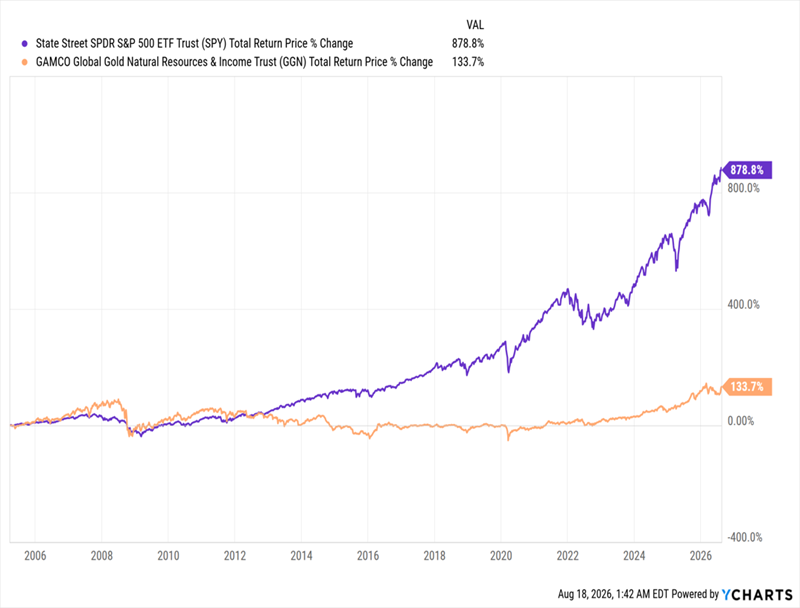
Here we see how GGN’s performance since its IPO in 2005 has been well behind the S&P 500, at a 4.1% annualized total return, as of this writing, versus 11.5% annualized.
The bottom line? If you’re investing for the long haul (and at my CEF Insider service, which focuses on these 8%+ paying funds, we very much are), GGN is not a great fund to buy. It’s more of an opportunity to get exposure to commodities for short-term runs when the time is right. And now, with oil high and gold correcting, is not that time.
My “60-Paycheck” Plan Delivers 9.7% Yields—and Gains—Into Retirement (and Beyond)
I think it’s pretty clear that the dividends, and growth, we need to fund our lifestyles are not going to be found in oil, gold, or other speculative plays.
We need real assets—I’m talking stocks and bonds issued by strong, profitable companies. Even better if we can buy those companies through a fund that takes their gains and “translates” them into strong income for us.
That’s what the 5 CEFs in my “60-Paycheck Dividend Plan” do. They come from across the economy, holding top blue-chip stocks, bonds and real estate investment trusts (REITs)—real income plays investors have counted on for generations—and hand us a sweet 9.7% dividend we can count on.
Best of all, each of these 5 funds pays us monthly, in line with our bills. That’s where the “60-Paycheck” name comes from: With one payout coming from each of these 5 funds every month, we get 60 separate dividend “paychecks” over the course of the year.
The full portfolio is waiting for you now. Click here and I’ll introduce it to you and give you a free Special Report revealing the 5 stout 9.7%-paying funds that make it work.