
We contrarians rarely play in the tech sector. It’s just not built for us.
Technology stocks are often overhyped, overcovered and valuation-rich. Wall Street already loves them, which means there’s no room for upgrade-triggered pops and few inefficiencies for us to exploit.
They’re also historically dividend-poor.
And Right Now, Tech Stocks Are Dividend-Destitute
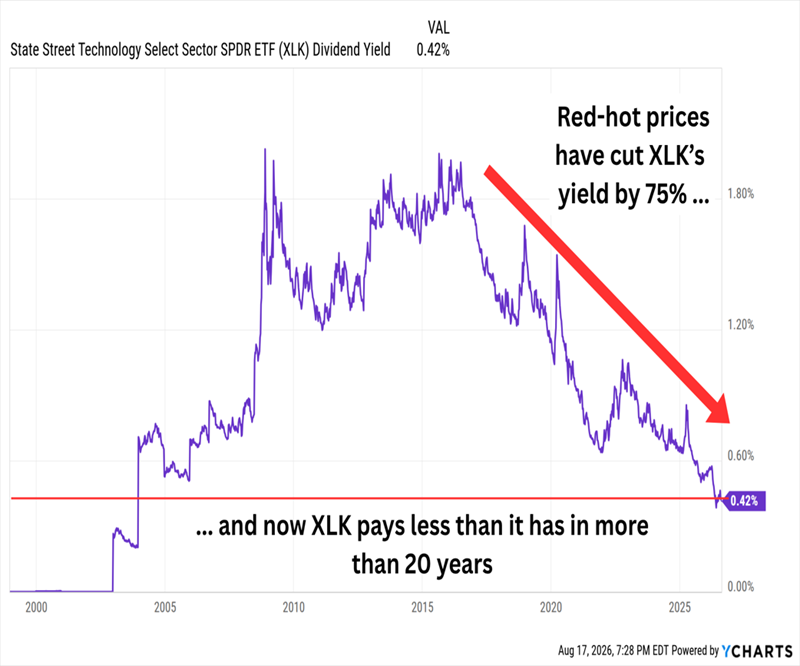
But despite ludicrous prices in the likes of Palantir Technologies (PLTR) and Crowdstrike Holdings (CRWD), the sector as a whole is starting to look more reasonable. Tech stocks’ forward P/E has quickly winnowed to near pre-COVID levels and isn’t much more expensive than the broader market.
And while the S&P 500’s tech companies might as well be paying IOUs, a few of the sector’s less traveled names look downright generous.
Of course, there is usually a reason why tech dividends are large. Often it is because investors are not giving their businesses a lot of credit going forward. Let’s see what is under the hood of these businesses.
Take, for instance, the following six tech plays, which are shelling out staggeringly high yields of between 4.4% and 8.1% that put the rest of the sector to shame.
Several Asian tech stocks have become everyday names here in the U.S. Semiconductor companies such as South Korea’s Samsung and SK Hynix (SKHY), as well as Taiwan Semiconductor (TSM), are tightly tied to artificial intelligence and thus a top priority for the financial media.
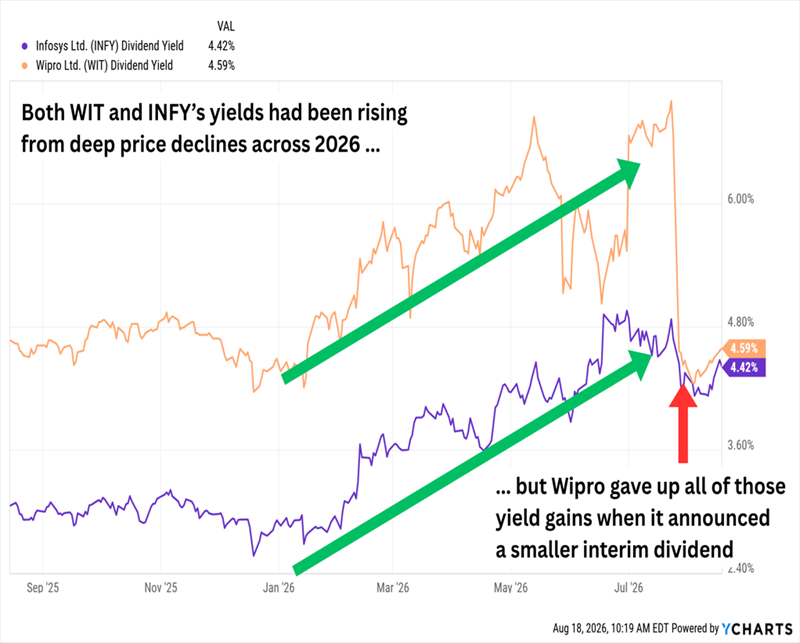
That same AI trade has swept traditional IT services companies like India’s Infosys (INFY, 4.4% dividend yield) and Wipro (WIT, 4.6% dividend yield) into the dustpan. While other businesses have traditionally called upon these and similar companies for coders, testers and other human specialists, they’re increasingly trying to determine whether AI can do the job instead.
Infosys and Wipro both acknowledge the solution is adapting to AI in one way or another. The former says it will hire 6,000 “forward deployed engineers,” or FDEs (a term popularized by Palantir), over the next few years. These engineers work on-site to build infrastructure and customize solutions for clients’ AI needs. The latter is teaming up with Databricks to develop AI-first products to serve the needs of wealth management, telecom, energy and other industries.
Both companies have lost nearly a third of their value in 2026. INFY traded at 22 times 2027 earnings at the start of this year; it currently trades at 14. WIT has thinned out from a 19 forward P/E to just 13.
Infosys and Wipro also both pay semiannual dividends, and like many international programs, those dividends usually fluctuate. Still, they both pay yields near 4.5% that are many times better than the sector average.
They reflect very different stories, however. Infosys’s yield is just a product of its recent losses. Wipro’s yield had been plumping up, too—until recently.
But a Sharp Interim Dividend Cut Knocked Off Several Points of Yield
Investors who would prefer a more reliable, regular dividend can look north to Waterloo, Canada’s OpenText (OTEX, 4.6% dividend yield). OpenText is an information management software company whose solutions span business networks, content services, cybersecurity, IT management and more. Like Wipro and Infosys, OpenText is viewed as an “AI loser” and is trying to shed that label by leaning into AI.
Earlier this year, the company divested noncore businesses Vertica and eDOCS. It brought on International Business Machines (IBM) veteran Ayman Antoun in April, and he has since pledged to ramp up the company’s investments in research & development and sales reps.
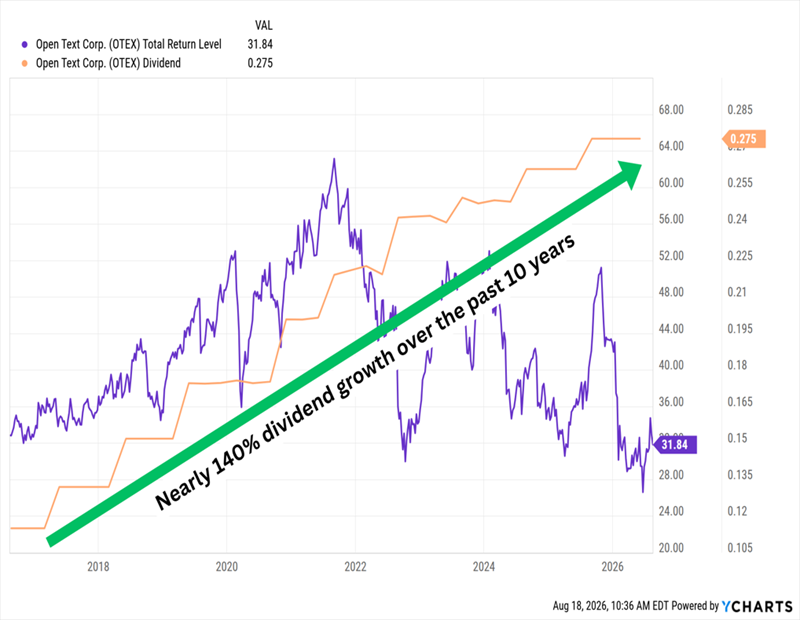
OTEX lost roughly a quarter of its value near the start of the year, and none of the above developments have gotten the stock out of its funk. So right now, we can own this potential turnaround story for less than 6 times adjusted earnings and collect an extremely well-covered 4%-plus that is paid quarterly and has been growing annually for more than a decade.
OpenText Has Opened Up Its Wallet
While we can capture decent yields from individual tech plays, funds are where we’ll find the sector’s standout income opportunities.
Take the FT Vest Technology Dividend Target Income ETF (TDVI, 5.6% dividend yield), for instance.
This exchange-traded fund owns a basket of Nasdaq Technology Dividend Index companies like Microsoft (MSFT) and Broadcom (AVGO), but it also sells call options—contracts that give the buyer the right to purchase a stock from the seller for a certain price within a certain period of time—on the S&P 500 and Nasdaq-100.
The premiums it collects from selling “covered calls” allow TDVI to take a portfolio that would normally pay us 1%-2% and instead pay out north of 5%!
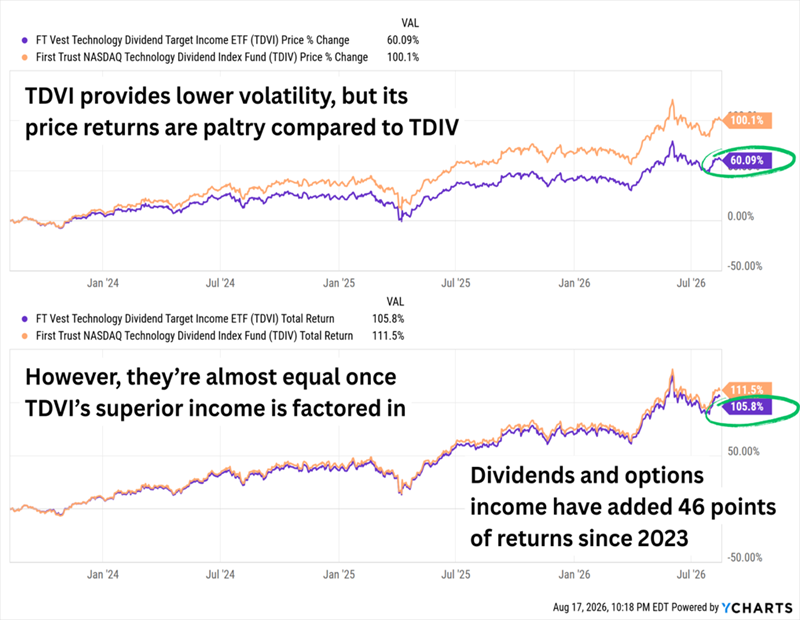
Covered-call funds typically reduce volatility, but at the cost of lower overall returns. That’s because if the stock rises to (or above) the option’s strike price, the shares will likely be “called away,” and we won’t enjoy any additional upside from the stock.
But FT Vest’s performance gap against the index it’s built around—represented by the First Trust NASDAQ Technology Dividend Index Fund (TDIV)—is modest compared to other covered-call ETFs.
TDVI Competes Despite Having an Arm Tied Behind Its Back
“Hey. Can’t we get 50%-60% yields from ETFs now?” Technically yes, but as I’ve written before, those are gimmicky, poorly run funds that don’t create shareholder wealth—they destroy it.
Back here on Planet Earth, we can get bigger (but still realistic) tech-sector yields from closed-end funds (CEFs). They trade options, too. But they can also use debt leverage to invest more than 100% of their assets in their portfolios, invest in private equity and use other tricks to gin up their performance and income.
Better still? While ETFs are built in a way that keeps their prices tightly locked to their net asset value (NAV), CEFs are much less efficient, so we can often buy these funds’ holdings for less than they’re actually worth.
The BlackRock Science and Technology Term Trust (BSTZ, 6.2% distribution rate) is a mostly tech-sector fund (80% of assets) with some global exposure. Comanagers Tony Kim and Reid Menge own companies “selected for their rapid and sustainable growth potential from the development, advancement and use of science and/or technology.”
Not exactly dividend-paying types. Instead, this monthly distribution is almost entirely made up of capital gains and return of capital (RoC). It’s a somewhat managed payout, though it does shift a little higher or a little lower from one year to the next.
We Occasionally Get Special Dividends, Too
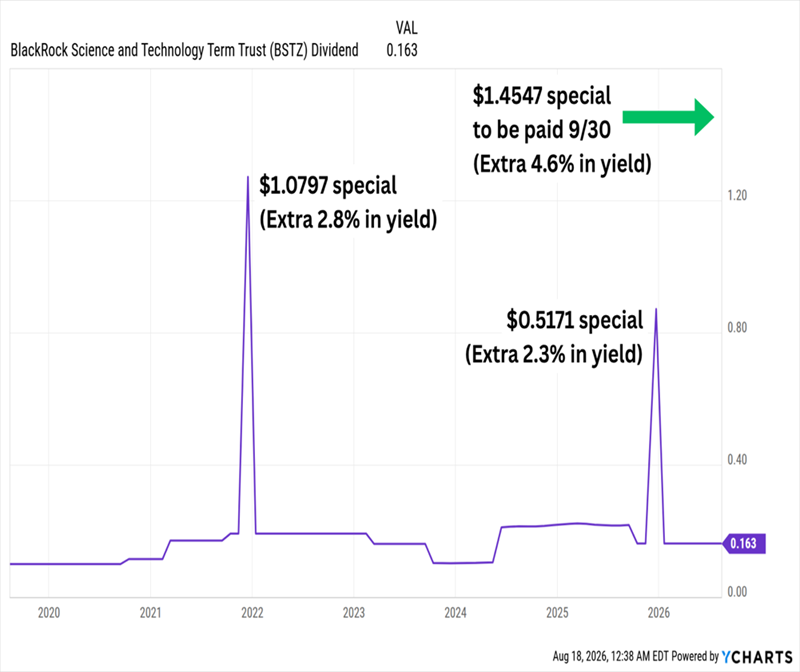
That most recent special would’ve kicked up the fund’s total yield to north of 10%.
But it’s not just the dividend that makes BSTZ stand out—it’s also the holdings.
BlackRock owns not just standard tech-sector fare like Nvidia (NVDA) and Micron (MU), but significant chunks of private firms including Databricks, quantum computing company PsiQuantum and Claude maker Anthropic (which might be a publicly traded firm in a couple months).
BSTZ’s ability to tap into the private markets hasn’t always worked out for it—in fact, it has returned only half as much as the broader tech sector since the fund launched in 2019. Things have picked up over the past couple years, though, resulting not just in outperformance, but a couple of booster shots to the already-generous distribution.
We can also buy BSTZ’s holdings for about 7% less than they’re worth. That’s nice, though that’s actually more expensive than its long-term discount to NAV of nearly 12%.
Just know that this CEF is a “term trust” that is expected to dissolve June 26, 2031, though the board can extend its life by up to 18 months.
I’ve talked about several tech plays that get us some sort of exposure to artificial intelligence, but the Virtus AI & Tech Opportunities Fund (AIO, 8.1% distribution rate) is a direct, focused play on the technology sector’s most pressing trend.
It’s a distribution monster. It pays us more than 8% on its regular payout alone. It pays us monthly. It pays us specials, too—the most recent extra distribution sends its yield into the double digits.
And AIO Has Given Us a Few Raises to Boot
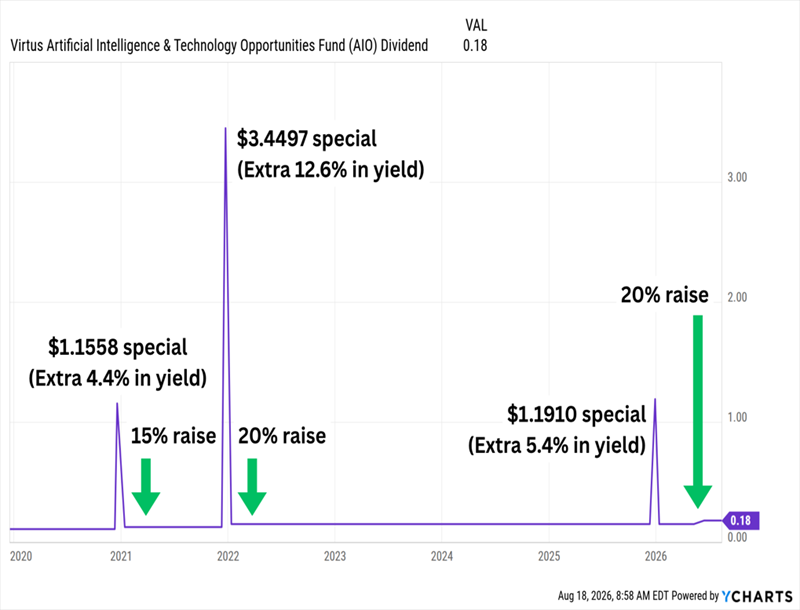
It’s also a much better deal than BSTZ right now, trading at a nearly 9% discount to NAV versus a long-term average of about 7%.
Unlike BSTZ, which largely just allocates its performance as distributions, AIO is actually constructed with income in mind. Yes, it holds traditional AI plays like Nvidia and Taiwan Semiconductor. But only about half its portfolio is made up of common stocks—the rest is a blend of convertible securities and high-yield bonds. So its distributions are made up of just about everything: dividend and interest income, capital gains, and RoC. The four-person management team also uses a modest amount of debt leverage, currently in the low teens, to juice its payout and returns.
My Wealth-Building Cheat Code: Monthly Dividends of 9%+
Investors are trained to think they have to choose between growth and the security of high monthly dividends.
But they don’t—and my “9%+ Monthly Payer Portfolio” is proof of that.
My 9%+ Monthly Payer Portfolio is built on the premise that “boring is beautiful.” They’re low-drama holdings that were picked because they won’t wilt every time the economy hiccups or Fed Chair Kevin Warsh sneezes. That’s in part because of their sky-high dividends: The portfolio averages more than 9%, and several of these picks pay us more than 11%!
But we’re not just getting defense—these very same dividend powerhouses offer double-digit price upside.
The dividend security allows us to live our lives instead of doomscrolling our brokerage accounts. The price potential allows us to not just keep our nest eggs intact, but actually grow them while using our rich dividends to pay the bills.
The math shows us just how powerful this income portfolio is: A mere $600,000 nest egg—less than half of what most financial gurus insist you need to retire—put to work in my 9%+ Monthly Payer Portfolio would generate a $54,000 annual income stream. That’s $4,500 every month in regular income checks!
Better still? While the market’s valuation is in the nosebleeds, many of my monthly dividend stocks remain in my “buy zone” … but they won’t stay there forever. So click here to learn everything you need about these generous monthly dividend payers right now!