
Why sit around and wait all quarter long for a dividend payment?
Monthly divvies are where the retirement party is at! These income “cheat codes” arrive alongside our bills and recurring expenses. What a concept!
But be careful because some monthly payers don’t pay enough to matter. Take Permian Basin Royalty Trust (PBT), which pays monthly but these divvies add up to just 1.2% annually. Gee, thanks.
$1M Invested in Either Would Pay Under the US Poverty Line
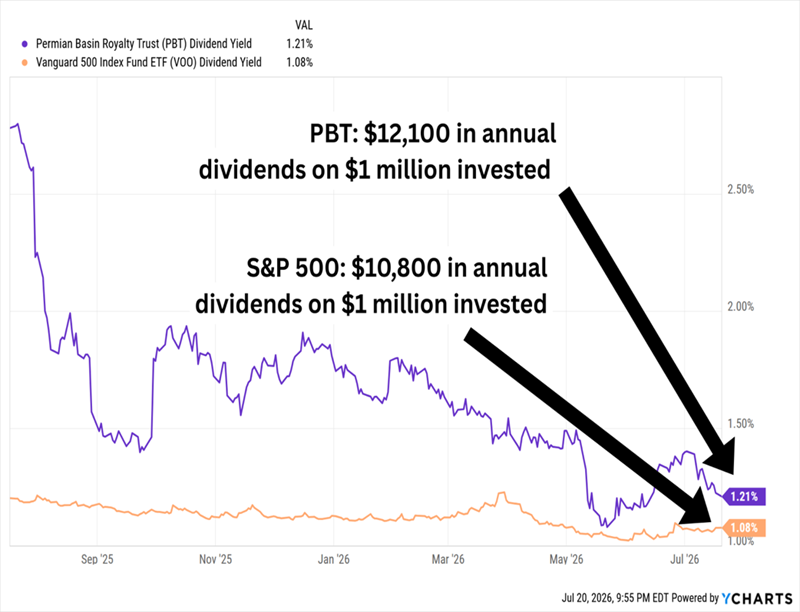
We need monthly payers that are committed to maximizing not just the frequency of shareholder rewards, but the size of the payout. And we need to shoot high—we shouldn’t settle for anything less than what it would take to retire on dividends alone.
Fortunately for us, many monthly dividend stocks fall within the high-yield acronyms: real estate investment trusts (REITs), business development companies (BDCs) and the like.
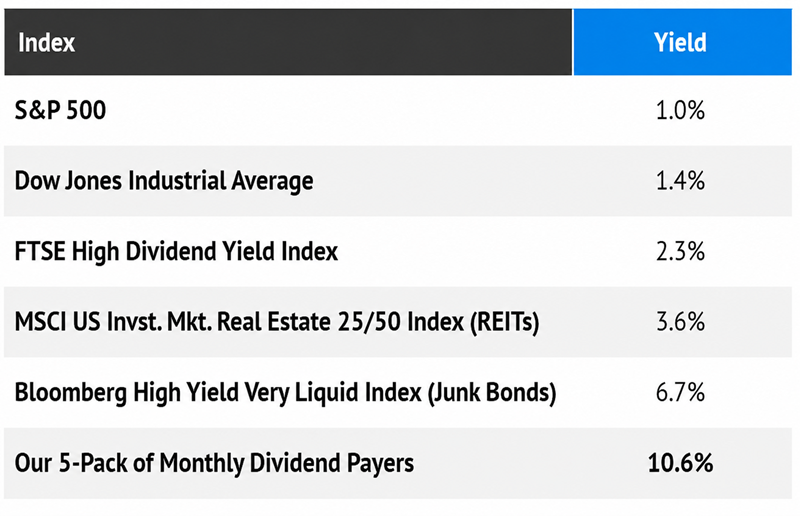
Today, for instance, I’ve put together a five-pack of monthly dividends that shell out an average of 10.6% annually. That means even half a million bucks evenly invested across them would generate a hefty “salary” of $53,000.
Let’s take a look.
Healthpeak Properties (DOC)
Dividend Yield: 5.4%
I’ll start with Healthpeak Properties (DOC), a healthcare REIT whose roughly 690 properties include outpatient medical facilities and laboratories, which are leased out to biopharma firms, health systems, physician groups, medical device manufacturers and more.
Healthpeak also deals in senior housing, albeit not as directly as it did just a few months ago. In March, DOC spun off that part of the business with an initial public offering of Janus Living (JAN). It wasn’t a full exit, however. Healthpeak not only retained more than 80% of the newly formed REIT, but it also is Janus’s external manager.
A couple months later, DOC received a much-needed jolt after reporting better-than-expected earnings and upgrading its funds from operations (FFO) outlook. Among the reasons for management’s optimism: The senior housing environment is improving, Janus appears primed to aggressively invest, and a weak laboratories market showed small signs that it’s starting to inflect.
And just this week, Healthpeak announced a $2.1 billion joint venture with Brookfield Asset Management (BAM) that will help DOC to pay down nearer-term debt (though it could be a short-term weight on earnings, too).
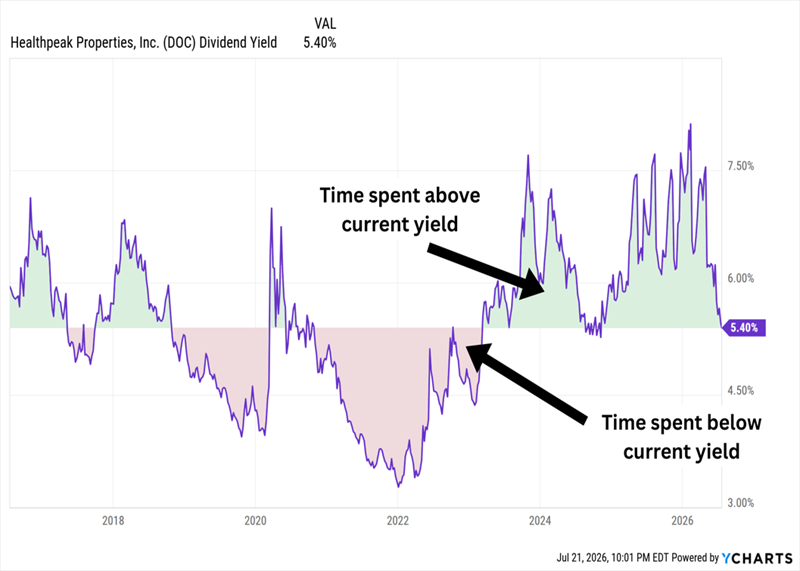
Healthpeak’s stock has delivered a year-to-date total return of almost 45% thanks to its summer ramp-up. It’s a welcome development for shareholders that have suffered through a decade-plus downtrend. However, new money is now buying a yield that’s well below historical highs and closer to a longer-term middle ground, while the P/FFO has wafted to just above 13—not wildly overpriced, but not discount territory either.
DOC’s Yield Has Dropped to Three-Year Lows
Itau Unibanco Holding (ITUB)
Dividend Yield: 6.2%
Most international companies pay dividends just once or twice a year, and some will even do a lopsided interim-and-final system. That’s practically useless for income planning.
Itaú Unibanco Holding (ITUB) isn’t exactly a conventional payer itself, but it at least doles out something each and every month.
Itaú Unibanco is the largest bank by assets in both Brazil and all of Latin America. It offers consumer banking products like credit cards and loans, but also commercial banking, advisory, real estate lending, life insurance and more. And while it’s headquartered in Brazil, it has operations across the Americas and Europe.
The company has printed bigger top and bottom lines every year since 2020, and it’s coming off a record-breaking first quarter in which it posted a $2.5 billion profit and a return on equity of around 25%. The company is also one of the region’s leaders in digital assets, giving it another potential growth avenue.
ITUB’s distributions are tied to performance, so Itaú Unibanco has increasingly been sharing the wealth with its stockholders. But while it pays much more frequently than most, it still has an odd system.
Itaú Unibanco: Generous but Complex
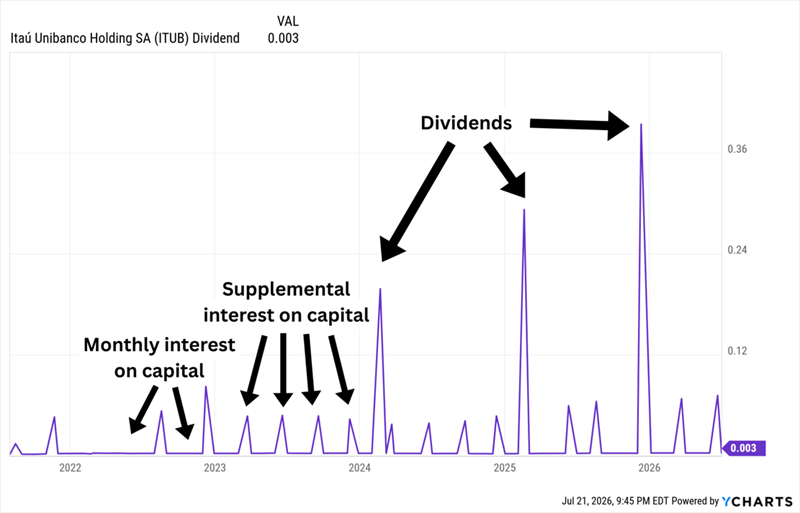
I’ve written several times about companies with regular-and-supplemental dividend programs. Itaú goes a step farther. The company distributes small monthly payments of “interest on capital” (IOC), but it will also make larger additional IOC payments throughout the year as able, then an actual dividend—usually its biggest payment—once a year.
The monthly payment only comes out to less than half a percent’s worth of yield; the real money is in those larger IOC distributions and the dividend. So while the dividends are a nice sweetener for investors who like ITUB for its growth potential, it’s not an ideal situation for retirement planners reliant on regular income.
Gladstone Investment (GAIN)
Dividend Yield: 9.1%
Let’s shift to business development companies, starting with one that has a regular-and-supplemental system like ITUB (but with a much more substantial baseline of income).
For the unfamiliar: BDCs were created by Congress in 1980 to spur investment in small businesses. Traditional banks often shunned smaller companies, either charging extremely high rates to compensate for the risk or outright refusing to lend to them. Enter BDCs, which provide equity, debt and other financing to small businesses that otherwise might not be able to raise capital.
Gladstone Investment (GAIN), for instance, provides financing to lower-middle-market companies that generate EBITDA (earnings before interest, taxes, depreciation and amortization) of between $4 million and $15 million annually, have attractive fundamentals and are run by strong management teams.
GAIN runs a small portfolio of just 29 investment companies right now, largely clustered in the business/consumer services, consumer products and manufacturing industries. Its investments include Phoenix Door Systems (industrial doors), ImageWorks Display (retail display shelving) and Old World Christmas (holiday-geared retail).
Gladstone Investment also stands out for its deal mix. Like with most BDCs, the majority of Gladstone’s financing is debt-based, and currently, all of that debt is floating-rate in nature. But GAIN is happier than most to deal in equity. Gladstone says the average BDC’s equity exposure is between 5% and 10%; its target is closer to 25%. This shields GAIN from interest-rate declines but puts it behind the 8-ball when rates climb.
There’s plenty to like from an operational standpoint. Net asset value has grown by nearly 30% between its fiscal Q1 and its recently reported fiscal Q4. Return on equity is consistently in the double digits and above peers.
The dividend is best described as “good with the potential for greatness.” GAIN’s monthly dividend comes out to a little less than 6%, which is high compared to the average stock and far better than what ITUB offers, but low relative to the BDC space. However, Gladstone Investment also pays supplemental distributions when it locks in gains from its equity investments.
If Only GAIN’s Gains Were a Bit More Predictable
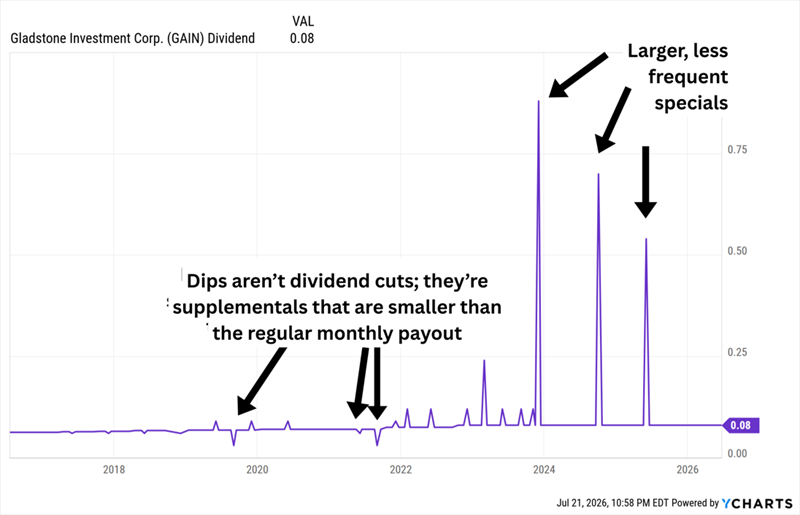
Right now, for instance, Gladstone Investment has gone roughly a year since its last supplemental. It might pay one later this year. It might do so in early 2027. It might be even longer; it’s hard to tell.
Still, it’s a decent income baseline with the potential for more, and it’s paid out by one of the industry’s better names. Pricing could be better, though, with GAIN shares currently trading right around the BDC’s net asset value.
PennantPark Floating Rate Capital (PFLT)
Dividend Yield: 14.0%
PennantPark Floating Rate Capital (PFLT) is another BDC that provides financing primarily via floating-rate senior secured loans—mostly first lien—but also through some equity and joint venture investments. Its target companies generate $10 million to $50 million in annual EBITDA.
This “value-added” BDC lends its expertise in specific industries, hence its portfolio focus on five categories: healthcare, consumer, business services, government services and software/technology.
Earlier this year, I wrote that PennantPark Floating Rate’s dividend has routinely outstripped its net investment income (NII), and did so again to close out 2025. The company insisted then that it could keep covering the payout.
But PFLT’s Actions Spoke Louder Than Words
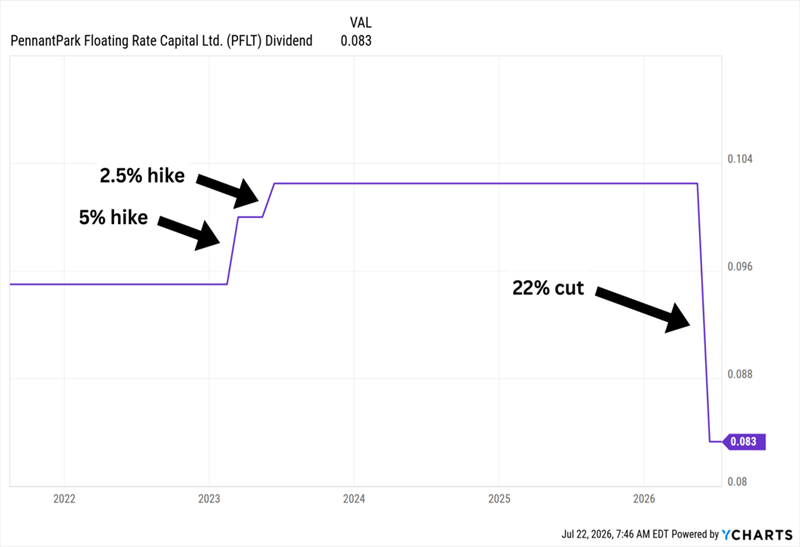
PFLT adjusted its monthly dividend program from 10.25 cents per share to an 8-cent regular, as well as supplemental dividends (50% of excess earnings). The first two supplemental dividends since the reduction were 0.33 cents apiece.
But not all dividend cuts are created equally. In the case of PFLT, its dividend cut is more a reflection of lower base rates than any underlying portfolio issues. In fact, the company’s credit quality is high relative to the sector, and sponsor investment activity is improving. Moreover, PFLT continues to trade for a song, priced at a 32% discount to NAV.
Invesco Mortgage Capital (IVR)
Dividend Yield: 18.2%
It’s hard to find better yields than in the mortgage REIT (mREIT) space, where double-digit payouts are the norm.
Mortgage REITs borrow at short-term rates, purchase mortgages paying long-term rates, then pocket the spread. Short-term rates are usually lower than long-term rates. But the ideal scenario is that short-term rates are also declining while long-term rates hold steady or also decline. In that scenario, mREITs’ existing mortgages, which were issued when rates were higher, will yield more than newly issued ones (and thus be worth more). On the flip side, rising rates weigh on the value of existing mortgages.
Invesco Mortgage Capital (IVR), for instance, owns “agency” mortgage-backed securities (MBS) from entities like Fannie Mae and Freddie Mac. These securities feel interest-rate pressure too, but it’s not as great because their MBSs are backed by the agencies, and thus they have virtually no default risk. I’ll also note that rising interest rates reduce the risk of prepayment, mostly because mortgage holders are less likely to refinance.
While Invesco Mortgage Capital yields a mouth-watering 18%, mortgage REITs historically have been prone to unstable dividends, and IVR is no different.
But Its Most Recent “Cut” Is Good News for Investors
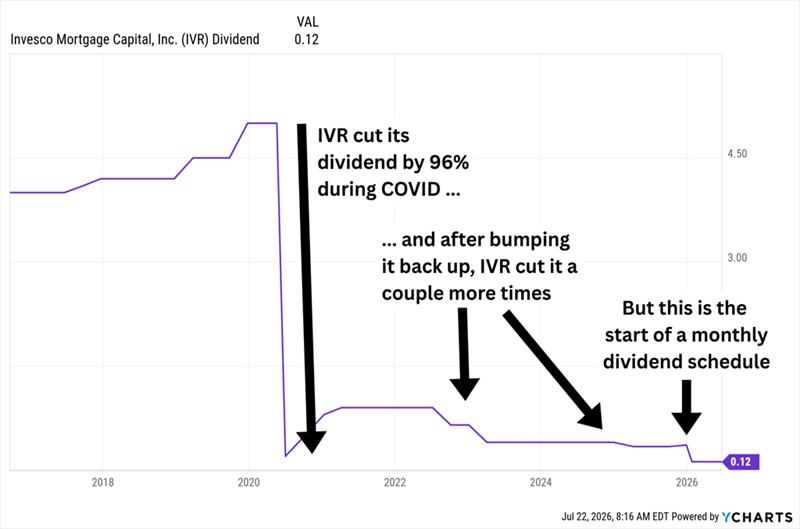
Near the end of 2025, IVR announced a modest 6% dividend hike to 36 cents per share to be paid in January. But in January, the company announced it would start to issue monthly dividends of 12 cents per share (so, the same amount each quarter).
Invesco Mortgage Capital has mostly underperformed its peers since COVID, but it has behaved much better over the past year or so. Dividend coverage, per its “earnings available per distribution” (EAD), is fine for now, too. But despite an effectively flat year-to-date performance (even accounting for its massive payout), shares trade at a thin discount to its shrinking book value.
Monthly Dividends of 11%+ We Can Actually Count On!
The monthly cadence? Great.
The frequent haircuts? Not so great.
Fortunately for us, we can collect massive monthly dividends without the fear of Lucy pulling the ball away.
My “11%+ Monthly Payer Portfolio” is built on the premise that “boring is beautiful.” It’s a collection of high-paying but low-drama holdings that won’t leave us reaching for the Pepto every time the economy hiccups or Fed Chair Kevin Warsh sneezes.
That dividend security allows us to live our lives instead of doomscrolling our brokerage accounts. And the high level of income helps us keep our nest eggs intact—unlike many retirement plans that require you to bleed out your savings as you age, the income this portfolio can generate is so rich, it can sustain a retirement on dividends alone.
Consider this: A mere $600,000 nest egg—less than half of what most financial gurus insist you need to retire—put to work in this powerful portfolio could generate a $54,000 annual income stream.
That’s $4,500 every month in regular income checks!
Even better? While the current bull run has many stocks priced for perfection, many of these monthly dividend stocks still remain in our “buy zone” … but they might not be for much longer. So click here to learn everything you need about these generous monthly dividend payers right now!