
Joblessness rose last month. And stocks jumped on the news.
It’s weird. And it’s giving us a rare chance to pick up a well-funded 6.8% dividend for 12.3% off its “regular” price.
This deal exists because the fund behind that healthy payout—a tech-focused closed-end fund (CEF) called the BlackRock Technology and Private Equity Term Trust (BTX)—is smack in the middle of a very profitable setup.
That is, both its price on the stock market (in purple below) and the value of its underlying portfolio (its net asset value, or NAV, in orange) are soaring this year:
BTX Skyrockets in 2026 …
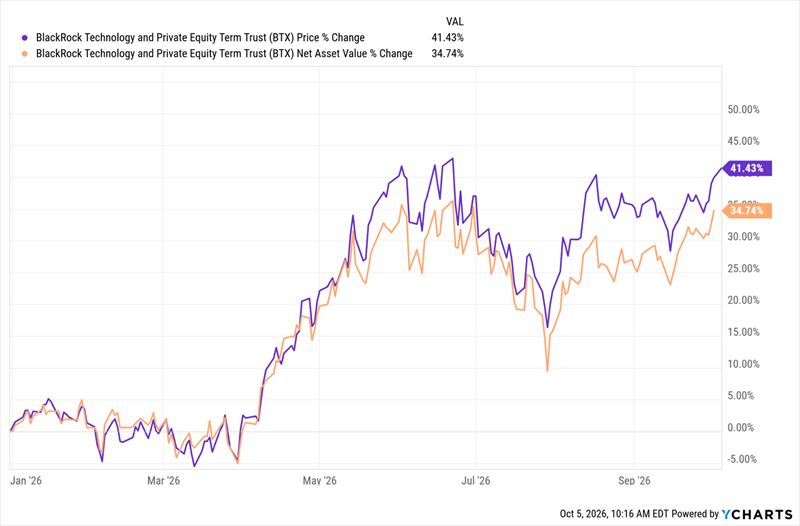
The fact that both the portfolio and market price can move independently of each other is a unique feature of CEFs. It’s one we contrarians can (and do!) take advantage of.
Especially in the case of BTX, whose NAV has been doing something interesting lately: rising faster than its price. That’s pushed the fund’s discount to NAV out. It’s now 12.3%.
In other words, we can buy this star performer for 88 cents on the dollar.
That’s right: A fund whose price has popped 41% in a little over nine months is actually cheaper than it was just over a month ago.
… And Goes on Sale at the Same Time
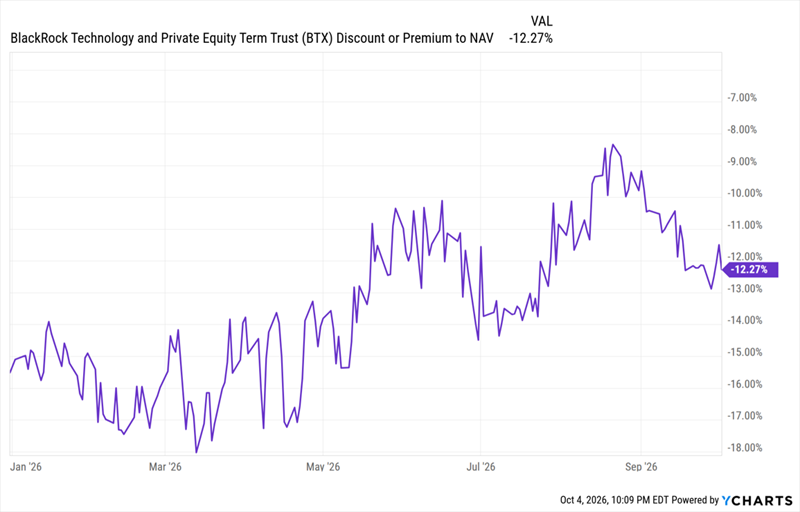
Try finding a deal like that in “regular” stocks! It can’t be done.
BTX’s performance is the kind of bounce-back we expected in February, when we bought the fund at my CEF Insider service after it fell victim to the “SaaS selloff.”
Remember that? It seems like years ago, but it was when investors panicked over fears AI would cripple software stocks as everyone learned to “vibe code.” We saw this fear as overdone, so we bought. Since then, BTX has returned 47% (including reinvested dividends).
We’re going to talk more about this fund’s holdings and strategy in a sec, but there’s something else we need to discuss first. It’s the reason why we’re being particularly aggressive in targeting undervalued income plays like BTX now.
Jobs Report Another Reminder We’re in “Upside-Down World”
To get at that, I want to bring your attention to the latest jobs numbers, released last Friday. They showed that only about 29,000 positions were created in September, well below the 90,000 economists expected.
Right after the report came out, something strange happened: Stocks rose on the news.
On the surface, it makes zero sense. If job numbers disappoint, the economy is by extension weak—and stocks should sell off.
But the details matter here. What we’re going to get into next points to why stocks rose, why I see them as likely to keep rising—and why underpriced equity CEFs like BTX really are in the driver’s seat here.
Let’s start with the overall jobs picture.
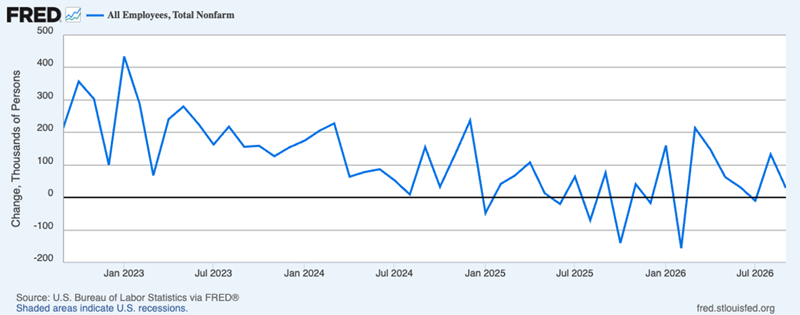
As mentioned, the US economy added 29,000 jobs in September, fewer than expected. That slippage feels like a long-term trend. The chart above shows that the number of jobs being added to the economy has been sliding for three years.
But this isn’t the bad news story it looks like. Because there are two longer-term shifts that explain it, and both point to a “balanced” labor market that’s great for the economy.
The first is a sign that Americans are growing richer: More of them are retiring earlier. As a result, the labor force participation rate for the 55+ set has fallen.
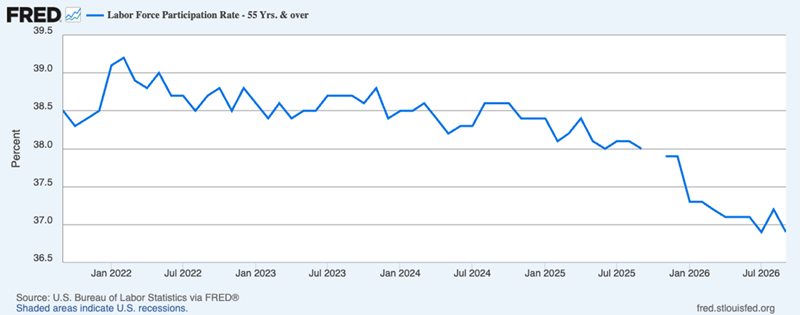
So with fewer older people working or trying to find work, the total number of jobs the economy will add at any given time should decline, as well. This, in turn, lowers the “breakeven” point needed to keep unemployment low and steady.
Then there’s the immigration story.
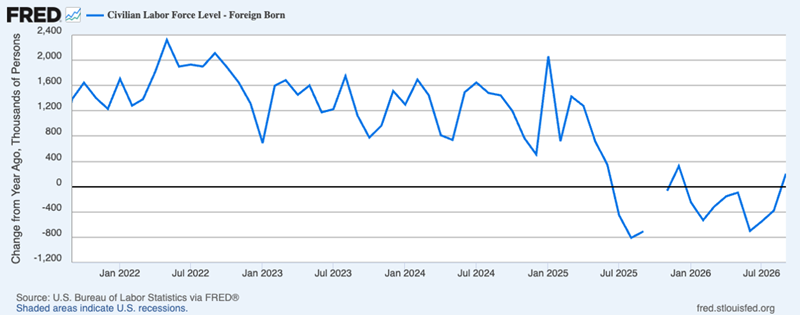
If we look at immigration purely from an economic standpoint, the facts are clear: Fewer people are coming to America to work. That will mean fewer job seekers, and thus fewer jobs added to the economy. Again, this lowers that breakeven mark needed to maintain a healthy unemployment rate.
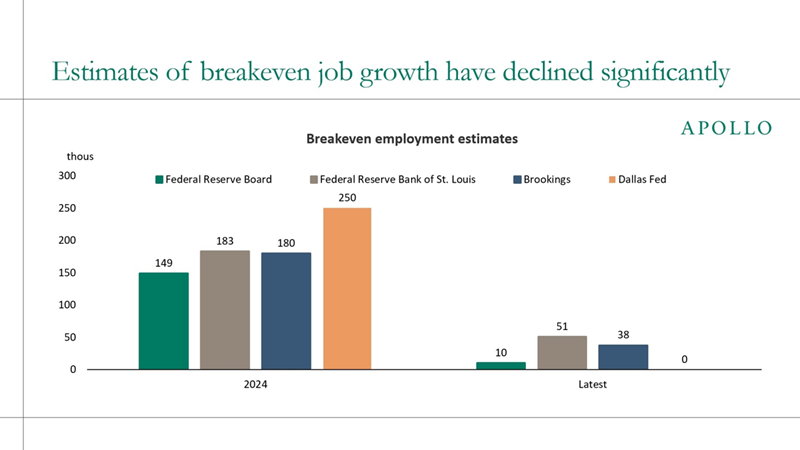
Economists have known about this for a while. It’s why expectations of job growth have fallen. And while last month’s numbers were below expectations (and we’ve seen some revisions downward in recent months), these differences aren’t enough to cause alarm.
Why This Is Good for Stocks (and Our CEFs)
In fact, those downward revisions are a reason for stocks to rise.
That’s because the job market is in a sweet spot: not so hot that it pushes the Fed to raise rates further, but not so cool that income growth stalls. (And as if to prove the point, odds of an October rate hike fell after the jobs report was released.)
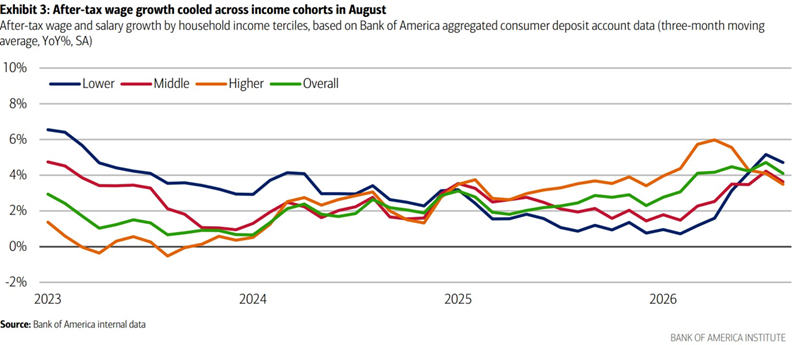
Research from Bank of America shows that lower-income groups saw 4.7% year-over-year after-tax wage growth in August. That’s higher than that month’s 3.4% inflation rate. While inflation is still too high, the result of higher-than-inflation wage growth is likely to be continued gains in corporate sales and profits.
Back to BTX
Like I said, the stock market saw a lot of this coming and reacted. Beyond last Friday’s bounce post-jobs report, we’ve seen S&P 500 index funds rise about 14% on the year, while those for the tech-focused NASDAQ 100 are now up around 20%.
Note, however, that while those gains are hitting index funds, CEFs investing in US stocks have dipped slightly and trail the two major indices on the year, with a 9.35% total return as of this writing.
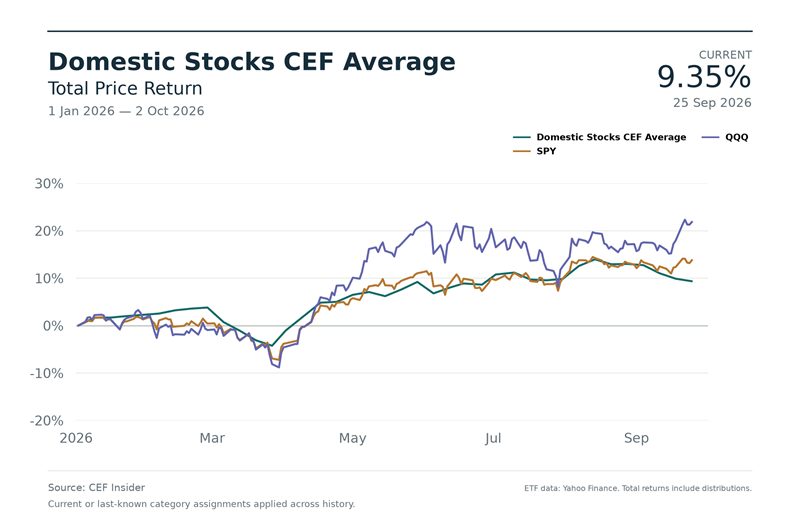
This is a strange situation that’s caused discounts among CEFs to expand to very wide levels, now 8.9% on average.
BTX, of course, is even more of a bargain, with that 12.3% markdown. That’s way too cheap for a fund that holds names like Micron Technology (MU), Lumentum Holdings (LITE) and NVIDIA (NVDA), all high-flyers fueling the AI revolution.
Moreover, BTX gives us some exposure to pre-IPO tech firms, as well—including Anthropic. That makes it a good “one-stop shop” for your portfolio’s tech bucket, especially since we individual investors can’t buy pre-IPO companies ourselves.
Then there’s the 6.8% dividend, which is well below the fund’s total NAV return this year. And when you calculate it based on NAV—not the discounted market price—the figure gets lower still: around 6%.
That leaves us with the trifecta we love to see in CEFs: strong performance, a wide discount, and a dividend well supported by NAV returns.
BTX is also the poster child for something else we’ve discussed many times in these columns: the slowness of CEF investors to respond to market changes, compared to those who buy regular stocks.
But the thing to bear in mind is that these investors typically do catch on eventually—especially when there’s a steady 6%+ dividend on the table. Getting in now lets us take advantage of that lag and kickstart BTX’s 6.8% dividend, too.
Treasuries? Forget ’Em. These 4 AI Funds Pay 10% (and They’re Cheap)
BTX isn’t the only AI-focused CEF investors have been slow to notice.
I’ve found 4 more. They yield 10% on average, and they trade at discounts that have been blown way out of proportion, too.
A setup like that sure beats Treasuries.
Sure, the 10-year Treasury is yielding the most it has since 2002, but you merely get your principal back at the end. That’s it.
Compare that to my 4 “Pivot Point” funds.
They yield nearly twice as much and invest in 4 corners of the AI revolution that aren’t getting nearly enough attention. Think things like robotics, drug research and the wave of mergers and acquisitions AI is in the process of sparking.
With CEF discounts now averaging 8.9%, we can buy these 4 funds now and start collecting their 10% dividends. Then we sit back and wait for the crowd to catch on.
Click here and I’ll tell you more about these 4 income powerhouses. You’ll also get a free Special Report revealing their names and tickers and a no-obligation 60-day trial to CEF Insider, too.
Don’t miss this opportunity. While your friends are getting zero price appreciation on their Treasuries, you could be collecting 2X the income and getting geared up for price gains, as well.