
500 out of 500.
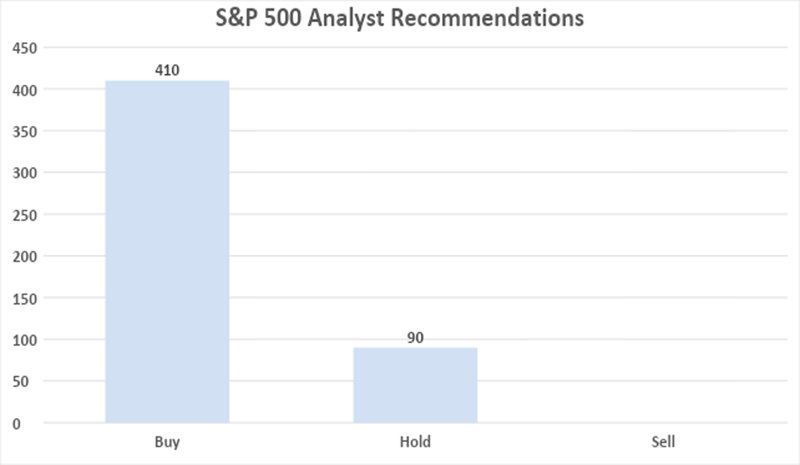
Do you know what that is? That, amazingly, is the number of stocks in the S&P 500 that the consensus says should be bought or held today. A perfect 500 out of 500.
Wow, so let’s do some “back of the envelope math.” There are 500 stocks in the index. And, let’s see, 500 should be bought or held. Which leaves…let’s see…zero sells.
Zero!
Meanwhile we have unprecedented business model disruption from the massive AI rollout. Biggest thing since the Internet or maybe even the railroads. Fortunes are being minted and vaporized with equal speed right before our very eyes.
And there are no sells in the S&P 500! According to the, ahem, compensated analysts that rate them. Simply astounding. Wouldn’t you think that one or two companies—maybe, just possibly—could be sells today? Nope, not at all.
Also get this. Would you believe that out of those 500, 410 are actual buys, which means you should put your new money into 82% of the index? Close your eyes and buy. Ha!
Does that feel right to you? Feels a bit slippery to me. Almost like analysts are handing out buy ratings like cheap business cards at a trade show.
500 Companies. Not a Single, Solitary Sell.
Analysts can keep their Buy calls. They are worth diddly squat. But a Sell call! Now we’re talking. They’re not there en masse but we can find some individual Sell calls to, get this, fade.
That’s right, we’re going dumpster diving for dividend payers with rare Sell ratings—so that we can step in and buy. How contrarian! And right now, Wall Street sees plenty of weakness in these five 6.4% to 12.9% payers, which average 8.9%. Let’s see if there’s opportunity.
General Mills (GIS)
Dividend Yield: 6.4%
General Mills (GIS) is best known for cereal brands such as Cheerios, Wheaties and Cocoa Puffs, Betty Crocker and Pillsbury baking products, and Häagen-Dazs ice cream—products that are squarely in the crosshairs of GLP-1 drugs, which suppress the urge to snack. Those drugs are on the rise, too. According to a Gallup analysis, 11% of Americans say they’re currently taking GLP-1 drugs for weight loss, which is up from 3% just two years ago.
And while GLP-1s can’t take full credit for it, General Mills’ top and bottom lines have been on a downswing for a couple years and are expected to dip more in 2026.
Investors Clearly Fear the Weight-Loss Reaper
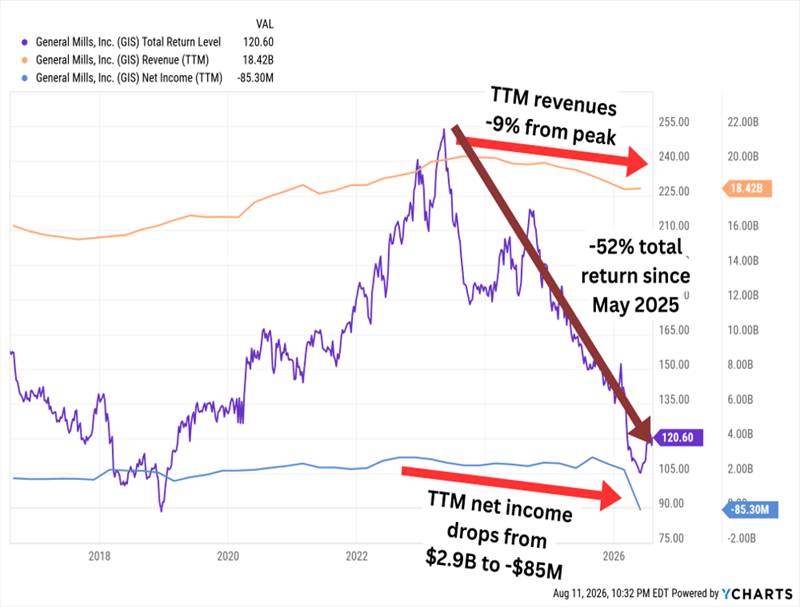
This change in fortunes has sent shareholders to the exits, cutting the stock by more than half over the past three years.
So is there reason enough to bite on what is a 6%-plus yield on one of the most recognizable consumer staples stocks?
GIS is more than just snacks—it also sells Progresso soups, Green Giant vegetables, even Blue Buffalo pet foods. And it’s trying to adjust to GLP-1 usage by adding more premium snacks and smaller packages aimed at the munchie-deficient.
But inflation is forcing many consumers to trade down, not up. So even though General Mills has eased up on the price hikes that had been driving sales, volume growth is still anemic. And despite a lack of growth, a 50%-plus haircut and a stretched dividend with little room for meaningful growth, shares still trade at 12 times next year’s earnings estimates—not exactly the deal we’d need to jump into such a troubled company.
I said months ago I don’t like General Mills. Nothing since has changed my mind. Wall Street doesn’t love it, either—12 Holds and as many Sells (4) as Buys is for all practical purposes a bearish outlook from the traditionally Pollyannaish research set.
The Campbell’s Company (CPB)
Dividend Yield: 6.9%
Fellow consumer staple name The Campbell’s Company (CPB) has sold off right alongside General Mills. The result is a nearly 7% yield that’s more than twice its historical norms and virtually unheard of in the sector.
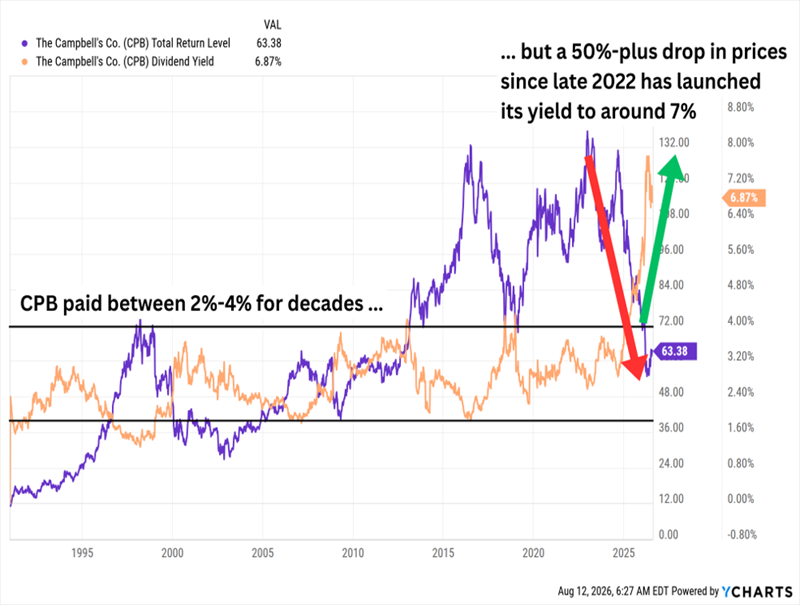
The story is extremely similar to General Mills:
- Campbell’s also owns a number of snack brands, including Pepperidge Farm baked goods, Goldfish and Lance crackers, Cape Cod and Kettle Brand chips, and Pace salsa, among others—that are endangered by GLP-1 usage.
- It too is more than snacks: CPB also sells its namesake Campbell’s and Chunky soup brands, as well as Prego and Rao’s pasta sauces, Swanson broths, Michael Angelo’s frozen meals, V8 vegetable juice and more.
- CPB has also recently slowed its pace of price hikes but hasn’t seen a recovery in volumes.
- Dividend coverage of around 80%, which leaves little room for growth, is about the same as GIS.
- Campbell’s shares trade for around 12 times weak earnings estimates.
- The pros don’t like it: It garners mostly Hold calls, and more Sells than Buys.
Campbell’s might look a little more appealing than GIS because it pays us a few more basis points and is slightly better positioned to capture a rising trend of Americans cooking at home. But this is still a dangerous yield from a company that’s increasingly on the wrong side of consumer tastes.
Ardagh Metal Packaging (AMBP)
Dividend Yield: 8.0%
Ardagh Metal Packaging (AMBP) has a lot for contrarians like us to love.
To start, it’s boring: Ardagh makes metal cans. This is a truly global company, boasting 23 production facilities in nine countries. It employs 6,500 people. It drove $5.5 billion in revenues last year by selling to makers of soft drinks, energy drinks, sparkling waters, beer, ciders, ready-to-drink cocktails and more. But it’s nothing more than, in its words, “100% infinitely recyclable” cans.
Ardagh is also well off the beaten path. No media hype of which to speak. No CNBC hits.
It pays us dearly, at nearly 8%. And it’s also a welcome exception to a dividend rule. We normally avoid foreign stocks because of their inconsistent payout schedules. However, AMBP, which is based in Luxembourg, has paid a consistent quarterly dividend for several years.
But We’d Certainly Welcome Some Growth in That Dividend
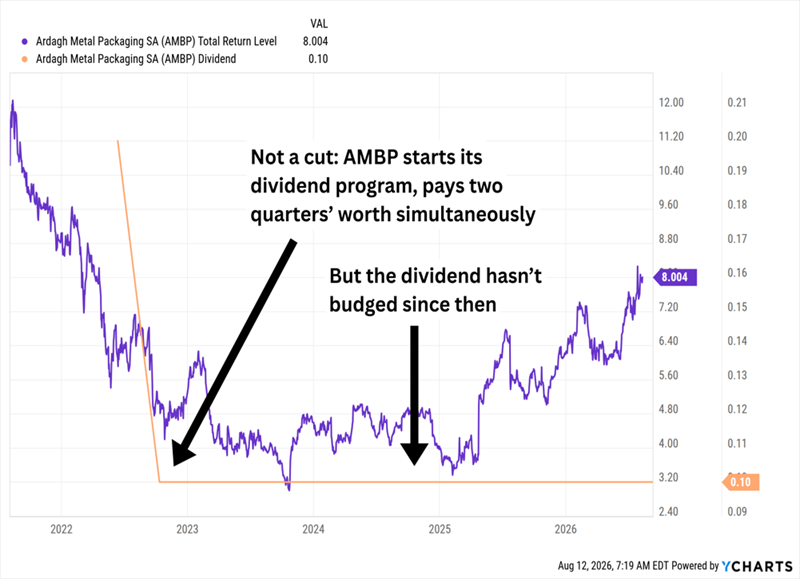
Ardagh, which is 76% owned by Ardagh Group, listed on the NYSE in 2021 by combining with a special purpose acquisition company (SPAC). The stock proceeded to drop like a rock, killing any buzz it might have had. But the company’s top line has been improving for years, and it has flipped from deep losses just a few years ago to modest profits in 2025 that are expected to grow this year and next. That means AMBP was paying dividends it couldn’t cover—the second quarter marked the first time in years that adjusted earnings exceeded the payout. A little nerve-wracking, but Ardagh is headed in the right direction.
Wall Street is almost all Holds and Sells on Ardagh, but the worry is less the business and more the valuation. The stock has roughly doubled from its 2025 lows, and shares now trade at nearly 17 times estimates for next year’s profits.
Brandywine Realty Trust (BDN)
Dividend Yield: 10.3%
Brandywine Realty Trust (BDN) is one of the largest “integrated” (or “hybrid”) real estate investment trusts (REITs) in the U.S. Its full portfolio consists of 112 properties, but its “core” portfolio of 57 properties is largely concentrated in Philadelphia and Austin—and is roughly 90% office in nature.
The pros are effectively split between Holds and Sells, and there’s little wonder why. Office properties, while rebounding, haven’t seen business rebound to anywhere near where they were before COVID. Last year, I pointed out that Brandywine’s funds from operations (FFO) were barely enough to pay for the dividend, and that the “13%-plus yield could be a rug-pull just waiting to happen.”
A Week Later, BDN Cut for the Second Time in Three Years
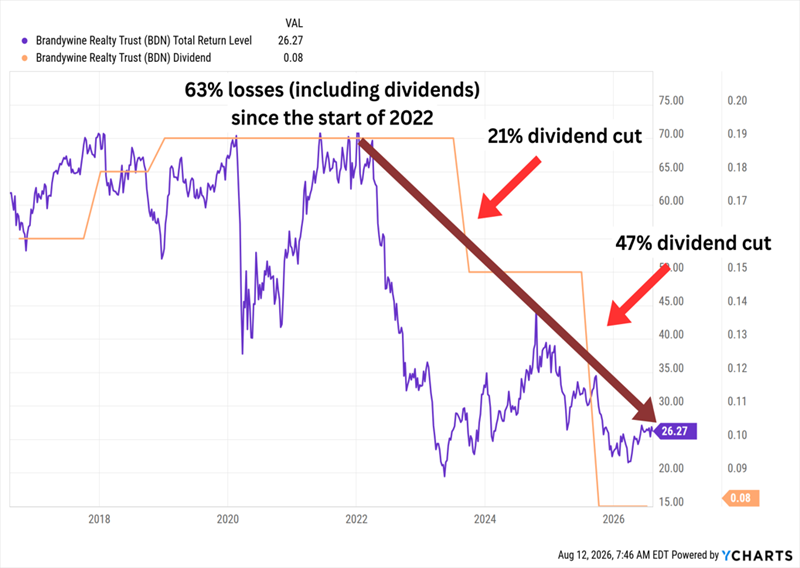
Brandywine has bounced back a little bit in 2026 as it does some much-needed cleanup. The company is simplifying its joint-venture portfolio and shedding underperforming properties. Occupancy is improving. The dividend cuts clearly hurt existing shareholders, but BDN now yields 10% at a much healthier FFO payout ratio below 60%. And shares trade at just 5.6 times this year’s FFO estimates.
What’s holding Brandywine back is its struggles in leasing out its two development projects. Improvements on that front could finally unlock the stock.
New Mountain Finance Corp. (NMFC)
Dividend Yield: 12.9%
We can always find high yields from business development companies (BDCs), which provide financing to smaller companies.
Take New Mountain Finance (NMFC), for instance. This nearly 13% yielder deals in U.S. upper-middle-market businesses backed by private equity sponsors. First-lien debt is its most common deal type, at roughly 65% of the portfolio currently, but it also has positions in second lien and subordinated debt, preferred stock, common stock, net lease deals, and senior lending programs.
Its portfolio is 113 companies wide right now, and it uses a “defensive growth” strategy, with a focus on investing in strong businesses in a couple dozen acyclical sectors.
And Yet, NMFC’s Dividend Has Been Anything But Defensive (Or Growing)
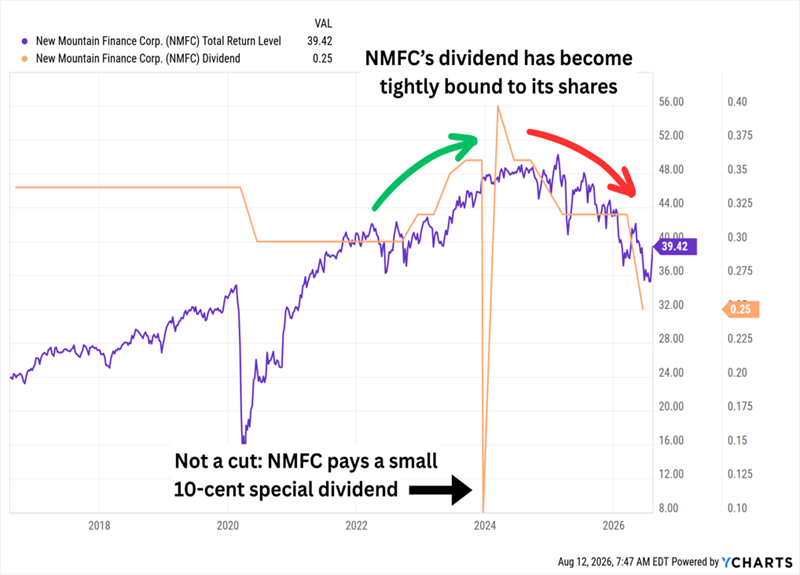
Wall Street doesn’t love what NMFC has to offer, giving it nothing but Hold and Sell ratings. New Mountain has been shedding net asset value (NAV), which has declined by more than 12% just since the start of 2025. More important as it pertains to the dividend: Net investment income (NII) has recently fallen off the shelf, forcing the most recent dividend cut to 25 cents per share—which is itself barely covered by the company’s most recent 26 cents’ worth of NII.
However, NMFC might still appeal to speculative dividend chasers. NAV declines are slowing. Credit quality is improving, and non-accruals are thinning. New Mountain is still buying back shares. Meanwhile, NMFC now trades at a nearly 30% discount to its NAV while paying well into the double digits.
Fight Off Market Chaos With This 12% Dividend Instead
We’re not going to stabilize our portfolios and bring in high, consistent income with companies that are on the ropes and can’t defend their dividends.
But we can find double-digit yields in more entrenched, proven names.
The best double-digit yielder on the market right now isn’t a single company, but a diversified fund with a highly skilled manager who has a track record of running up the score on his competition.
His bond portfolio not only shells out a wild 12% yield, but it’s also set up for stock-like gains.
This fund checks off just about every income box I can think of:
- It pays a whopping 12% in annual income!
- It has increased its dividend over time
- It has paid out multiple special dividends
- And it pays its dividends each and every month!
And that superstar manager I mentioned? Morningstar previously named him a Fixed Income Manager of the Year, and he’s been inducted into the Fixed Income Analysts Society Hall of Fame.
That’s about as good a resume as we’ll find, and his fund will pay us $1,100 for every $10K we invest.
But the window is closing fast! Premiums on funds like these tend to rise as volatility ticks higher and as investors rotate out of growth stocks and into reliable sources of income like this. I don’t want you to miss your chance. Click here and I’ll introduce you to this incredible 12% payer and give you a free Special Report revealing its name and ticker.