
The numbers are starting to support something I’ve long argued about AI: Yes, this technology is shifting the job picture—but it’s not throwing millions out of work.
Instead, the economy is shifting.
The new story? While tech-sector jobs are being cut (temporarily, I believe), growth in other areas—including those that are employing AI to drive growth (and hiring along with it)—is flourishing.
Investors, however, still haven’t caught on. And an ongoing stream of dour headlines—from a “hot” war in Iran to a trade war with Canada—has distracted them further.
That’s set up an opportunity in high-yielding, equity-focused closed-end funds (CEFs) like the Liberty All-Star Equity Fund (USA), payer of a blockbuster 11.4% dividend.
I mention USA because its top positions—NVIDIA (NVDA), Alphabet (GOOGL), Microsoft (MSFT), Capital One Financial (COF), Visa (V) and Amazon.com (AMZN)—make it a good replacement for a US large-cap stock index fund.
The twist, of course, is that 11.4% dividend! This payout also comes with a sweet setup that’s relevant now: USA pays four quarterly installments of 2.5% of its net asset value (NAV, or the value of its underlying portfolio) as dividends, for a total of 10% of NAV throughout the year.
(Because the fund trades at a discount to NAV—more on that below—that 10% yield on NAV translates into roughly 11.4% on the fund’s discounted market price. This is another advantage of investing in a discounted CEF.)
That “NAV peg” means that when USA’s portfolio rises or falls, its dividend does the same. And thanks to the fund’s strong NAV growth, USA’s payout has been growing (in the up-and-down fashion you’d expect).
USA’s Payout Tracks Its Portfolio
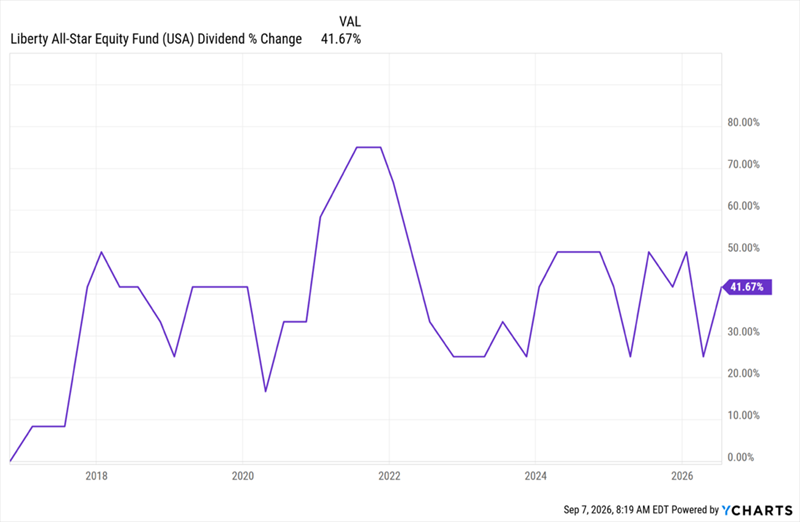
I expect that payout to keep growing as the AI “jobpocalypse” story continues to unravel.
Latest Numbers Flip the Script on the AI Jobs Scare
The latest employment report from the Bureau of Labor Statistics nicely captures the changes new technologies are bringing. First up, the headline number: The US economy created 162,000 jobs in August, far ahead of expectations.
The sector-by-sector picture also told us something interesting: While AI may be weighing on jobs in the information sector (down 23,000 in August), other sectors (including AI adopters) added workers.
Gainers included sectors benefiting from the data-center buildout, such as manufacturing (+16,000) and construction (+22,000). There were also 13,000 jobs added in healthcare, where AI is speeding up drug research and improving treatment options. School-district hiring also added gains (+42,000).
And the biggest gain, in food services (59,000 new jobs), shows that workers are being added in areas so far mostly disconnected from AI, helping offset the displacement of some of those cut from the information sector.
This is exactly what I’ve been expecting over the last few years. And as for those losses in information work, bear in mind that AI infrastructure and software will need to be repeatedly updated and replaced as the tech’s breakneck evolution continues. That, in turn, should fuel a rebound in that sector’s hiring numbers.
All this news is good on its own, but it’s also a reversal of what we’ve seen over the last couple of years:
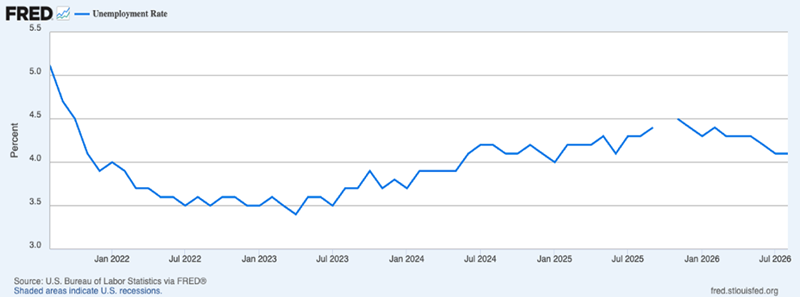
As you can see in the chart above, until the start of 2026, the unemployment rate was ticking higher. But now we have more than half a year of a different trend, with the rate holding at a still-low 4.1%.
And alongside strong demand for workers, we’re seeing US corporate earnings rise as businesses find ways to use those workers more efficiently (and yes, AI is a factor here, too) to fuel further growth—and hiring. This has been going on for a while now, helping boost profits in almost all sectors.
And as we can see below, expectations for full-year earnings per share this year have grown almost across the board in the last couple of months. And even areas that saw earnings expectations shrink only saw decreases of 1% or less.
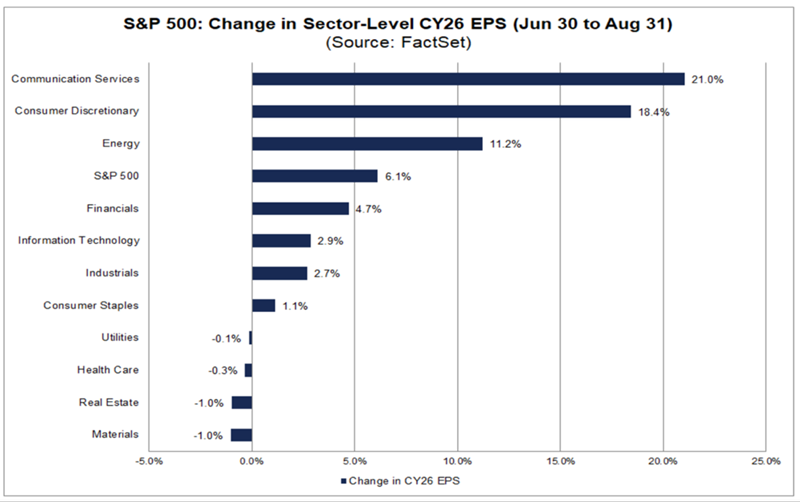
Combined with the jobs data, this tells us that the value of Americans’ labor is rising, making the economy more efficient. That, in turn, supports further gains for stocks.
USA Turns Stock Gains Into Income
This brings us back to USA, which has more than tripled investors’ money in the last decade, with most of that return coming in the form of dividends.
USA Rides Its Payout to a 3X Return
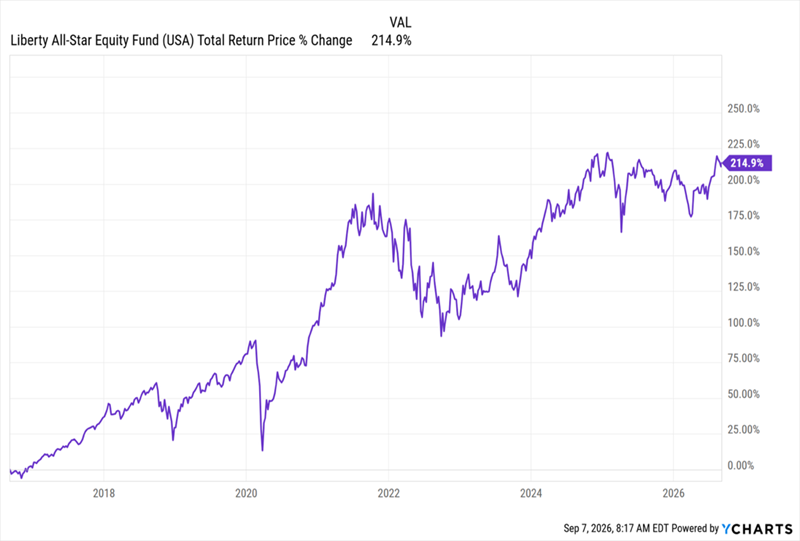
Here’s the thing, though: Despite that performance. Despite the 11.4% yield—the fund has gotten cheaper over the last 18 months:
USA’s Deepening Discount
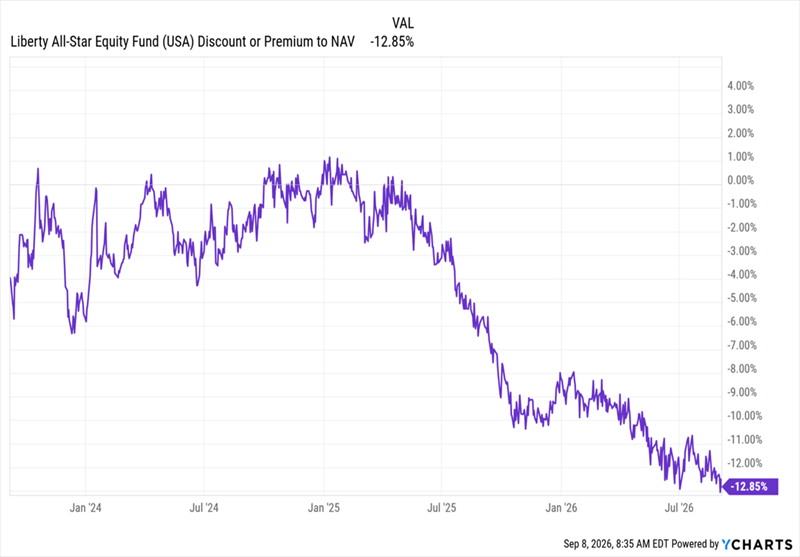
As I write, we can buy USA’s portfolio for around 87 cents on the dollar. That gives us a second advantage USA carries over an index fund (beyond the 11.4% dividend!), as index funds never trade at a meaningful discount. USA’s current discount is also far wider than the fund’s five-year average markdown of just 1.8%.
That discount also positions USA for extra upside when the crowd comes around to the idea that, while AI is transforming the economy, it’s not the job destroyer most people thought it would be.
Instead, it’s looking a lot like other innovations we’ve seen in the past, such as the advent of the Internet, email and mobile devices. In all those cases, yes, workers were displaced, but the overall long-term trend was toward more hiring.
As for USA itself, we’re paying close attention to the fund’s discount. We love the fact that it’s near 13%, but we want to see it start to level off and move back toward par before we hit the buy button.
And history does suggest that a markdown this wide is unlikely to stick around for the long term, given how much wider it is than the five-year average.
These 10%-Paying Funds Are Urgent Buys NOW
Dear reader, PLEASE don’t take that last line to mean we’re waiting around.
Nothing could be further from the truth!
We remain laser-focused on getting ahead of AI as it spreads across the economy. We’re doing it by targeting 4 other CEFs that track 4 under-the radar (for now!) megatrends that AI is supercharging.
I’m talking about AI accelerating drug research. Advancing robotics. Spiking power consumption. And just straight-up igniting business expansion (and the loans needed to fuel it).
I call each of these early-stage breakouts economic “Pivot Points.”
And our 4 “Pivot Point” CEFs are plugged straight into each of these powerful shifts. All 4 are deeply discounted, but unlike USA, they’ve given us the signal we need to buy in now—and position ourselves for gains.
The fact that these 4 CEFs yield an outsized 10% on average doesn’t hurt, either!
I’ve put our full “Pivot Point” plan into a free strategic briefing you can access right here. You’ll also get instant access to a free Special Report revealing the names and tickers of these 4 funds.
I urge you to click through and discover these 4 funds for yourself now, before their discounts snap shut.