
Look, we all know the old “truism” of investing: Want higher returns? You’d better be prepared to take on higher risk.
That’s not always true, however. In fact, sometimes markets do strange things, and a so-called “conservative” investment can turn around and deliver stunning returns. This is even more common in the world of closed-end funds (CEFs), where even stranger things can happen than in the “regular” stock world.
That’s in part because CEFs are a small market, so they tend to draw more individual investors, but fewer hedge funds and big banks. That can cause CEFs to overreact to some changes in the economy and markets and underreact to others, setting the stage for those strange moves I just mentioned.
Just such a thing has occurred at a CEF I’ve admired for many years, the 9%-yielding Virtus Equity & Convertible Income Fund (NIE). On the surface, this one sounds about as conservative as you can get.
For starters, its portfolio is stocked with established blue chips, with NVIDIA (NVDA), Apple (AAPL), Amazon.com (AMZN) and Caterpillar Inc. (CAT) among its top holdings.
But as you can see below, only around 56% of the fund’s portfolio is in stocks. Another 40% or so is in convertible securities, with the balance in cash.
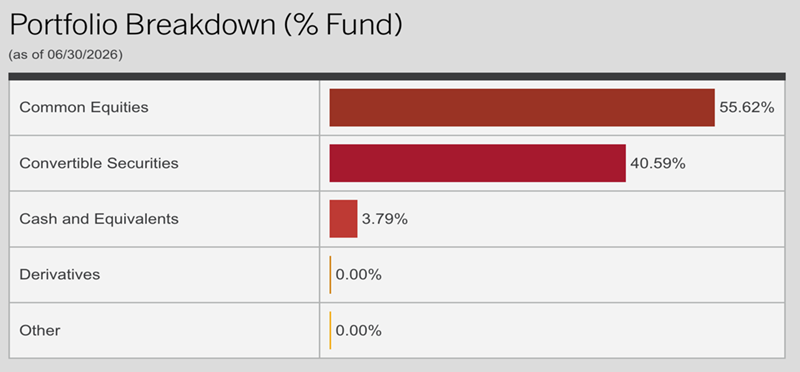
Source: Virtus Investment Partners
Those convertible securities give the fund additional income while tempering volatility. NIE holds both convertible bonds and convertible preferred stocks.
Convertible bonds are debts issued by companies that can be “converted” to equity in the right circumstances (these vary from bond to bond). That gives these assets more potential upside, in addition to a consistent income stream.
Similarly, convertible preferred stocks pay higher dividends than “regular” stocks and feature less volatility. Like convertible bonds, they can also be converted to common stocks for additional upside.
With such a large portion of the portfolio dedicated to assets like convertibles, you’d expect a fairly stodgy return from NIE. But that hasn’t been the case. At my CEF Insider advisory, we sold this fund in May for a sweet 58% total return in a little over four years.
That’s a nice return for an income play like this, and we may very well swing back into this one in the future, especially when you consider that NIE has posted a 253% return in the last decade (we have, in fact, held it three times in CEF Insider over this period and banked a positive total return every time):
NIE Triples (and Then Some) in 10 Years
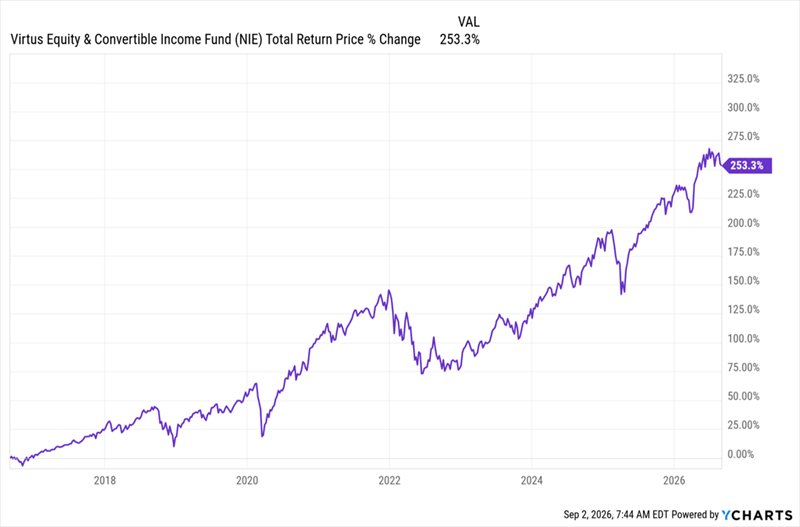
You can see at right, too, that the fund has largely moved sideways since our sell call in May, justifying our move and setting up the fund’s next jump, if history is any guide.
At the same time, NIE has been growing its payout, both in the form of special dividends paid earlier this decade and a growing regular dividend.
NIE’s Strong Returns Translate Into Higher Dividends
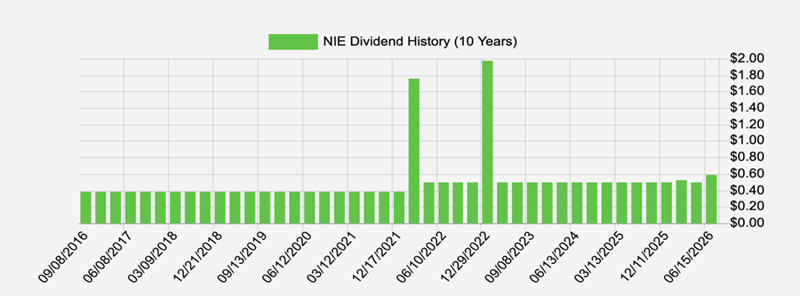
Source: Income Calendar
With this in mind, it’s clear that NIE is a good way to maximize income and diversify across hundreds of companies—and multiple asset classes, too. At the same time, it delivers far better returns than you’d expect from a portfolio like this. That stands in sharp contrast to the “more risk, more return” logic most folks believe.
Let me wrap with the fund’s discount to net asset value (NAV, or the value of its underlying portfolio). As I write this, it’s around 10%, which means we can buy for around 90 cents on the dollar. That sounds great, but it’s around the fund’s five-year average discount and narrower than the roughly 12% NIE saw when we sold it in May.
So we’re not buying until NIE’s discount widens further—ideally below that 12% level from last May. Until then, though, this is a top-quality CEF to put on your watch list.
5 “Urgent Buy” Monthly Dividend CEFs (Paying 9.7%)
We’re not waiting till NIE’s discount drops—far from it! Because this latest market turbulence has set up some terrific deals on some of our other favorite CEFs.
That list starts with my 5 top monthly payers, which kick out a solid 9.7% yield, on average, between them.
And we’re all in.
These 5 funds’ discounts are irresistible now, as they hand us an opportunity to buy cheap—and kickstart that fat, monthly paid 9.7% yearly income stream.
Don’t miss out on these 9.7% “dividend deals.” Click here to learn more and get a free Special Report revealing their names and tickers.