
Covered-call funds give us something we demand at a time like this: outsized 8%+ payouts!
And the last few months have shown us something else: These funds work—especially when you use them in a specific kind of market (hint: conditions just like those we’re facing now).
Covered-Call Funds “Translate” Option Gains Into 8%+ Dividends
Even though the name sounds complicated, covered-call funds have a relatively straightforward setup behind them. They start by letting you hold a bundle of stocks, just like, say, an ETF would. In the case of the covered-call fund we’ll talk about today, the Nuveen S&P 500 Dynamic Overwrite Fund (SPXX), these are the companies in the S&P 500.
So far, so good. But here’s where the difference comes in: Instead of pocketing the sad 1% yield offered up by the typical S&P 500 index fund, we can pull in a rich 8.7% payout with SPXX.
That’s because, instead of simply holding the S&P 500 and hoping for “paper gains,” SPXX goes one step further by selling covered calls on its portfolio.
Under this approach, SPXX sells the right to buy its stocks to option buyers at a fixed date and price in the future. The fund charges option buyers a fee (called a “premium” in option-speak) for these rights, and it keeps these fees whether or not these trades actually go through.
Those premiums then go into that 8.7% payout.
As you may be sensing by now, these funds work better in some kinds of markets than in others. Rising markets, for example, do generate gains in their underlying portfolios, as would be the case with a traditional index fund.
But a rising market also comes with a baked-in downside: It caps a covered-call fund’s gains, as more of its top performers are sold, or “called away.”
A falling market, on the other hand, means the stocks SPXX holds are less likely to be called away. So while SPXX gets to keep its stocks, and the premiums these options generate, its net asset value (NAV, or the value of its underlying portfolio) still takes a hit.
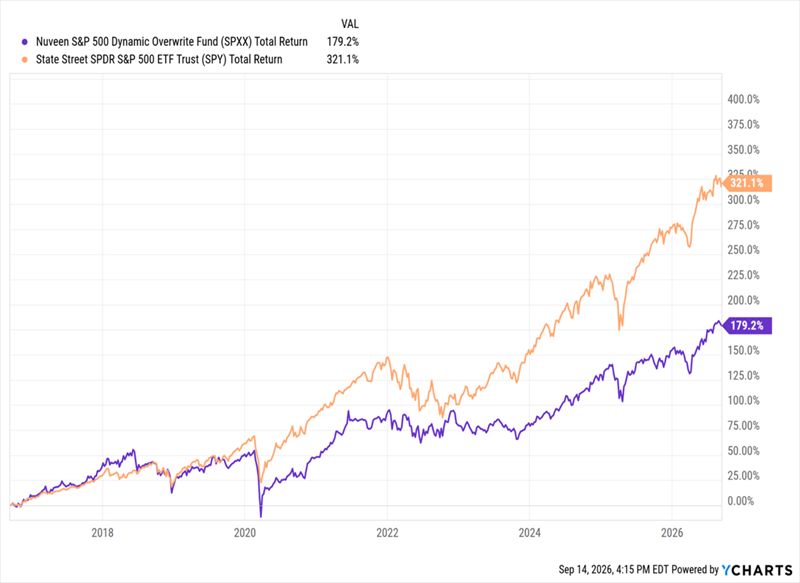
This is why, for example, we avoid holding funds like SPXX for the long haul: They get hurt just as much as an index fund in a market drop, while their gains are capped as stocks rise. You can see that in the long-run performance of SPXX (in purple below) compared to that of the State Street SPDR S&P 500 ETF Trust (SPY), the popular S&P 500 index fund:
In the Long Run, SPY Tops SPXX
By process of elimination, then, we’re left with the ideal time to hold a covered-call fund like SPXX: in a sideways market.
When markets go essentially nowhere, SPXX’s NAV stays more or less stable. That means it keeps the stocks it owns—and still collects those option premiums—while we enjoy the fund’s 8.7% dividend in peace.
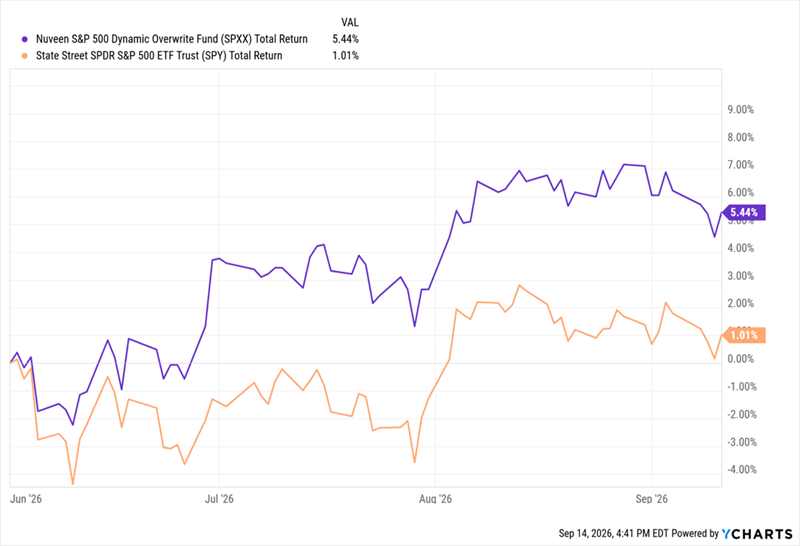
The last two-and-a-half months show this in action: Since June 1, SPY has returned around 1% (see in orange below), as of this writing, while SPXX (in purple) has returned just north of 5%:
SPY Flatlines, SPXX Surges
This, of course, doesn’t mean we can simply buy SPXX over SPY whenever the market is stuck in neutral. That’s because stocks can move dramatically higher or lower pretty well any time, clipping SPXX’s gains or compressing its NAV when they do.
To make the most of a fund like this, then, you need to be consistently right about the market’s next move. That, of course, is impossible.
But fortunately, there is another type of CEF that gives us high income, a discount and a clear shot at long-term outperformance without having to predict the market’s next turn. And it’s even simpler than a covered-call CEF. I’m talking about a straightforward equity-focused CEF holding blue chip stocks and run by a seasoned pro.
No covered calls involved at all. Or if they are, they have a minimal impact.
With a “pure” fund like this, our fund manager simply makes buy and sell decisions based on their experience in the market. The resulting gains help fund the dividend.
Case in point: the Adams Diversified Equity Fund (ADX), which holds blue chip stalwarts like Apple (AAPL), Microsoft (MSFT), Amazon.com (AMZN) and JPMorgan Chase & Co. (JPM). ADX is long on experience: It’s been around since 1929.
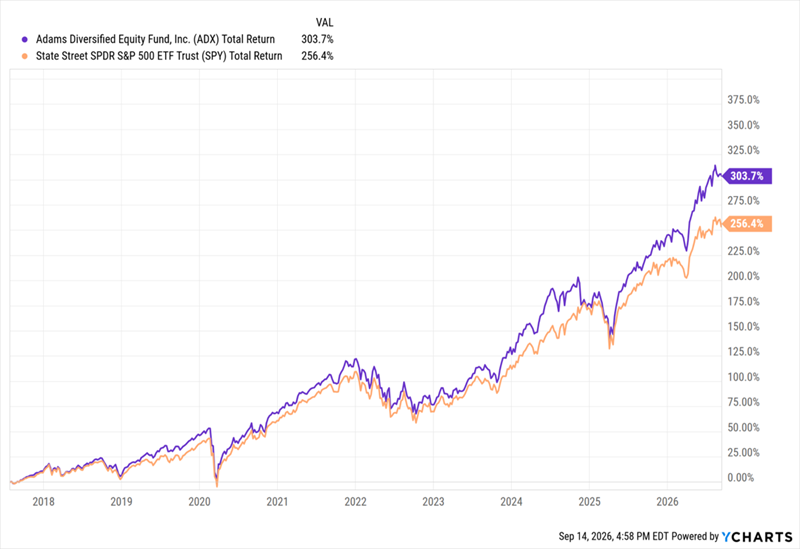
We’ve held the fund since the early days of my CEF Insider service—I recommended it in just our fifth-ever issue, in July 2017. And this fund (current yield: 7.8%) has delivered, with a market-beating 304% total return since then (see in purple below), as of this writing.
Dividends? Gains? Long-Term Outperformance? ADX Delivers Them All
ADX has done it not by selling covered calls but through effective portfolio management. The fund also does something somewhat unusual with its dividend: It fixes the payout to NAV, with the goal of paying a minimum annual distribution rate of 8% of average NAV, dished out in four quarterly installments.
To be sure, this does cause the fund’s payout to float around a bit. But with an overall total return as strong as this one is, we’re more than okay with that. And if you want a steadier income stream, there are plenty of other CEFs—holding everything from stocks and corporate bonds to REITs, municipal bonds and preferred shares—offering that, with payouts often issued monthly, to boot.
Before I sign off, one final note on ADX: At the moment, the fund’s discount is around 2%, which we’ll take, but I’d like to see it widen out a bit more before we make a major move in. That, to be sure, is something that could easily happen if the market pullback deepens. I’ll let CEF Insider members know when the next buy window opens.
Get in on ADX’s Next Buy Window—and Grab My Top 4 AI Buys Now (for 10%+ Yields)
The best way to get in on ADX at the right time is to become a CEF Insider member, of course. And right now, I’m inviting you to road test the service yourself under our no-risk 60-day money-back guarantee.
That’s not all.
Because with AI fears now back in vogue (no, we do not think this technology will spell the end of humanity!), I’ve released one more thing I want to make sure all investors get their hands on.
I’m talking about my latest exclusive report on where I see the technology going next—and the 4 funds I’m urging all investors to buy now to get in ahead of the wave.
Of course, dividends are front and center here: These 4 urgent buys yield 10% on average. And with the discounts on offer, I see plenty of upside ahead, too.