
“How’s your hip?” my wife asked. The emphasis on hip was bearish for me as I limped from, well, you’ll see.
My gait had been good (dare I say normal?) for the last 10 days. She justifiably wondered what was up.
“The jog,” I mumbled. And shrugged.
“He cleared you to jog?”
Really, he did! Sort of. “Yes,” I replied confidently. “He said yesterday it was probably OK.”
I had just completed a three-week round of shots to calm down my hip osteoarthritis, but these treatments tend to rile up the joint before helping. So, my jog was… premature.
I had to admit: “I went a little fast. Pace was just above a 10-minute mile…”
She’d had enough. “You always overdo things.” Sigh. “Mod-er-a-shun.” She enunciated her reminder.
Well, fair enough, and as a good hubby, I didn’t try jogging again for a week. (I didn’t volunteer that my next “jog” would be a rec league basketball game. Not exactly moderation! Especially with a thin six-man lineup, which would equate to 30+ minutes of game time.)
She has a point about moderation. And while I’m not great about it athletically, I do pay attention when investing. Especially with a crucial metric I use for my Hidden Yields subscribers: share buybacks. This week I ran the numbers and my practice of “avoiding extremes”—neither too few nor too many, but Goldilocks—can work quite well.
We’re taught to believe buybacks are always good, and generally speaking, they are. When companies repurchase stock (and don’t defeat the purpose by issuing a lot of options to employees), fewer shares remain outstanding. Buybacks tend to improve every per-share metric on the board, and the stock market rewards this. Earnings per share, and our beloved dividends per share, grow more easily on a reduced share count.
How? When a company buys back a share, it “saves” paying a dividend on that for infinity! That money is freed up to pay the rest of the shares more. It’s a virtuous circle!
So, the fewer shares, the better. But there’s a limit here too! The sweet spot is healthy moderation: Companies that buy back between 5% and 10% of their shares per year perform the best.
I ran the numbers from 1998 to 2025 and looked at how much a company’s share count changed year over year. A lot of data! I examined 227,000 (yes, I said “a lot!”) potential 12-month holding periods: share count at the start, share count at the end, then the next 12 months’ total returns (stock gains plus dividends).
(Numbers people take note: I kept the delisted companies in. Many studies drop them but that keeps the losers out of the results—which means survivorship bias. We want truth, which means we keep the flops.)
Quarter by quarter across the 111 quarters I measured, the 5%-plus shrinkers as a group beat the rest of the field by nearly 3 points a year. They won 70% of the quarters once I lined each company up against its own sector peers.
Buybacks generally are a good thing but the pace matters. The 5% to 10% clip per year is the best, the sweet spot. And curiously, it edged out companies buying back 10% to 20%!
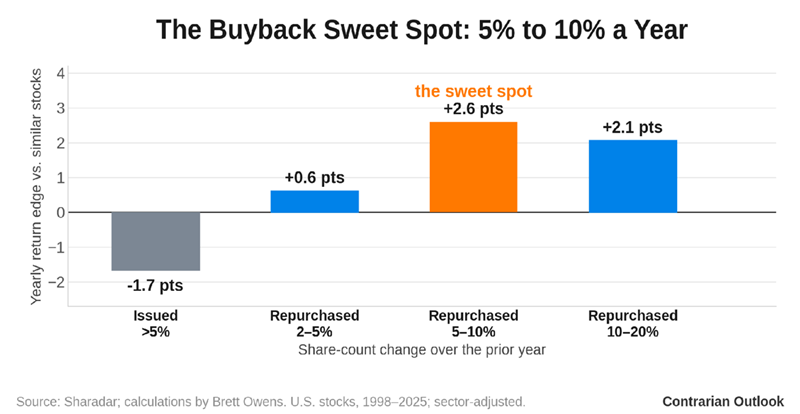
Companies that diluted—issuing lots in option grants to employees and management, for example—went the other way, actually increasing their share counts. If a company increases more than 5% of its shares per year, watch out. These printers lagged their sector peers in three of every five quarters.
The buyback edge is more nuanced than anyone on Wall Street will tell you. Steady and consistent is the best way to go. Goldilocks wins! You don’t want to buy back too many shares, nor do you want to issue them, either.
And look past the flashy buyback announcements. Some companies announce buybacks but don’t follow through on them! Our numbers are what actually happened.
Without question, this “sweet spot” can be a great place to find hidden value.
Take Aflac (AFL). To the untrained eye, it looks like a dividend snoozer. But here’s what the vanilla beans who overlook the insurance duck are missing: a 6.3% reduction in share count over the past year. Aflac is right inside of our 5% to 10% buyback bonanza band and wouldn’t you know it, the stock is a steady returner for us at Hidden Yields.
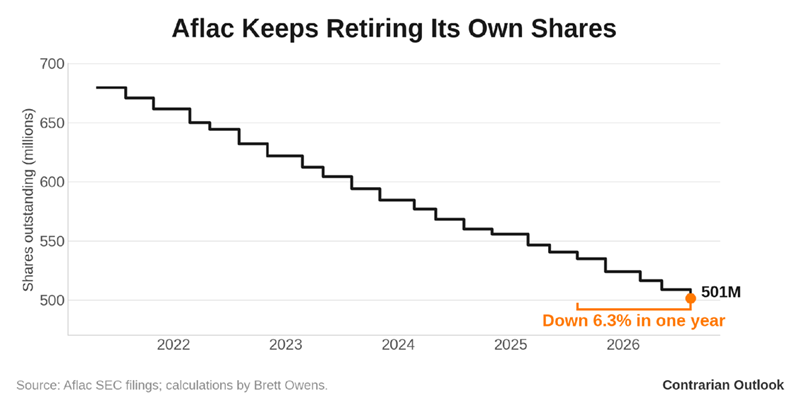
While AFL dished $309 million in dividends in the second quarter, it bought back $983 million worth of shares. Adding these together, at this pace we are enjoying an elite 8.9% of its market cap per year coming back to us as shareholders.
As Aflac shrinks its shareholder pie, it grows our slice.
And a fatter piece of a shrinking pie is what we’re all about at Hidden Yields. This is the secret to finding stocks that can deliver double-digit total returns no matter what the market does. The key: find the combination of dividend growth and share buybacks. You want it just right: that nice easy jog that keeps you from limping into the kitchen just before dinnertime.
I call dividend payers that buy back shares at the sweet spot pace “hidden yield” stocks because they deliver strong yearly returns that Wall Street simply doesn’t see. It’s the secret to 15% returns per year, every year, from secure cash cows like Aflac.