
If you like dividends, check out the discounted cash flows currently available in REIT land. Real estate investment trusts (REITs) have hit the skids in recent months as investors have panicked about the Federal Reserve raising rates. Their worries bring value to us, and today we’re going to highlight five REITs yielding 5.3% to 12.3%.
Now, we income investors are fans of REITs because they pay out most of the profits to us as dividends. Congress created this business structure decades ago, and it included a mandate for dividends—REITs, in exchange for significant federal tax advantages, must dole out at least 90% of their taxable income as distributions back to us.
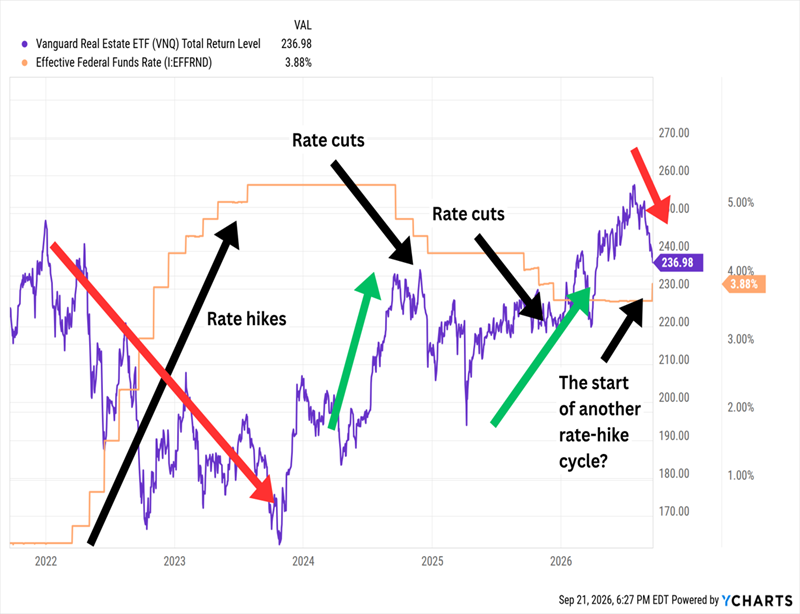
But they have a big weakness: interest rates. Rising rates increase REITs’ borrowing costs and make bonds more competitive, which makes REIT prices fall.
When We Zoom In on REITs, We See an Inverse Relationship to Rates
But that’s not the whole story.
REITs might retreat in the face of rate hikes over the short term, but longer term, they’re pretty resilient. That’s because rate hikes are a Fed tool to cool off a hot economy, and economic strength is undoubtedly good news for real estate.
To Get the Bigger Picture, We Have to Zoom Out
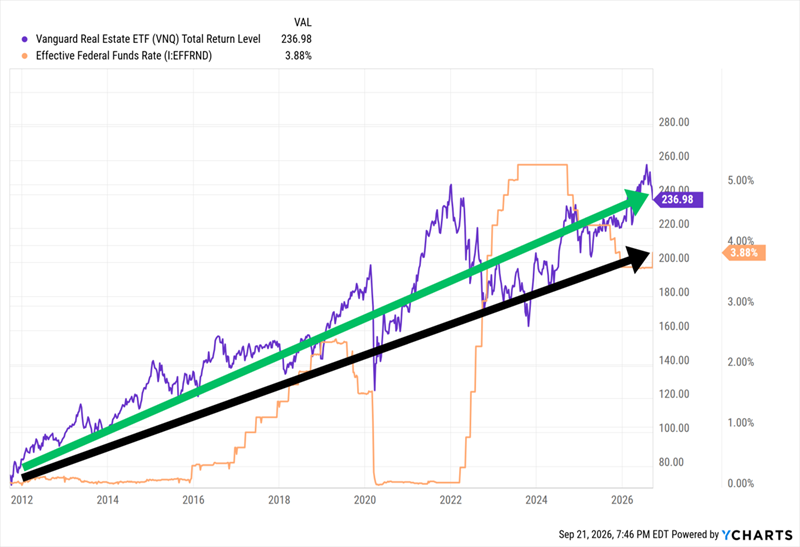
Even with just one rate hike, the Fed has knocked off a decent bit of the real estate sector’s froth.
This might not be the absolute bottom. But the risk-reward is shifting in our favor—and the yields are getting fat enough for us to take them seriously.
Let’s look at those five REITs that are starting to call out to us.
Alexandria Real Estate Equities (ARE, 5.3% dividend yield) owns 336 properties amounting to 36 million rentable square feet (RSF), as well as another 2.8 million RSF in Class A/A+ properties under construction. It operates under a “cluster” model, targeting areas such as Boston, New York City and the San Francisco Bay Area with numerous interconnected companies and institutions in biotechnology, life science, biomedical, pharmaceutical and other healthcare fields.
Ultimately, though, this makes Alexandria an office REIT.
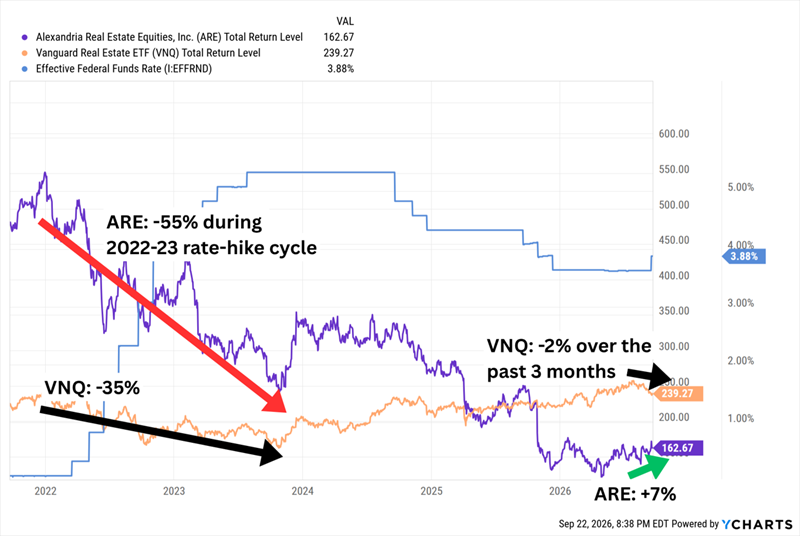
Operating in this miserable corner of the real estate sector would have been bad enough. But over the past few years, ARE also has faced a glut of lab space, significant cuts in NIH funding, declining venture capital for healthcare startups and the series of rate hikes between 2022 and 2023 that weighed on most REITs. All of that not only has sent Alexandria’s shares into a 70% tailspin since 2022, but it also forced the company to take a hacksaw to its dividend with a 45% cut last year.
If we’re being optimistic, though, we now have a chance to buy a REIT in the historically hardy healthcare business for just 7 times estimates for this year’s adjusted funds from operations (AFFO), and that is paying new buyers 5% on a much better-covered distribution. We’re also buying a company that has done much better in the face of 2026’s potential (and eventually actual) Fed hawkishness than it did a few years ago.
Just look at how ARE did in the period three months before the 2022-23 rate hikes through three months after them, and the stock’s good behavior a few months ahead of 2026’s raise.
Has ARE Finally Found the Bottom?
But I don’t think Wall Street has fully priced in what looks like an operationally weaker 2027. The company has identified a little more than $100 million in annual rent that’s tied to 2027 expirations, which has Wall Street projecting a steep drop in FFO next year. On that basis, ARE trades closer to 11 times AFFO estimates—and while that’s not expensive, it doesn’t exactly scream “bargain” given the direction Alexandria’s needle is pointed.
Four Corners Property Trust (FCPT, 6.8% dividend yield) is a retail real estate player, but it focuses on an uncommon sliver of the space: restaurant properties.
FCPT has a vast portfolio of 9.0 million square feet across 1,336 properties in 48 states. And its leading tenants include the likes of Olive Garden, LongHorn Steakhouse and Cheddar’s Scratch Kitchen. If those names sound familiar, that’s because they’re all brands that belong to Darden Restaurants (DRI), which spun off Four Corners in 2015 to unlock the value of its real estate.
But while Darden-linked restaurants once accounted for virtually all of FCPT’s annualized base rent, that number is closer to 40% today. Another 30% is spread across Chili’s, Outback Steakhouse, Buffalo Wild Wings, other casual dining restaurants and other quick-service restaurants. The remaining 30% has been diversified across auto service, medical retail—including the recently acquired Mission Pet Health portfolio, which includes another 102 properties—and other retail.
FCPT’s Motley Crew: Restaurants, Veterinary Care and Car Repair
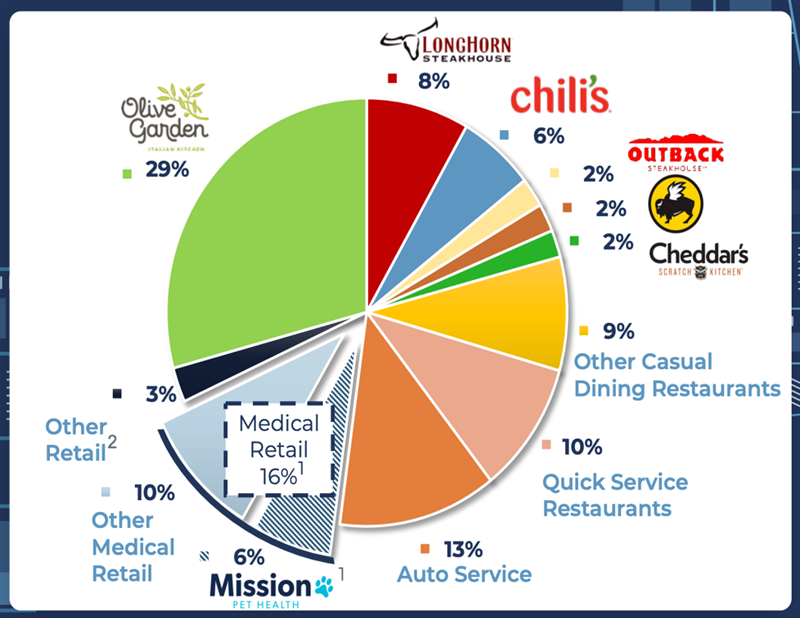
Source: Four Corners Property Trust July 2026 Investor Presentation
While FCPT has greatly outperformed the real estate sector since its creation, it’s not exactly brimming with growth potential. Many of its rents are below-market, and its newer properties don’t deliver a ton of yield.
On the other hand, Four Corners owns high-quality properties that it leases out to stable tenants. It’s also a net-lease REIT, which means tenants are responsible for maintenance, insurance and taxes. FCPT just collects the rent and calls it a day, which is great for earnings visibility. And that visibility has not only empowered the company to raise its payout every year for nearly a decade, but given it the flexibility to make a recent switch to a monthly dividend schedule.
In that light, its recent dip to a sub-13 P/AFFO is OK, but we might want to wait for better prices.
Easterly Government Properties (DEA, 7.7% dividend yield) is another niche REIT trading on the cheap.
Easterly owns 106 Class A properties that are leased to U.S. government agencies through the General Services Administration. Its portfolio stretches from coast to coast, housing the IRS, FBI, ATF, FDA, EPA, FAA and many more agencies.
The government as a tenant? Surely, it doesn’t get safer than that!
Oh, It Does.
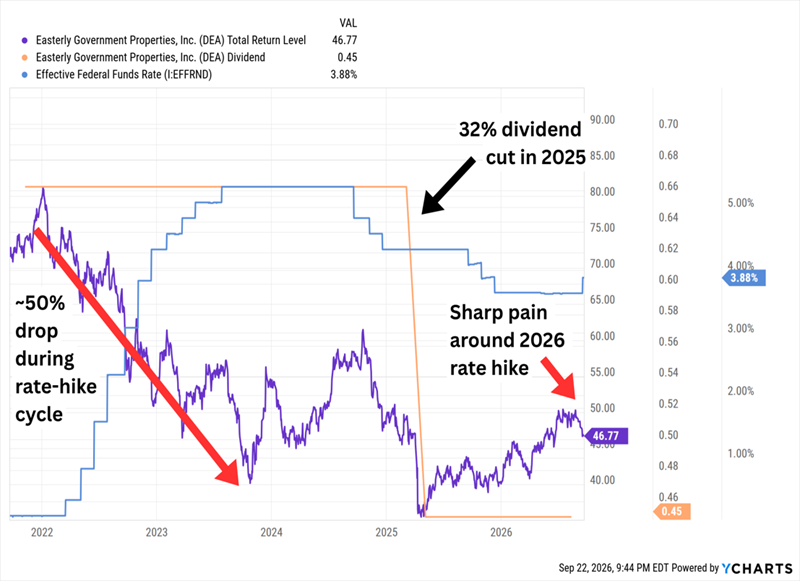
Easterly doesn’t operate cookie-cutter strip malls—it builds to suit agencies’ specific purposes: courthouses, labs, outpatient facilities. So because there’s not much competition for its properties, the government has some leverage, making rent growth difficult to come by.
Making matters worse? Uncle Sam has a $2 trillion deficit to tame, and as far as spending cuts go, cutting office space is one of the easiest moves Washington can make.
And last year, the company executed a 1-for-2.5 reverse stock split, which reduces a company’s share count and artificially raises share prices—often done to stay in the good graces of institutional buyers and the company’s listing exchange.
DEA has been in the midst of a yearlong bounce, but its recent rate-inspired dip has dragged its P/AFFO down to just a hair under 10, and brought its yield to nearly 8%. That would seem like a bargain even for other troubled REITs, but it still doesn’t fully compensate us for the risk of waiting out such an uphill battle.
Millrose Properties (MRP, 10.7% dividend yield) is another oddball: a “land banking” REIT that exists to buy and develop residential land, then sell finished homesites back to homebuilders through option contracts with predetermined costs.
Millrose was spun off from Lennar (LEN) in early 2025. The stock ramped higher for a few months, but it has since flattened out, including a double-digit dive since early September when it became clear a rate hike was nigh. Indeed, the Fed is doubly dangerous here, as its decisions affect not just REITs, but the housing market, too.
Still, it’s an intriguing name that keeps getting more interesting. At the end of July, Millrose announced a strategic partnership with developer JPI that brought the company’s residential homesite option platform into Class A multifamily properties. It’s an underserved area in which MRP is well-positioned to offer attractive financing solutions, though it’s also even more rate-sensitive than the single-family sector.
Millrose also has an obvious income appeal: Not only does it pay a double-digit yield, but it has improved its distribution every quarter since coming public.
That Streak Has Slowed, But It’s Still Alive
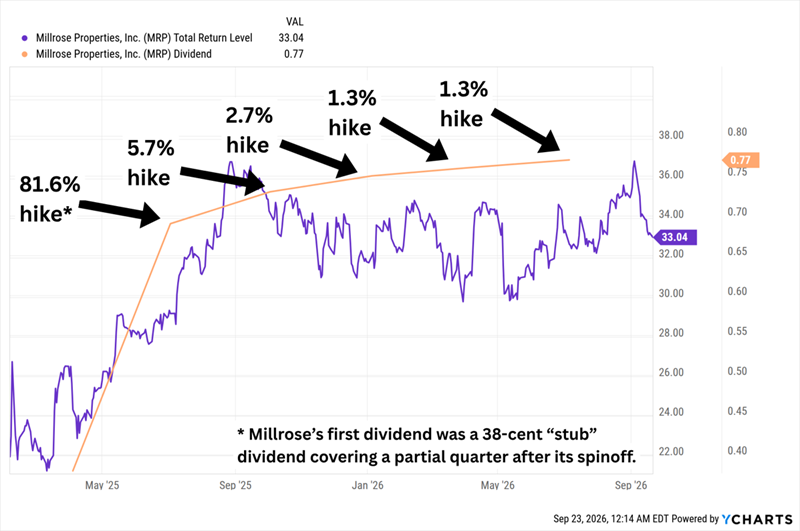
Just be aware: Millrose’s dividend policy is to deliver 100% of its AFFO back to shareholders. That’s obviously great for us while AFFO is still growing—and Wall Street believes that will continue until late next year. But it’s very possible that future dividends dive back below today’s payout.
A forward P/AFFO of around 11 isn’t screamingly cheap, but it’s at least fair for a real estate specialist that’s treading into new markets. But given MRP’s reaction to the Fed’s recent move, a longer rate-hiking cycle could give us a more attractive entry point.
Ellington Financial (EFC, 12.3% dividend yield) is a different brand of real estate company: a mortgage REIT, or mREIT. Unlike the REITs above that own physical properties, EFC holds “paper” real estate including residential and commercial mortgage loans, residential transition loans, commercial mortgage-backed securities (CMBSs) and collateralized loan obligations (CLOs).
Mortgage REITs borrow at short-term rates to buy assets tied to long-term rates, and they pocket the difference. They want short-term rates to be lower than long-term rates, and they’d prefer the spread to be wide. So while their business model is different from “equity” REITs, they also don’t love when the Fed hikes its short-term rate.
Ellington Takes a Smaller Hit This Time Around
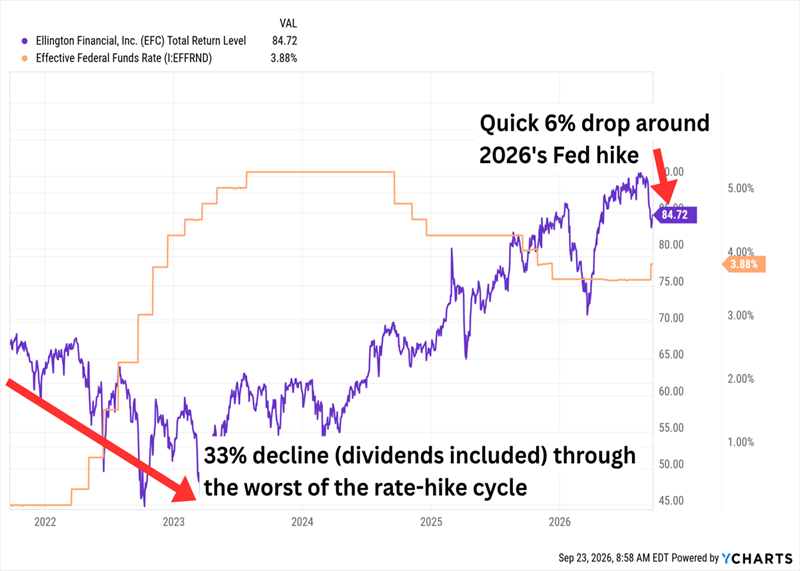
The Federal Reserve might not be on Ellington’s side, but the mREIT’s operational strength this year is reason to believe that it could successfully navigate a short and shallow rate-hiking cycle. Its Longbridge Financial subsidiary, which originates and services reverse mortgages, continues to bolster the bottom line. Residential transition loans and commercial mortgage bridge loans are growing, too.
The double-digit monthly dividend, for now, appears to be reasonably covered, though that bears watching if the Fed continues tightening. And a 7% discount to book provides decent cover.
Avoid the Retirement ‘Death Spiral’: Collect 8% or More for Life
We need to target plump dividends like what these REITs pay if we’re going to make it to, and more importantly through, retirement.
“But I’m sitting on blue chips and bonds!”
Yes. And you’re also sitting on an income time bomb.
Millions of investors cross their fingers and hope that the S&P 500 and the “4% rule” will get them through retirement. But the 4% rule only works until it doesn’t.
Every few years, the market will dip. That’s just how the markets go. But because of the paltry income a basic blue-chips-and-bonds portfolio generates, you’ll be forced to sell more shares when prices are low. And when shares rebound, you’ll need an even bigger gain just to get back to your original value.
That’s the retirement death spiral.
But sky-high dividends change the equation. Instead of sweating every market dip, we just collect income and let the portfolio do its job. We just need more stability than any one sector can offer—and that’s where my 8% “No Withdrawal” Retirement Portfolio comes in.
The “No Withdrawal” portfolio produces a high enough level of income that we can fund our retirements without even touching our nest eggs.
The math is simple: An 8% average yield can make a $500,000 nest egg pay an annual $40,000 retirement salary. If you have a cool million saved up, you’re breezing through retirement on $80,000 a year.
Let me show you the stealth payout plays that Wall Street overlooks—names that yield 8%, 9% or even more that can help us coast forever on dividends alone. Please click here and I’ll share the details on these secure funds with very generous dividends!