
We love it when a stock “pays us back” in dividends. The faster, the better!
Most people don’t get this luxury. They’re stuck “grinding it out” with the S&P 500’s 1% payers.
Not us. We’re hunting for dividends big enough to let us retire on our payouts alone. We’re talking 7%, 8% and larger divvies.
Two high-payers leap to mind here—and not only because of their rich payouts: the JPMorgan Equity Premium Income ETF (JEPI) and the Global X S&P 500 Covered Call ETF (XYLD).
We like both because they let us create a “synthetic” yield on our paltry S&P 500 dividends: 7.2% from JEPI, and 8.5% for XYLD.
Thanks to those high payouts, both funds have “repaid” a healthy slice of the prices we paid for them at Contrarian Income Report. Consider:
We bought JEPI in the May 2024 issue of CIR. Our buy price: $56.06 a share. The divvies we’ve collected: $11.08 per share.
Total “payback”: 19.8% in about 2.5 years.
All in all, we’ve booked a 23% total return here.
XYLD has made even faster progress, thanks to its higher yield: We bought it in the April 2025 CIR, at $36.20 a share. Total dividends collected: $6.41 a share.
Total “payback”: nearly 18% in 18 months.
Our total return: 36%.
These “dividend paybacks” don’t get enough attention. That’s too bad, because they naturally “de-risk” our buy. And once we clear our buy price, everything else is gravy!
But enough looking back. Let’s talk more about JEPI and XYLD, because both funds have a setup in front of them I expect to make their payouts stronger.
That makes now a great time to buy—and start getting paid back in just a few weeks (both funds pay monthly—another plus S&P 500 investors miss out on!).
Sideways—Yet Fearful—Market a Perfect Setup
You don’t need to look at a chart to know that this market has been twitchy. Five-hundred-point swings in the Dow have become routine.
The CNN Fear & Greed Index, a good indication of investors’ mood, is at 32 out of 100 now—fear territory.
Even so, the S&P 500 has wobbled sideways since early August. That’s the “sweet spot” for covered-call funds like JEPI and XYLD.
Here’s why: Both hold S&P 500 stocks, so both will move generally with the market. But their use of covered-call options sets them apart from your typical index fund. Under these deals, these funds agree to sell their stocks at a set price, by a set date. Whether or not these trades go through, the funds keep the fees they charge for these rights.
What we want, then, is a market like this one: high volatility, which raises the value of option premiums, but grinding sideways, so many of these options expire worthless.
When that happens, JEPI and XYLD keep the stock and the fee—and hand it over to us in the form of those high dividends.
Why XYLD Has Outrun JEPI (and We’re Okay With That)
To be sure, XYLD and JEPI swing with the markets, but their option strategies do help cushion their downside.
You can see that in their performance since this “sideways” market set in around August 5. JEPI (in orange below) has outrun the benchmark State Street SPDR S&P 500 ETF Trust (SPY), in purple, by a little, as of this writing.
XYLD, in blue, has beaten it by a lot:
Covered-Call Funds Do Their Thing. But Why the Gap?
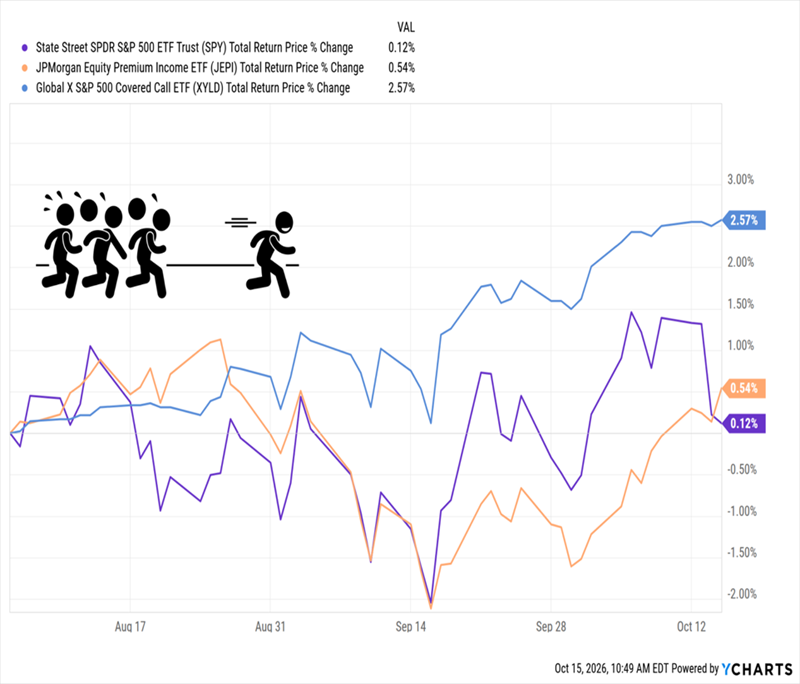
That’s just what we expect. The reason for the difference is in their holdings.
JEPI, for its part, leans defensive: Its portfolio is around 15.6% tech and 7.1% communication services. That latter section includes stocks like Netflix (NFLX), Alphabet (GOOGL) and Meta Platforms (META).
This puts JEPI’s combo of tech and communication services at 22.7%—around half of the S&P 500’s 44%.
That alone helps steady JEPI. Then we’ve got big slices in less-volatile sectors like healthcare (11.4% of the portfolio), financials (10.2%) and consumer staples (8%). JEPI also sells calls on only a portion of its assets, and at prices above where the market is trading. This explains its lower 7.2% yield.
The fund’s dividend varies based on option income in any particular month. (Management doesn’t sell assets to smooth it out—the payout is what it is.)
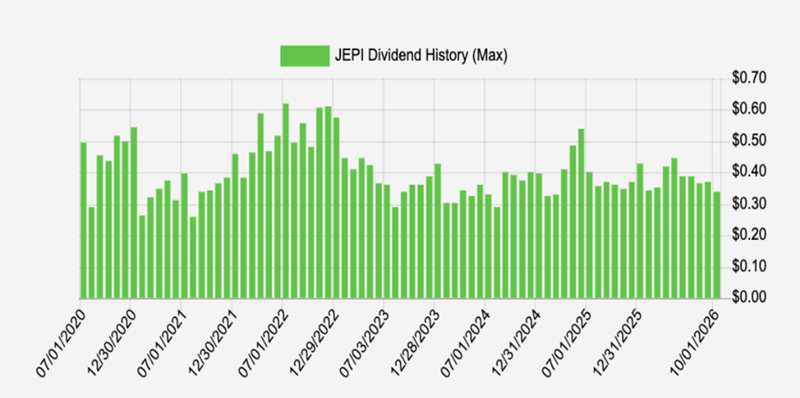
Source: Income Calendar
Looking ahead, we’ve likely got more October volatility, with the midterms following closely after. That would boost the value of option premiums. Meantime, we get a nice “starting point” from that 7.2% yield.
XYLD: Higher Dividend, Higher Risk
XYLD? It sells calls against its entire portfolio and does so “at the money,” or at the current market price. The result: bigger premiums (and hence a higher yield), but also more missed upside.
That’s why the fund pays more. Its portfolio also holds the entire S&P 500, including its heavy tech/communication-services weighting, which makes it the more aggressive of the two. Also bear in mind that, like JEPI, XYLD’s payout moves with its option income, so it floats some.
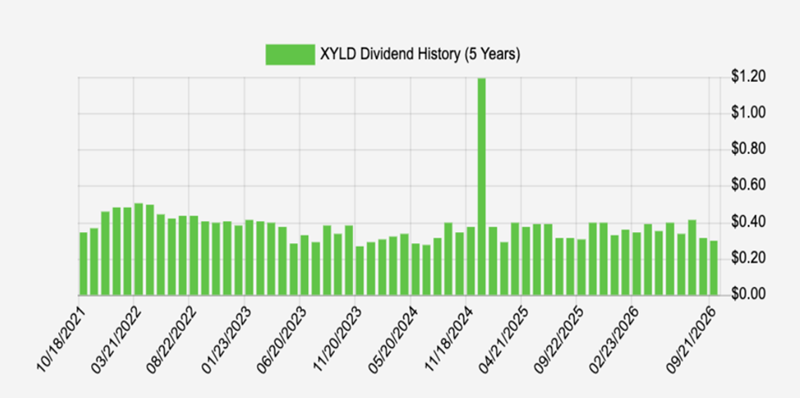
Source: Income Calendar
But also like JEPI, XYLD collects richer premiums in times of fear (like now). And because it leans so heavily on options income, it’s built to deliver most of its return as dividends.
Where does that leave us? With a two-fund “conservative-aggressive” mix that keeps us rolling toward a full “dividend payback,” thanks to their rich monthly payouts.
These 9% Monthly Dividends Pay You Back Even Faster
JEPI and XYLD are both solid picks—buy recommendations in my 9% Monthly Payer Portfolio.
But covered-call funds serve a specific purpose and are best held in volatile markets like these. So these two are only part of the mix. The rest of the portfolio includes assets we can hold on to for the (very) long term.
As the name says, it holds high payers (9% on average) that pay every month. That’s 9X what the S&P 500 pays, so your “payback” can build faster.
That’s our whole strategy: Collect dividends this big so we can avoid dipping into our nest egg. And we don’t need a seven-figure portfolio to do it.
I’d like to show you my full 9% Monthly Payer Portfolio now, starting with my top 3 picks. They’re in my free Special Report, “Monthly Dividend Superstars: Yields Up to 16.2% With Double-Digit Upside.”
Click here and I’ll tell you more about my 9% Monthly Payer portfolio and give you this exclusive report free. Buying just a few of these picks could make a big difference in your income stream—and your first monthly payouts could arrive within weeks.