
For a while, utilities were that sneaky play on AI. A picks-and-shovels provider, if you will.
Here’s why: AI usage is booming. What does AI use? It uses energy. AI is a notable energy hog, so the local utility company was the sneaky early beneficiary. Power prices would go up with more demand from that new data center down the street, and it was another customer for this utility’s captive audience.
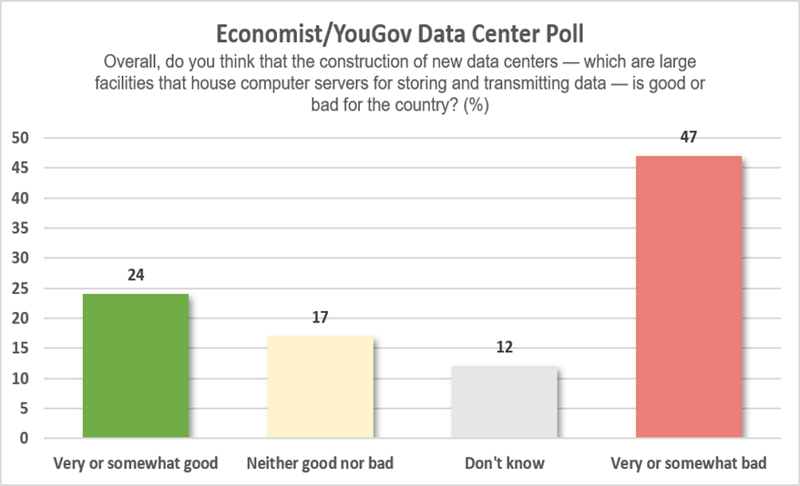
Now things have changed a bit. Everyone publicly hates data centers:
Source: Economist/YouGov
What does it mean when poll numbers like this happen? It means everyone who’s left to sell utilities has already sold. They’re down 10%. Not all utility stocks are going to sink based on data center sentiment.
Why so unpopular? Among other issues, wherever a data center shows up, customers of whichever utility helps power that data center frequently face skyrocketing electric bills.
A recent deal between Constellation Energy (CEG) and Alphabet’s (GOOGL) Google looks like a potential blueprint for utilities to keep nabbing data center business without squeezing customers. Constellation will sell 3.6 gigawatts of electricity to Google via long-term deals that will let it upgrade nearly a dozen nuclear reactors—an improvement that could add almost as much electricity as a new nuclear reactor.
It’s a nifty deal: Google gets reliable clean power and Constellation profits off existing assets without having to build new plants. Local rates are unchanged. If this works out as hoped, we’ll see more arrangements like this one.
And a day prior to that deal, the Department of Energy announced a $4.2 billion conditional loan commitment to upgrade a trio of nuclear plants in Ohio and Pennsylvania. That’s extra power to fuel data centers without a direct hit to ratepayers (albeit with an indirect hit to all us taxpayers).
Whether these initiatives will keep prices in check and appease customers, and whether other “utes” will benefit from similar arrangements, remains to be seen. But the headlines-fueled jump in utility stocks indicates Wall Street is a believer.
The sector’s forward P/E is near decade-long lows regardless, so we still have time to jump. That makes me eager to look under the hood to check the fundamentals of these five utility plays, which are paying us up to 10.8% and can tap into that AI growth.
FirstEnergy (FE)
Dividend Yield: 4.1%
First up is FirstEnergy (FE), which provides electric service to more than 6 million customers in Maryland, New Jersey, New York, Ohio, Pennsylvania and West Virginia. Its power-generating facilities include coal, hydroelectric, wind, solar and nuclear, and it does business via about a dozen different subsidiaries, such as Ohio Edison, Illuminating Company, Potomac Edison and Penn Power.
FirstEnergy doesn’t have any nuclear plants to upgrade—in fact, it used to own the three plants I mentioned earlier, but they now belong to miserly payer Vistra (VST, 0.6% yield). But FE still is setting up as a major data center beneficiary. Here’s what CEO Brian Tierney said during July’s Q2 conference call:
“Across our system, total forecasted data center demand has increased 30% since the first quarter to approximately 25 gigawatts (GW). And during the second quarter alone, we contracted an additional 2.1 GW, bringing our total contracted demand to 6.4 gigawatts. We expect an additional 1.5 GW to enter into contracts in the next couple of weeks.
For perspective, our contracted and pipeline demand now represents approximately 70% of our July system peak load of 34.8 GW.”
The company has a geographic AI advantage, too. Most of FirstEnergy’s territory falls within the PJM Interconnection regional transmission organization, which has been making moves to better handle the explosion of data centers within its borders.
FE was famously part of a political scandal that a U.S. attorney called “likely the largest bribery, money laundering scheme ever perpetrated against the people of the state of Ohio.” FirstEnergy eventually paid hundreds of millions of dollars in penalties and customer refunds to settle charges of political bribery. But with its monetary uncertainty now in the rear-view mirror, the utility has returned to dividend growth.
FE Is Making Up for Lost Time
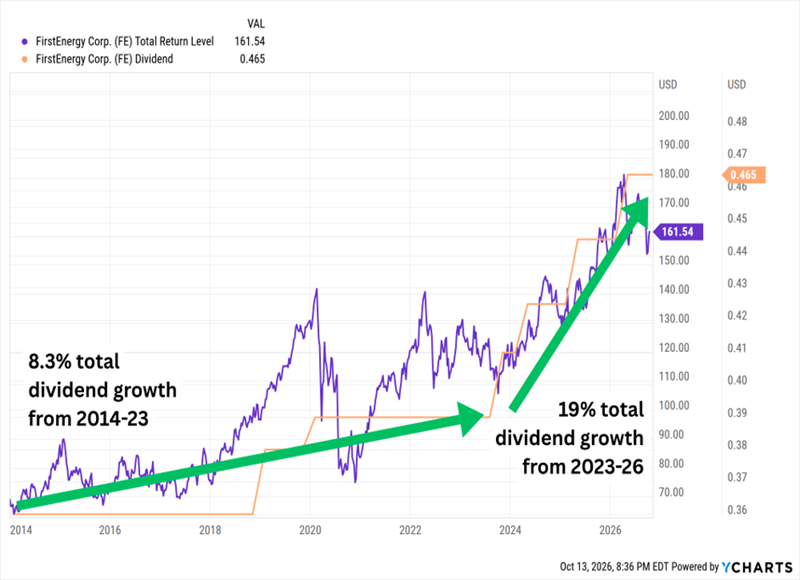
We shouldn’t expect explosive dividend growth out of utilities, FE included, but a sub-70% payout ratio provides plenty of room for future improvements. The 16.5 forward P/E isn’t a screaming deal, in line with both the rest of the sector and its own long-term average.
Portland General Electric (POR)
Dividend Yield: 4.9%
Portland General Electric (POR) is a smaller regional utility that provides electricity to 1.9 million customers across more than 50 cities in Oregon.
I’ve said previously that Oregon generally, and Portland specifically, is a decent but not particularly large nor explosive data center market. Still, “PGE” was an early mover in the AI grid, and it continues to expand that part of the business. Across 2025 and 2026, the company has executed five contracts with data center customers for 430 megawatts (MW). And it has a massive pipeline of large-load requests (formal applications submitted by big electricity consumers) from hyperscalers and industrial customers.
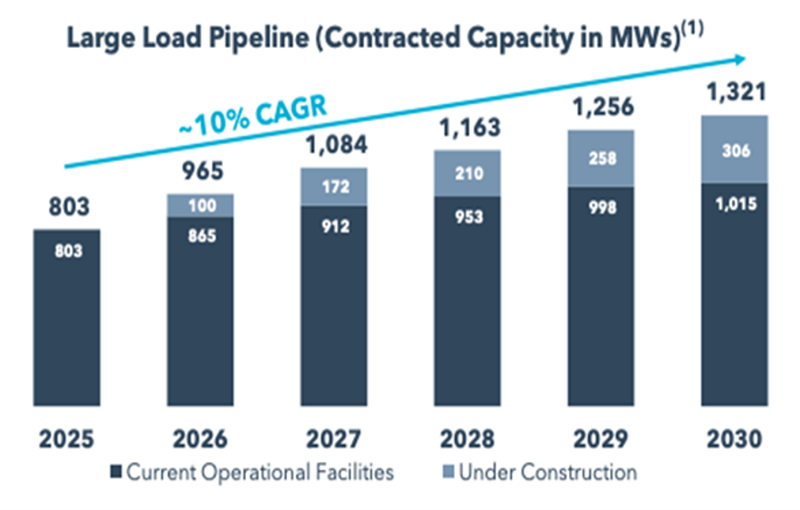
Source: Portland General Electric Investor Presentation (July 31, 2026)
PGE received a helping hand from the state in 2025 when it passed the POWER Act, which empowered the state’s utility commission to begin establishing new rules for data centers and other high-energy users. This year, Oregon adopted the commission’s framework, which (among other things) requires large-load users to cover all costs of distribution-system upgrades necessary to serve them. It also green-lit PGE’s proposal to raise rates for large-load users by 29.7%.
Portland General Electric is hardly without its issues. It’s also sinking a lot of money into mitigating the growing risk of wildfires in the state. And regardless of the state’s moves to force data centers to eat their own costs, the projects remain politically unpopular.
The stock isn’t popular, either. POR shares have underperformed the sector by about 5 percentage points this year. But they now trade at just 13 times this year’s earnings estimates and pay a (well-covered) yield of almost 5%.
Clearway Energy (CWEN)
Dividend Yield: 6.2%
Clearway Energy (CWEN) is the clean-energy-generation “yieldco” that holds operational assets spun off from Clearway Group. Its portfolio of assets boasts 14 GW of gross generation capacity and coast-to-coast operations spanning 27 states. That includes about 11 GW of wind, solar, and battery-energy storage systems, while the rest is “flexible dispatchable power generation” used in keeping grids stable.
In addition to traditional data center deals, Clearway also inks “behind-the-meter” agreements, in which data centers generate energy on-site using renewables rather than tapping into a traditional utility grid.
The Clearway Group “devco” has a roughly 32 GW development pipeline, which includes about 17 GW of capacity under development specifically for co-located data center supply as of the second quarter. That’s 30% more than it had just a quarter earlier!
But in general, a continued drip of developed projects into Clearway Energy should keep up what is one of the more interesting dividend charts I’ve seen:
CWEN Delivers Frequent, Consistent Dividend Growth
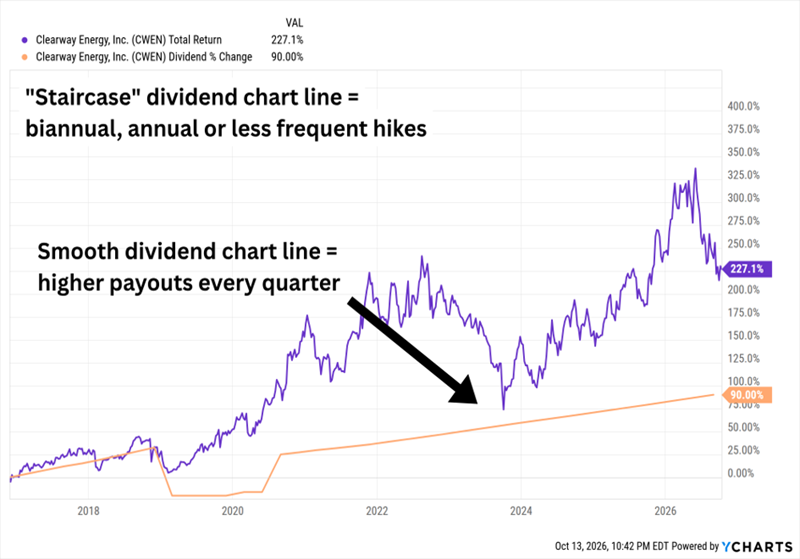
Normally, a quarterly dividend raiser’s chart will curve into flattening out as dividend growth decelerates. But CWEN has managed to keep up an extremely stable rate of dividend expansion for years. But I also included the 2019 cut—linked to the bankruptcy of PG&E (PCG), a major Clearway customer at the time—as a warning that no matter how stable a dividend looks, it’s not necessarily bulletproof.
CWEN, like the rest of the sector, has been a dog this year. That and several hikes have plumped up the dividend to more than 6%. But it hasn’t brought the stock anywhere near value territory, with shares trading at 25 times this year’s expected earnings.
BlackRock Utilities, Infrastructure, & Power Opportunities Trust (BUI)
Distribution Rate: 7.2%
We can juice our income—and spread out our risk, and (in some cases) buy utes for less than they’re worth—by investing in closed-end funds (CEFs).
The BlackRock Utilities, Infrastructure, & Power Opportunities Trust (BUI) is a great example of what CEF-land has to offer. It’s a portfolio of “companies that are engaged in the utilities, infrastructure and power opportunities business segments anywhere in the world” that yields more than 7% and has delivered income consistency (and recently, growth).
BUI Serves Up a Few Raises (And a Special Distribution, Too)
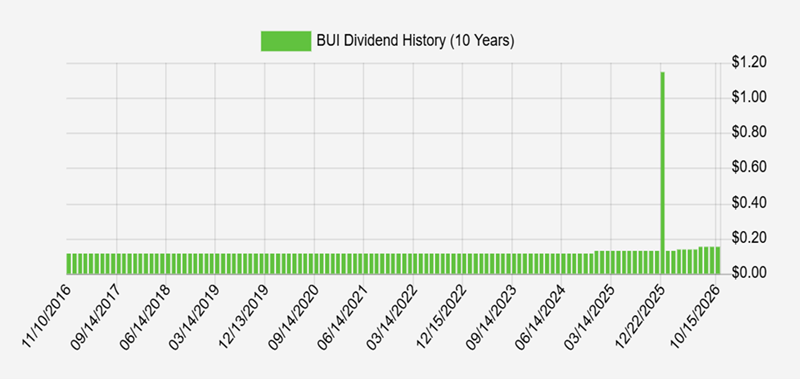
Source: Income Calendar
But while “utilities, infrastructure and power opportunities” might sound like three different ways to refer to utilities, it’s not. While the sector accounts for the majority of assets, it’s a small majority at just 55% right now. BUI is also rich in energy companies, industrials and even a handful of materials stocks—so while we get to hold names like NextEra Energy (NEE) and Duke Energy (DUK), we also hold the likes of rail operator Union Pacific (UNP) and midstream firm Targa Resources (TRGP).
That’s not necessarily bad, but it does mean we’re investing in multiple themes. On the plus side, that means income more than twice as great as even the highest-paying utility ETFs and occasional rips triggered by assets from other sectors. On the downside, BUI can be more volatile than a pure-play ute fund.
BlackRock’s CEF could use some ripening, though. While closed-end funds can and do trade at discounts to their net asset value, BUI doesn’t—at least not right now. Its historical average is a hair under NAV, and it’s currently priced at a hair over. No matter what way we look at it, that’s no deal.
NYLIM CBRE Global Infrastructure Megatrends Term Fund (MEGI)
Distribution Rate: 10.8%
The headline numbers from the NYLIM CBRE Global Infrastructure Megatrends Term Fund (MEGI) look a lot better. We’re earning almost 11%. It still trades close to its historic discount to NAV, but that discount is a much sweeter 10%. And while MEGI hasn’t been around for long—it’s celebrating its fifth birthday this month—the dividend history is promising.
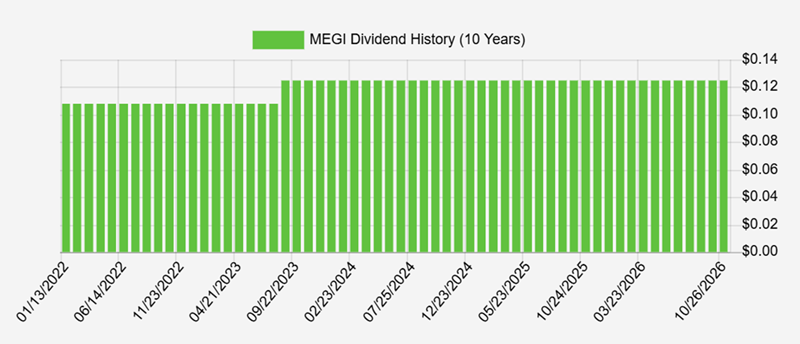
Source: Income Calendar
New York Life Investment Management’s fund is clearer about its split attention; its investment strategy chases “megatrends of decarbonization, digital transformation and asset modernization, which are reshaping the demand for infrastructure assets and driving income and growth potential.”
Even then, utilities like Constellation and Xcel Energy (XEL) are a slightly greater majority at 60% of assets. Like with BUI, we get double-digit energy and industrial exposure, too—and a 10% dose of real estate. Unlike BUI, management also uses debt to try to squeeze more out of the portfolio. The fund currently has about $800 million in assets under management, but effective debt leverage of more than 20% gives it closer to $1 billion in investment exposure.
My Retirement Income Plan for 2027
I keep an eye on MEGI because we can take advantage of its occasional bigger-than-usual discount as a shorter-term trade. But that strategy is too inconsistent for what we should be focused on in 2027 and beyond:
Build a portfolio that generates so much annual income by the time you retire, you’ll never have to sell a single share.
That’s the entire point of my “No Withdrawal” portfolio, which solves the retirement-nest-egg shortfall that literally millions of Americans face today.
Before COVID, the talking heads on CNBC and Fox Business told us we needed to have at least $1 million saved if we wanted to retire comfortably. When inflation kicked into high gear, that number did, too—it became $1.25 million, then $1.5 million. This year, I’ve seen numerous headlines asking whether $2 million is enough to retire!
But here on planet Earth, the average 55- to 64-year-old has just more than $500,000 socked away!
What will that half-million get you?
- If you invest that $500,000 in a traditional 60/40 portfolio, you’ll earn $26,900 a year. That’s just above the poverty line.
- If you invest that $500,000 in my 8% “No Withdrawal” Retirement Portfolio, you’ll earn an annual income of 8%, 9% or even 10%+. That means you could bank $40,000 to $50,000 (and potentially more) each year!
Let me show you the high-yield names I have lined up for 2027 and beyond, and I’ll reveal how you could live off $500,000 for the rest of your life. Details on these generous dividends— up to 16.2%—are waiting for you here.