
WOOF!
I pogoed off my couch for a split second. (Well, maybe a quarter-inch leap… a meaningful move at my age, nonetheless.) My work-from-home afternoon was temporarily interrupted by my security team: Bizzi the Weimaraner.
But there was no reason for alarm! I could tell, even as she issued her follow-up warnings:
WOOF!
WOOOOOOOF!
“Got it,” I commended her. “Noted.” WOOF! “Thank you.”
Her tell was in her tone. The mailman. He walks up our steps, she flips out. But not really—her bark has a mailman tone to it. (And by the way, he’s the rare, unfortunate mailman who can’t stand dogs. Which makes his day-to-day more difficult. The neighborhood hounds can sense his hesitation and extend the ritual at each and every house.)
Seven barks in, our anti-pup carrier gingerly (too slowly, if I may say) pushes the mail through our mail slot. My protector hits a full crescendo. The early holiday catalogues drop unceremoniously onto our living room floor. Rinse and repeat, see you the same time tomorrow, everyone. (Though not me. There’s a reason I have an office—including a separate mailroom!)
Alas, no actual threat this afternoon. Bizzi’s bark tone was the tell. As it often is on Wall Street, too.
As I write to you from my office chair, the stock jock suits are howling at AI borrowers, louder than Bizzi, “Your loans are in danger!” Trading on “default insurance”—the risk of nonpayment—for the 10 largest AI spenders and chipmakers popped more than eightfold this year, to $176 billion. That’s a chunk of insurance changing hands!
That means investors are buying protection against AI companies defaulting on their debt payments. This fear has spread to other income investments, including preferreds.
Okay, I get it. The credit market is nervous, and when this happens, it punishes the rest of Income Land. Investors are dumping perfectly good payers, such as preferred stock funds, which fell all fall.
The decline kicked off in September when rates rose. This punished long bond prices and bond proxies including preferreds. Fine. We know bonds move inverse to rates. Then credit jitters spread like the cold and flu in October. Now we have fears of an AI winter in November.
But here’s where you and I should get up off our proverbial investing couches. There are perfectly good income funds caught up in this Wall Street worry ritual.
Let’s say we own a preferred stock fund. Should we heed the warning barks? Or “ignore them” and buy low and collect the monthly payouts?
The preferred stock asset class is a promise plus a payout. Preferred shares put us ahead of regular “common” stockholders for dividends—we are paid first. But we sit behind bondholders when the you-know-what hits the fan. So, yes, we receive preference but only over the regular common stock holders.
So far, so good. The tradeoff? Preferreds offer less upside than common shares. That’s okay. We are focused on income, not buying and hoping that our portfolio goes up, so this is a trade we are just fine making because preferreds tend to pay more (often a multiple more) than common shares.
Sounds compelling, yes, but how exactly do we make this trade as individual investors? How do we buy preferreds?
Preferred stock selection is not for beginners. Got a complex database with specific terms, interest rates, and credit quality? How about analysis based on various credit scenarios?
No thanks! We’re trying to retire—not perspire—on dividends here! And as we maximize our leisure time and passive income we “outsource” this research to expert preferred stock managers like Flaherty & Crumrine and Nuveen. Why spin cycles in the minutiae of individual preferred selection when we can simply buy the funds (which trade just like stocks)?
Let’s consider the four biggest positions for First Trust Preferred Securities and Income ETF (FPE), a popular preferred ETF. One click and we have this portfolio which is made up firstly of banks (the classic issuers of preferred stock): Bank of America (BAC), Barclays (BCS), Wells Fargo (WFC) and Citigroup (C). Further down the list we have two utilities, NextEra Energy (NEE) and Xcel Energy (XEL).
You know what FPE’s top 10 holdings don’t include? AI or data center related debt!
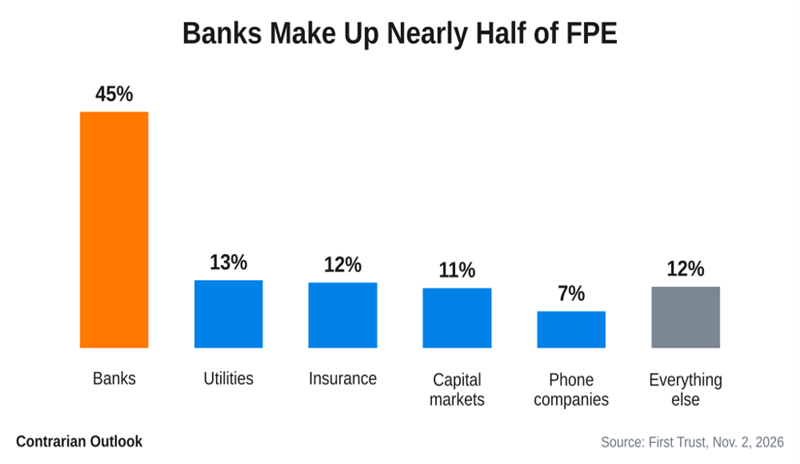
For every $100 in FPE’s portfolio, $45 sits in bank securities. The next $13 sits in utilities and $12 in insurers. That’s $70 out of $100 in traditional, “boring” (boring is good!) preferred payers.
Let’s say AI play Broadcom (AVGO) takes on more debt tomorrow. This doesn’t affect the terms of the Wells Fargo preferred whatsoever.
Now, could trouble with an AI borrower reach a bank? Sure. Banks lend to data center projects, and if many of these loans sour, the bank’s capital can take a hit. Which is why we want funds that invest in banks that have adequate capital and a diversified loan portfolio.
The bigger risk for preferreds? Interest rates. Preferred stocks typically have no maturity date, so like long-duration bonds, they lose value when long-term rates rise.
Let’s say a preferred stock pays 6%. That looks attractive when long rates are at 3%, and far less so when they rise to 6%. Why lend money to a company that has to make money and fight off competitors when you can give it to Uncle Sam for the same amount?
Now, FPE as an ETF trades for about the value of what it owns—its net asset value (NAV). So there’s no discount here, but you can snag one by considering preferred closed-end funds (CEFs) instead.
CEFs work differently from ETFs in that they don’t create and redeem shares every day. They are, well, closed! So their prices can drift above and below NAV. When below, that is the discount we contrarians love.
Most preferred CEFs also borrow to buy more preferreds. Generally this boosts income because they are borrowing for less than they earn. But borrowing also magnifies losses when prices drop.
But we need to make sure each fund earns its payout—and this is different from promising a dividend! Let’s look at two leading preferred ETFs and five top preferred CEFs. You’ll notice:
- The CEFs offer a better deal from a discount-to-NAV standpoint.
- Three of the CEFs have poor income coverage!
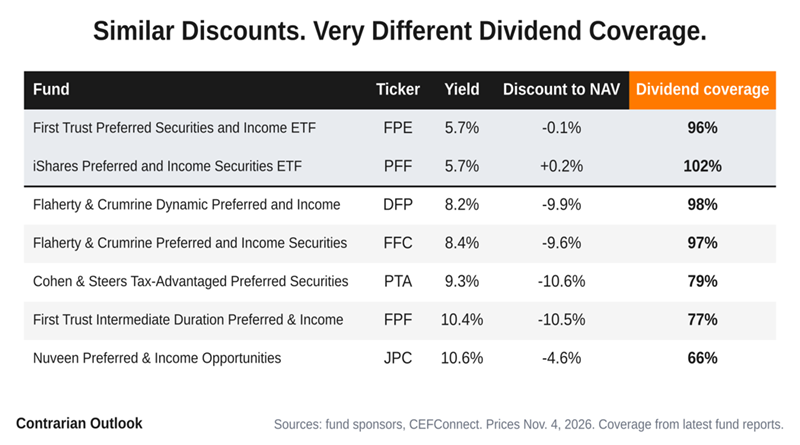
Flaherty & Crumrine Dynamic Preferred and Income Fund (DFP) and sister fund Flaherty & Crumrine Preferred and Income Securities Fund (FFC) are the best with 98% and 97% dividend coverage. From here it turns dicey with Nuveen Preferred & Income Opportunities Fund (JPC) rounding out the list with only two-thirds dividend coverage.
Translation: DFP and FFC roughly earn enough to fund their dividends from income. JPC is paying (for now) but covering the gap from elsewhere.
Whichever fund you buy, use a limit order. Some of these trade thinly.
So which fund would I buy now? Please read the November issue of Contrarian Income Report here to find out!
(Not yet a subscriber? Take Contrarian Income Report for a risk-free test drive and I’ll send you my favorite preferred fund and full research right away. Plus, as a thank you, I’ll also send you my latest monthly dividend machine report (featuring payouts that annualize to more than 11%).